FYfalse0001816017http://fasb.org/us-gaap/2025#LiabilitiesCurrenthttp://fasb.org/us-gaap/2025#LiabilitiesCurrenthttp://fasb.org/us-gaap/2025#LiabilitiesCurrenthttp://fasb.org/us-gaap/2025#LiabilitiesCurrent0001816017spir:ExactEarthAcquisitionMember2025-12-310001816017spir:EquityDistributionAgreementMemberus-gaap:CommonClassAMember2025-12-310001816017spir:SpireCustomerMember2024-01-012024-12-310001816017srt:RestatementAdjustmentMember2024-12-310001816017us-gaap:PropertyPlantAndEquipmentMember2024-01-012024-12-310001816017spir:SatelliteLaunchAndGroundStationWorkInProgressMember2024-12-310001816017spir:StockOptionsMember2025-01-012025-12-310001816017us-gaap:ForeignCountryMember2025-12-310001816017spir:InServiceGroundStationsMembersrt:MinimumMember2025-12-310001816017us-gaap:USTreasuryBondSecuritiesMemberus-gaap:FairValueInputsLevel1Memberus-gaap:FairValueMeasurementsRecurringMemberus-gaap:InvestmentsMember2025-12-310001816017spir:ThreeMonthTermSecuredOvernightFinancingRateSOFRMember2022-06-130001816017us-gaap:CommercialPaperMemberus-gaap:FairValueMeasurementsRecurringMemberus-gaap:InvestmentsMember2025-12-310001816017us-gaap:ResearchAndDevelopmentExpenseMember2025-01-012025-12-310001816017spir:GroundStationsInServiceMember2024-12-310001816017spir:SalesCommissionsMember2024-12-310001816017srt:MinimumMember2025-12-310001816017us-gaap:RestrictedStockMember2024-01-012024-12-310001816017spir:ContingentEarnoutLiabilityMember2025-12-310001816017spir:ExactEarthAcquisitionMember2024-12-310001816017us-gaap:SoftwareAndSoftwareDevelopmentCostsMember2025-12-310001816017spir:RestrictedStockUnitsPerformanceStockUnitsAndEmployeeStockPurchasePlanSharesMember2025-01-012025-12-310001816017spir:VendorMembersrt:MinimumMemberus-gaap:GeographicConcentrationRiskMember2024-01-012024-12-310001816017spir:SalesCommissionsMember2025-12-310001816017spir:CreditAgreementWarrantsMemberus-gaap:MeasurementInputExpectedTermMember2025-12-310001816017us-gaap:SalesRevenueNetMemberus-gaap:CustomerConcentrationRiskMembercountry:US2025-01-012025-12-310001816017us-gaap:FairValueInputsLevel1Memberus-gaap:FairValueMeasurementsRecurringMember2024-12-310001816017spir:TwoThousandTwentyThreeBlueTorchWarrantsMemberus-gaap:CommonClassAMember2023-09-270001816017spir:FinishedSatellitesNotInServiceMember2025-12-310001816017us-gaap:USTreasuryBondSecuritiesMemberus-gaap:FairValueMeasurementsRecurringMemberus-gaap:InvestmentsMember2025-12-310001816017spir:LongTermAssetMemberus-gaap:GeographicConcentrationRiskMembercountry:US2025-01-012025-12-310001816017us-gaap:CommonStockMember2025-01-012025-12-310001816017us-gaap:FairValueInputsLevel3Memberspir:ContingentEarnoutLiabilityMember2025-01-012025-12-310001816017us-gaap:CommonClassAMember2026-03-100001816017us-gaap:NotesReceivableMember2024-12-310001816017us-gaap:MeasurementInputRiskFreeInterestRateMemberspir:ContingentEarnoutLiabilityMember2024-12-310001816017stpr:NY2025-01-012025-12-310001816017spir:LongTermAssetMemberus-gaap:GeographicConcentrationRiskMembercountry:CA2024-01-012024-12-310001816017us-gaap:MoneyMarketFundsMemberus-gaap:FairValueInputsLevel1Memberus-gaap:FairValueMeasurementsRecurringMember2024-12-310001816017spir:ContingentEarnoutLiabilityMember2025-01-012025-12-310001816017us-gaap:PatentsMember2025-12-310001816017us-gaap:FairValueInputsLevel3Memberus-gaap:FairValueMeasurementsRecurringMemberus-gaap:InvestmentsMember2025-12-310001816017us-gaap:FairValueInputsLevel2Memberus-gaap:MoneyMarketFundsMemberus-gaap:FairValueMeasurementsRecurringMember2025-12-310001816017spir:StockOptionsMember2025-01-012025-12-310001816017spir:LongTermLiabilitiesMemberspir:ContingentEarnoutLiabilityMemberus-gaap:FairValueMeasurementsRecurringMember2024-12-310001816017srt:RestatementAdjustmentMember2025-01-012025-03-310001816017spir:RevisedMember2024-01-012024-12-310001816017us-gaap:RetainedEarningsMember2024-12-310001816017spir:NonSubscriptionBasedContractsMember2025-01-012025-12-310001816017spir:TwoThousandTwentyThreeBlueTorchWarrantsMember2025-01-012025-12-310001816017us-gaap:DevelopedTechnologyRightsMember2024-12-310001816017us-gaap:MeasurementInputExpectedDividendRateMemberspir:CreditAgreementWarrantsMember2024-12-310001816017us-gaap:CashAndCashEquivalentsMemberus-gaap:CashMember2024-12-310001816017us-gaap:DevelopedTechnologyRightsMember2025-12-310001816017us-gaap:FairValueInputsLevel1Memberspir:LongTermLiabilitiesMemberus-gaap:FairValueMeasurementsRecurringMember2025-12-310001816017spir:NorthStarDisputeMember2024-10-200001816017us-gaap:CommonClassAMemberspir:SecuritiesPurchaseAgreementWarrantsMember2024-03-210001816017us-gaap:CashAndCashEquivalentsMember2024-12-310001816017spir:RevisedMember2024-12-310001816017us-gaap:CashAndCashEquivalentsMemberus-gaap:MoneyMarketFundsMember2025-12-310001816017us-gaap:CostOfSalesMember2024-01-012024-12-310001816017us-gaap:AccumulatedOtherComprehensiveIncomeMember2025-12-310001816017spir:TwoThousandTwentyTwoBlueTorchWarrantsMemberspir:ReducedExercisePriceMember2023-09-270001816017spir:CreditAgreementWarrantsMember2025-01-012025-12-310001816017us-gaap:MeasurementInputRiskFreeInterestRateMemberspir:ContingentEarnoutLiabilityMember2025-12-310001816017us-gaap:PrivatePlacementMember2025-03-122025-03-120001816017spir:CreditAgreementWarrantsMemberus-gaap:FairValueInputsLevel1Memberspir:LongTermLiabilitiesMemberus-gaap:FairValueMeasurementsRecurringMember2024-12-310001816017us-gaap:FairValueInputsLevel1Memberus-gaap:FairValueMeasurementsRecurringMember2025-12-310001816017spir:DueInOneYearOrLessMember2025-12-310001816017us-gaap:FairValueMeasurementsRecurringMemberus-gaap:InvestmentsMember2025-12-310001816017spir:CreditAgreementWarrantsMembersrt:MaximumMemberus-gaap:MeasurementInputExpectedTermMember2024-12-310001816017spir:SecuritiesPurchaseAgreementMemberus-gaap:CommonClassAMember2024-03-210001816017us-gaap:FairValueInputsLevel1Memberus-gaap:FairValueMeasurementsRecurringMemberus-gaap:InvestmentsMember2025-12-310001816017us-gaap:CashAndCashEquivalentsMember2025-12-310001816017spir:LongTermAssetMemberus-gaap:GeographicConcentrationRiskMemberus-gaap:EMEAMember2025-01-012025-12-310001816017spir:UnrealizedGainsLossesOnAvailable-For-SaleDebtSecuritiesNetMember2023-12-310001816017us-gaap:MachineryAndEquipmentMember2024-12-310001816017us-gaap:CommonClassAMember2025-01-012025-12-310001816017us-gaap:FairValueInputsLevel3Memberspir:ContingentEarnoutLiabilityMember2025-12-310001816017spir:SalesCommissionsMember2025-01-012025-12-310001816017srt:ScenarioForecastMember2026-02-012026-02-280001816017spir:SalesCommissionsMember2024-01-012024-12-310001816017us-gaap:RestrictedStockUnitsRSUMember2025-12-310001816017country:GB2025-01-012025-12-310001816017us-gaap:AccumulatedTranslationAdjustmentMember2024-12-310001816017spir:LongTermAssetMemberus-gaap:GeographicConcentrationRiskMember2025-01-012025-12-310001816017spir:TwoThousandTwentyTwoBlueTorchWarrantsMember2024-01-012024-12-310001816017spir:LongTermAssetMemberus-gaap:GeographicConcentrationRiskMembercountry:CA2025-01-012025-12-310001816017us-gaap:FairValueInputsLevel3Memberus-gaap:CommercialPaperMemberus-gaap:FairValueMeasurementsRecurringMemberus-gaap:InvestmentsMember2025-12-310001816017spir:SpireCustomerMember2025-01-012025-12-310001816017spir:ARL3HarrisAgreementMemberspir:ExcessRevenueMember2025-12-310001816017us-gaap:LatestTaxYearMemberus-gaap:DomesticCountryMember2025-01-012025-12-310001816017spir:L3HarrisAgreementMember2025-04-252025-04-250001816017spir:BtcTermLoanMember2024-12-310001816017us-gaap:FairValueInputsLevel3Memberspir:LongTermLiabilitiesMemberus-gaap:FairValueMeasurementsRecurringMember2024-12-310001816017us-gaap:SalesRevenueNetMembercountry:GBus-gaap:CustomerConcentrationRiskMember2024-01-012024-12-310001816017spir:OriginalExercisePriceMemberspir:TwoThousandTwentyTwoBlueTorchWarrantsMember2022-06-130001816017us-gaap:GeneralAndAdministrativeExpenseMember2024-01-012024-12-310001816017spir:ContingentEarnoutLiabilityMember2024-12-310001816017spir:CreditAgreementWarrantsMemberus-gaap:FairValueInputsLevel2Memberspir:LongTermLiabilitiesMemberus-gaap:FairValueMeasurementsRecurringMember2024-12-310001816017us-gaap:CommonClassAMember2025-06-100001816017spir:NorthStarDisputeMember2024-09-202024-09-200001816017srt:ScenarioPreviouslyReportedMember2024-12-310001816017us-gaap:AccountsReceivableMemberus-gaap:CustomerConcentrationRiskMemberspir:CustomerAMember2025-01-012025-12-310001816017us-gaap:RetainedEarningsMember2025-12-310001816017srt:ScenarioPreviouslyReportedMember2024-01-012024-12-310001816017us-gaap:AdditionalPaidInCapitalMember2024-12-310001816017us-gaap:CommonStockMember2024-01-012024-12-310001816017us-gaap:SalesRevenueNetMemberus-gaap:CustomerConcentrationRiskMemberspir:OtherRegionOfAsiaPacificMember2024-01-012024-12-310001816017us-gaap:SalesRevenueNetMemberspir:OtherRegionOfEMEAMemberus-gaap:CustomerConcentrationRiskMember2025-01-012025-12-310001816017us-gaap:RestrictedStockUnitsRSUMember2024-12-310001816017spir:SeveranceMember2025-01-012025-12-310001816017spir:SubscriptionBasedContractMember2024-01-012024-12-310001816017us-gaap:MoneyMarketFundsMemberus-gaap:FairValueInputsLevel1Memberus-gaap:FairValueMeasurementsRecurringMember2025-12-310001816017country:CA2025-01-012025-12-310001816017spir:UnderAccruedMember2025-01-012025-03-310001816017stpr:MD2025-01-012025-12-310001816017spir:OtherMember2025-01-012025-12-310001816017us-gaap:SalesRevenueNetMemberus-gaap:CustomerConcentrationRiskMemberus-gaap:EMEAMember2024-01-012024-12-310001816017us-gaap:SalesRevenueNetMemberus-gaap:CustomerConcentrationRiskMembercountry:CA2024-01-012024-12-310001816017us-gaap:SalesRevenueNetMemberus-gaap:CustomerConcentrationRiskMemberspir:OtherRegionOfAsiaPacificMember2025-01-012025-12-3100018160172025-12-310001816017us-gaap:CommonClassAMemberspir:SecuritiesPurchaseAgreementWarrantsMember2024-03-212024-03-210001816017spir:StockOptionsMember2024-01-012024-12-310001816017us-gaap:FairValueInputsLevel3Memberus-gaap:MoneyMarketFundsMemberus-gaap:FairValueMeasurementsRecurringMember2025-12-310001816017srt:AmericasMemberus-gaap:SalesRevenueNetMemberus-gaap:CustomerConcentrationRiskMember2024-01-012024-12-310001816017spir:CreditAgreementWarrantsMemberus-gaap:FairValueInputsLevel1Memberspir:LongTermLiabilitiesMemberus-gaap:FairValueMeasurementsRecurringMember2025-12-310001816017us-gaap:CostOfSalesMember2025-01-012025-12-310001816017us-gaap:FairValueInputsLevel3Memberus-gaap:FairValueMeasurementsRecurringMember2024-12-310001816017spir:CustomerDMemberus-gaap:AccountsReceivableMemberus-gaap:CustomerConcentrationRiskMember2024-01-012024-12-310001816017us-gaap:SoftwareDevelopmentMember2025-12-310001816017spir:CreditAgreementWarrantsMemberspir:MeasurementInputCommonStockFairValueMember2024-12-310001816017us-gaap:FurnitureAndFixturesMember2024-12-310001816017spir:ARL3HarrisAgreementMember2025-01-012025-12-310001816017spir:SecuritiesPurchaseAgreementMemberus-gaap:CommonClassAMember2024-03-212024-03-210001816017us-gaap:CommonClassBMember2026-03-100001816017spir:VendorMembersrt:MinimumMemberus-gaap:GeographicConcentrationRiskMember2025-01-012025-12-310001816017spir:MaritimeBusinessMember2024-01-012024-12-310001816017us-gaap:RetainedEarningsMember2024-01-012024-12-310001816017srt:AmericasMemberus-gaap:SalesRevenueNetMemberus-gaap:CustomerConcentrationRiskMember2025-01-012025-12-310001816017us-gaap:SalesRevenueNetMemberus-gaap:CustomerConcentrationRiskMember2025-01-012025-12-310001816017spir:CanaccordGenuityLlcMemberspir:EquityDistributionAgreementMemberus-gaap:CommonClassAMember2022-09-142022-09-140001816017us-gaap:ComputerEquipmentMember2024-12-310001816017spir:GroundStationsInServiceMember2025-12-310001816017us-gaap:FairValueInputsLevel3Memberspir:LongTermLiabilitiesMemberus-gaap:FairValueMeasurementsRecurringMember2025-12-310001816017us-gaap:SalesRevenueNetMemberspir:OtherRegionOfEMEAMemberus-gaap:CustomerConcentrationRiskMember2024-01-012024-12-310001816017spir:UnrealizedGainsLossesOnAvailable-For-SaleDebtSecuritiesNetMember2024-01-012024-12-310001816017spir:PrivatePlacementWarrantsMember2025-03-122025-03-120001816017country:DEspir:LongTermAssetMemberus-gaap:GeographicConcentrationRiskMember2025-01-012025-12-310001816017us-gaap:AdditionalPaidInCapitalMember2023-12-310001816017srt:ScenarioPreviouslyReportedMember2025-03-310001816017us-gaap:TradeNamesMember2024-12-310001816017us-gaap:AccumulatedTranslationAdjustmentMember2023-12-310001816017us-gaap:FairValueInputsLevel1Memberus-gaap:CommercialPaperMemberus-gaap:FairValueMeasurementsRecurringMemberus-gaap:InvestmentsMember2025-12-310001816017spir:CreditAgreementWarrantsMemberus-gaap:MeasurementInputRiskFreeInterestRateMember2024-12-310001816017us-gaap:TradeNamesMember2025-12-310001816017spir:BlueTorchTermLoanFacilityMember2022-06-130001816017us-gaap:AccumulatedOtherComprehensiveIncomeMember2025-01-012025-12-310001816017spir:ExpectedTimeOfSatisfactionOverNextThirtySevenToFortyEightMonthsMember2025-12-310001816017us-gaap:FairValueInputsLevel2Memberspir:LongTermLiabilitiesMemberus-gaap:FairValueMeasurementsRecurringMember2025-12-310001816017spir:UnrealizedGainsLossesOnAvailable-For-SaleDebtSecuritiesNetMember2025-01-012025-12-310001816017spir:TwoThousandTwentyOnePlanMemberus-gaap:CommonClassAMember2025-01-012025-12-310001816017spir:UnrealizedGainsLossesOnAvailable-For-SaleDebtSecuritiesNetMember2025-12-310001816017us-gaap:USTreasuryBondSecuritiesMemberus-gaap:FairValueInputsLevel2Memberus-gaap:FairValueMeasurementsRecurringMemberus-gaap:InvestmentsMember2025-12-310001816017us-gaap:SalesRevenueNetMemberspir:OtherRegionOfAmericasMemberus-gaap:CustomerConcentrationRiskMember2025-01-012025-12-310001816017us-gaap:CommonStockMember2025-12-310001816017us-gaap:SellingAndMarketingExpenseMember2024-01-012024-12-310001816017spir:LongTermAssetMemberus-gaap:EMEAMemberus-gaap:GeographicConcentrationRiskMember2024-01-012024-12-310001816017spir:NorthStarDisputeMember2024-10-302024-10-300001816017us-gaap:AdditionalPaidInCapitalMember2025-12-310001816017country:DE2025-01-012025-12-310001816017us-gaap:CommonStockMember2024-12-310001816017spir:LongTermAssetMemberus-gaap:GeographicConcentrationRiskMember2024-01-012024-12-310001816017spir:MaritimeTransactionMember2025-01-012025-12-310001816017spir:IntroducingFeeMemberspir:WarrantToUrgentCapitalLlcMember2022-06-130001816017spir:CustomerOneMemberus-gaap:CustomerConcentrationRiskMemberspir:RevenueMember2024-01-012024-12-310001816017spir:ExpectedTimeOfSatisfactionOverNextOneToTwelveMonthMember2025-12-310001816017us-gaap:RetainedEarningsMember2025-01-012025-12-310001816017spir:WarrantToUrgentCapitalIncMember2025-12-310001816017spir:CreditAgreementWarrantsMemberus-gaap:FairValueInputsLevel2Memberspir:LongTermLiabilitiesMemberus-gaap:FairValueMeasurementsRecurringMember2025-12-310001816017us-gaap:FurnitureAndFixturesMember2025-12-310001816017srt:MinimumMemberspir:CustomerOneMemberspir:RevenueMemberus-gaap:CustomerConcentrationRiskMember2024-01-012024-12-310001816017spir:SubscriptionBasedContractMember2025-01-012025-12-310001816017stpr:CA2025-01-012025-12-310001816017us-gaap:FairValueInputsLevel3Memberspir:CreditAgreementWarrantsMemberspir:LongTermLiabilitiesMemberus-gaap:FairValueMeasurementsRecurringMember2025-12-310001816017us-gaap:SoftwareAndSoftwareDevelopmentCostsMember2024-12-3100018160172025-06-300001816017us-gaap:CommercialPaperMemberus-gaap:InvestmentsMember2025-12-310001816017us-gaap:SoftwareDevelopmentMember2024-12-310001816017spir:PrivatePlacementWarrantsMember2025-03-120001816017us-gaap:AccountsReceivableMemberus-gaap:CustomerConcentrationRiskMemberspir:CustomerCMember2024-01-012024-12-310001816017spir:CreditAgreementWarrantsMemberspir:LongTermLiabilitiesMemberus-gaap:FairValueMeasurementsRecurringMember2025-12-310001816017us-gaap:DomesticCountryMember2025-12-310001816017spir:BlueTorchWarrantsMember2025-06-110001816017srt:RestatementAdjustmentMember2025-03-310001816017spir:FccLicensesMember2025-01-012025-12-310001816017us-gaap:FairValueInputsLevel2Memberus-gaap:MoneyMarketFundsMemberus-gaap:FairValueMeasurementsRecurringMember2024-12-310001816017spir:LongTermLiabilitiesMemberus-gaap:FairValueMeasurementsRecurringMember2025-12-310001816017spir:CreditAgreementWarrantsMemberspir:MeasurementInputCommonStockFairValueMember2025-12-310001816017spir:MeasurementInputCommonStockFairValueMemberspir:ContingentEarnoutLiabilityMember2024-12-310001816017us-gaap:SalesRevenueNetMemberus-gaap:CustomerConcentrationRiskMemberus-gaap:EMEAMember2025-01-012025-12-310001816017srt:AmericasMemberspir:LongTermAssetMemberus-gaap:GeographicConcentrationRiskMember2025-01-012025-12-310001816017srt:MinimumMemberus-gaap:AccountsReceivableMemberus-gaap:CustomerConcentrationRiskMember2025-01-012025-12-310001816017spir:TwoThousandTwentyOnePlanMemberus-gaap:EmployeeStockOptionMember2025-01-012025-12-310001816017us-gaap:StateAndLocalJurisdictionMember2025-12-310001816017spir:ForecastDelayMember2026-03-012026-03-310001816017spir:FinishedSatellitesNotInServiceMember2024-12-310001816017srt:AmericasMemberspir:LongTermAssetMemberus-gaap:GeographicConcentrationRiskMember2024-01-012024-12-310001816017us-gaap:FairValueInputsLevel2Memberus-gaap:FairValueMeasurementsRecurringMemberus-gaap:InvestmentsMember2025-12-310001816017spir:L3HarrisAgreementMemberspir:CompanyPaidPortionMember2025-04-252025-04-250001816017spir:TwoThousandTwentyOnePlanMemberus-gaap:EmployeeStockOptionMember2025-12-310001816017spir:LesserMemberspir:TwoThousandTwentyOnePlanMemberus-gaap:CommonClassAMember2025-01-012025-12-310001816017spir:UnrealizedGainsLossesOnAvailable-For-SaleDebtSecuritiesNetMember2024-12-310001816017us-gaap:FairValueInputsLevel3Memberspir:ContingentEarnoutLiabilityMember2024-12-310001816017spir:SecuritiesPurchaseAgreementMember2024-03-210001816017spir:EquityDistributionAgreementMemberus-gaap:CommonClassAMember2025-01-012025-12-310001816017spir:LongTermAssetMembercountry:GBus-gaap:GeographicConcentrationRiskMember2025-01-012025-12-310001816017spir:InServiceGroundStationsMembersrt:MaximumMember2025-12-310001816017srt:ScenarioPreviouslyReportedMember2025-01-012025-03-310001816017spir:CreditAgreementWarrantsMember2025-01-012025-12-310001816017us-gaap:MeasurementInputExpectedDividendRateMemberspir:CreditAgreementWarrantsMember2025-12-310001816017spir:CreditAgreementWarrantsMemberus-gaap:MeasurementInputPriceVolatilityMember2025-12-310001816017spir:RevisedMember2025-03-3100018160172024-01-012024-12-310001816017spir:TwoThousandTwentyTwoBlueTorchWarrantsMember2022-06-130001816017spir:ExpectedTimeOfSatisfactionOverNextTwentyFiveToThirtySixMonthsMember2025-12-310001816017us-gaap:PensionPlansDefinedBenefitMember2025-01-012025-12-310001816017spir:MaritimeBusinessMember2025-01-012025-12-310001816017spir:ExactEarthAcquisitionMember2025-01-012025-12-310001816017spir:ExpectedTimeOfSatisfactionOverNextRemainingMember2025-12-310001816017us-gaap:FairValueInputsLevel3Memberus-gaap:MoneyMarketFundsMemberus-gaap:FairValueMeasurementsRecurringMember2024-12-310001816017us-gaap:FairValueMeasurementsRecurringMember2024-12-310001816017us-gaap:FairValueInputsLevel2Memberus-gaap:FairValueMeasurementsRecurringMember2024-12-310001816017us-gaap:CommonClassAMemberspir:BlueTorchWarrantsMember2025-05-300001816017us-gaap:MoneyMarketFundsMemberus-gaap:FairValueMeasurementsRecurringMember2025-12-310001816017spir:SatelliteInServiceMember2024-12-310001816017us-gaap:AccumulatedOtherComprehensiveIncomeMember2024-01-012024-12-310001816017us-gaap:NotesReceivableMember2025-12-310001816017stpr:DC2025-01-012025-12-310001816017srt:MinimumMemberspir:CustomerOneMemberus-gaap:CustomerConcentrationRiskMemberspir:RevenueMember2025-01-012025-12-310001816017spir:EquityDistributionAgreementMemberus-gaap:CommonClassAMember2023-06-012023-06-300001816017us-gaap:USGovernmentDebtSecuritiesMemberus-gaap:InvestmentsMember2025-12-310001816017us-gaap:CommonClassAMember2025-12-3100018160172025-01-012025-12-310001816017spir:UnderAccruedMember2024-10-012024-12-310001816017spir:CreditAgreementWarrantsMembersrt:MinimumMemberus-gaap:MeasurementInputExercisePriceMember2024-12-310001816017us-gaap:DevelopedTechnologyRightsMember2025-01-012025-12-310001816017us-gaap:AccountsReceivableMemberus-gaap:CustomerConcentrationRiskMemberspir:CustomerAMembersrt:MaximumMember2025-01-012025-12-310001816017spir:CreditAgreementWarrantsMembersrt:MinimumMemberus-gaap:MeasurementInputExpectedTermMember2024-12-310001816017us-gaap:FairValueInputsLevel3Memberspir:CreditAgreementWarrantsMemberspir:LongTermLiabilitiesMemberus-gaap:FairValueMeasurementsRecurringMember2024-12-310001816017spir:AssetsHeldForSaleMember2024-12-310001816017country:SG2025-01-012025-12-310001816017spir:NonSubscriptionBasedContractsMember2024-01-012024-12-310001816017us-gaap:CommonStockMember2023-12-310001816017us-gaap:CommonClassAMember2025-05-300001816017spir:CreditAgreementWarrantsMember2024-01-012024-12-310001816017us-gaap:CommonClassAMemberspir:BlueTorchWarrantsMember2025-06-110001816017us-gaap:PensionPlansDefinedBenefitMember2025-12-310001816017srt:RestatementAdjustmentMember2024-01-012024-12-310001816017country:LU2025-01-012025-12-310001816017us-gaap:SalesRevenueNetMemberus-gaap:CustomerConcentrationRiskMembersrt:AsiaPacificMember2024-01-012024-12-310001816017us-gaap:NotesReceivableMemberspir:CustomerOneMemberus-gaap:CustomerConcentrationRiskMember2024-01-012024-12-310001816017spir:BlueTorchTermLoanFacilityMember2025-04-252025-04-250001816017us-gaap:ForeignCountryMember2025-01-012025-12-3100018160172025-04-252025-04-250001816017spir:LongTermAssetMembercountry:LUus-gaap:GeographicConcentrationRiskMember2025-01-012025-12-310001816017us-gaap:FairValueInputsLevel2Memberus-gaap:FairValueMeasurementsRecurringMember2025-12-310001816017spir:BlueTorchTermLoanFacilityMember2025-01-012025-12-310001816017spir:CapitalizedSatelliteLaunchCostsAndInServiceSatellitesMembersrt:MaximumMember2025-12-310001816017us-gaap:SalesRevenueNetMembercountry:GBus-gaap:CustomerConcentrationRiskMember2025-01-012025-12-310001816017us-gaap:RestrictedStockUnitsRSUMemberspir:TwoThousandTwentyOnePlanMember2025-12-310001816017us-gaap:RestrictedStockUnitsRSUMember2025-01-012025-12-310001816017spir:OtherCountriesMember2025-01-012025-12-310001816017us-gaap:CommonClassBMember2025-12-310001816017us-gaap:FairValueInputsLevel2Memberspir:LongTermLiabilitiesMemberus-gaap:FairValueMeasurementsRecurringMember2024-12-310001816017spir:WarrantToUrgentCapitalLlcMember2022-06-130001816017us-gaap:SalesRevenueNetMemberus-gaap:CustomerConcentrationRiskMembercountry:CA2025-01-012025-12-310001816017stpr:VA2025-01-012025-12-310001816017us-gaap:FairValueInputsLevel1Memberspir:LongTermLiabilitiesMemberspir:ContingentEarnoutLiabilityMemberus-gaap:FairValueMeasurementsRecurringMember2024-12-310001816017us-gaap:NotesReceivableMemberspir:CustomerOneMemberus-gaap:CustomerConcentrationRiskMember2025-01-012025-12-310001816017us-gaap:USTreasuryBondSecuritiesMemberus-gaap:InvestmentsMember2025-12-310001816017us-gaap:CommonClassAMember2024-12-310001816017us-gaap:FairValueMeasurementsRecurringMember2025-12-3100018160172025-10-012025-12-310001816017us-gaap:AccumulatedTranslationAdjustmentMember2025-12-310001816017spir:RevisedMember2025-01-012025-03-310001816017us-gaap:MachineryAndEquipmentMember2025-12-310001816017us-gaap:FairValueInputsLevel3Memberus-gaap:FairValueMeasurementsRecurringMember2025-12-310001816017spir:ARL3HarrisAgreementMember2025-12-310001816017us-gaap:NotesReceivableMemberus-gaap:CustomerConcentrationRiskMemberspir:CustomerOneMember2025-12-310001816017us-gaap:SellingAndMarketingExpenseMember2025-01-012025-12-310001816017srt:MaximumMember2025-12-310001816017us-gaap:PensionPlansDefinedBenefitMember2024-01-012024-12-310001816017us-gaap:InvestmentsMember2025-12-3100018160172023-12-310001816017us-gaap:ResearchMemberus-gaap:DomesticCountryMember2025-12-310001816017spir:SecuritiesPurchaseAgreementWarrantsMemberspir:AllianceGlobalPartnersMember2025-01-012025-12-310001816017spir:CreditAgreementWarrantsMemberus-gaap:MeasurementInputExercisePriceMembersrt:MaximumMember2024-12-310001816017spir:LongTermAssetMembercountry:LUus-gaap:GeographicConcentrationRiskMember2024-01-012024-12-310001816017country:DEspir:LongTermAssetMemberus-gaap:GeographicConcentrationRiskMember2024-01-012024-12-310001816017spir:CreditAgreementWarrantsMemberspir:LongTermLiabilitiesMemberus-gaap:FairValueMeasurementsRecurringMember2024-12-310001816017us-gaap:GeneralAndAdministrativeExpenseMember2025-01-012025-12-310001816017spir:CreditAgreementWarrantsMemberus-gaap:MeasurementInputRiskFreeInterestRateMember2025-12-310001816017us-gaap:LeaseholdImprovementsMember2025-12-310001816017us-gaap:AdditionalPaidInCapitalMember2024-01-012024-12-310001816017spir:TwoThousandTwentyThreeBlueTorchWarrantsMember2024-01-012024-12-310001816017spir:OriginalExercisePriceMemberspir:TwoThousandTwentyTwoBlueTorchWarrantsMember2023-09-270001816017spir:UnderAccruedMemberspir:MaritimeTransactionMember2025-01-012025-03-310001816017spir:RevenueMemberus-gaap:CustomerConcentrationRiskMemberspir:CustomerOneMember2025-01-012025-12-310001816017us-gaap:SalesRevenueNetMemberus-gaap:CustomerConcentrationRiskMembercountry:US2024-01-012024-12-3100018160172024-12-310001816017spir:RestrictedStockUnitsPerformanceStockUnitsAndEmployeeStockPurchasePlanSharesMember2024-01-012024-12-310001816017us-gaap:LeaseholdImprovementsMember2024-12-310001816017us-gaap:PrivatePlacementMember2025-03-120001816017us-gaap:FairValueInputsLevel3Memberus-gaap:USTreasuryBondSecuritiesMemberus-gaap:FairValueMeasurementsRecurringMemberus-gaap:InvestmentsMember2025-12-310001816017spir:OtherLongTermDebtMember2024-12-310001816017spir:EarnoutSharesMember2024-01-012024-12-310001816017us-gaap:CommonClassBMember2025-01-012025-12-310001816017spir:PreFundedWarrantsMemberus-gaap:CommonClassAMember2025-06-100001816017us-gaap:AccountsReceivableMember2025-01-012025-12-310001816017us-gaap:FairValueInputsLevel3Memberspir:ContingentEarnoutLiabilityMemberspir:LongTermLiabilitiesMemberus-gaap:FairValueMeasurementsRecurringMember2024-12-310001816017us-gaap:MeasurementInputPriceVolatilityMemberspir:ContingentEarnoutLiabilityMember2025-12-310001816017us-gaap:AccumulatedOtherComprehensiveIncomeMember2023-12-310001816017us-gaap:CashAndCashEquivalentsMemberus-gaap:MoneyMarketFundsMember2024-12-310001816017spir:MeasurementInputCommonStockFairValueMemberspir:ContingentEarnoutLiabilityMember2025-12-310001816017spir:ExpectedTimeOfSatisfactionOverNextThirteenToTwentyFourMonthsMember2025-12-310001816017us-gaap:MoneyMarketFundsMemberus-gaap:FairValueMeasurementsRecurringMember2024-12-310001816017us-gaap:CommonClassBMember2024-12-310001816017spir:NorthStarDisputeMember2024-02-242024-02-240001816017us-gaap:USTreasuryBondSecuritiesMemberus-gaap:CashAndCashEquivalentsMember2025-12-310001816017srt:MaximumMember2025-01-012025-12-310001816017us-gaap:SalesRevenueNetMemberus-gaap:CustomerConcentrationRiskMembersrt:AsiaPacificMember2025-01-012025-12-310001816017spir:SatelliteInServiceMember2025-12-310001816017spir:StockOptionsMember2024-01-012024-12-310001816017spir:CreditAgreementWarrantsMemberus-gaap:MeasurementInputPriceVolatilityMember2024-12-310001816017us-gaap:RestrictedStockMember2025-01-012025-12-310001816017us-gaap:AdditionalPaidInCapitalMember2025-01-012025-12-310001816017spir:FccLicensesMember2025-12-310001816017spir:LongTermAssetMemberus-gaap:GeographicConcentrationRiskMembercountry:US2024-01-012024-12-310001816017us-gaap:RetainedEarningsMember2023-12-310001816017spir:FccLicensesMember2024-12-310001816017us-gaap:SalesRevenueNetMemberspir:OtherRegionOfAmericasMemberus-gaap:CustomerConcentrationRiskMember2024-01-012024-12-310001816017us-gaap:RestrictedStockUnitsRSUMember2024-01-012024-12-310001816017us-gaap:NotesReceivableMemberspir:CustomerOneMemberus-gaap:CustomerConcentrationRiskMember2024-12-310001816017us-gaap:ResearchAndDevelopmentExpenseMember2024-01-012024-12-310001816017spir:SatelliteLaunchAndGroundStationWorkInProgressMember2025-12-310001816017us-gaap:SalesRevenueNetMemberus-gaap:CustomerConcentrationRiskMember2024-01-012024-12-310001816017spir:PreFundedWarrantsMember2025-03-120001816017spir:SecuritiesPurchaseAgreementMemberus-gaap:CommonClassAMember2024-02-042024-02-040001816017spir:PrivatePlacementWarrantsMember2025-01-012025-12-310001816017spir:CapitalizedSatelliteLaunchCostsAndInServiceSatellitesMembersrt:MinimumMember2025-12-310001816017us-gaap:AccumulatedOtherComprehensiveIncomeMember2024-12-310001816017us-gaap:CashAndCashEquivalentsMemberus-gaap:CashMember2025-12-310001816017us-gaap:PropertyPlantAndEquipmentMember2025-01-012025-12-310001816017spir:PreFundedWarrantsMember2025-03-122025-03-120001816017us-gaap:MeasurementInputPriceVolatilityMemberspir:ContingentEarnoutLiabilityMember2024-12-310001816017spir:TwoThousandTwentyTwoBlueTorchWarrantsMember2025-01-012025-12-310001816017spir:CreditAgreementWarrantsMemberus-gaap:MeasurementInputExercisePriceMember2025-12-310001816017us-gaap:AccumulatedTranslationAdjustmentMember2025-01-012025-12-310001816017spir:LongTermLiabilitiesMemberus-gaap:FairValueMeasurementsRecurringMember2024-12-310001816017country:GBspir:LongTermAssetMemberus-gaap:GeographicConcentrationRiskMember2024-01-012024-12-310001816017us-gaap:FairValueInputsLevel1Memberspir:LongTermLiabilitiesMemberus-gaap:FairValueMeasurementsRecurringMember2024-12-310001816017us-gaap:ComputerEquipmentMember2025-12-310001816017spir:CustomerBMemberus-gaap:AccountsReceivableMemberus-gaap:CustomerConcentrationRiskMember2025-01-012025-12-310001816017spir:EarnoutSharesMember2025-01-012025-12-310001816017us-gaap:PatentsMember2024-12-310001816017us-gaap:CustomerConcentrationRiskMember2025-12-310001816017us-gaap:AccumulatedTranslationAdjustmentMember2024-01-012024-12-310001816017us-gaap:FairValueInputsLevel2Memberus-gaap:CommercialPaperMemberus-gaap:FairValueMeasurementsRecurringMemberus-gaap:InvestmentsMember2025-12-310001816017spir:ComputerSoftwareAndWebsiteDevelopmentMember2025-12-310001816017spir:ARL3HarrisAgreementMember2024-01-012024-12-310001816017us-gaap:FairValueInputsLevel2Memberspir:ContingentEarnoutLiabilityMemberspir:LongTermLiabilitiesMemberus-gaap:FairValueMeasurementsRecurringMember2024-12-310001816017us-gaap:TradeNamesMember2025-01-012025-12-31xbrli:purexbrli:sharesspir:Segmentspir:Installmentsiso4217:USDspir:ReportingUnit
UNITED STATES
SECURITIES AND EXCHANGE COMMISSION
Washington, D.C. 20549
FORM 10-K
(Mark One)
|
|
☒ |
ANNUAL REPORT PURSUANT TO SECTION 13 OR 15(d) OF THE SECURITIES EXCHANGE ACT OF 1934 |
For the fiscal year ended December 31, 2025
OR
|
|
☐ |
TRANSITION REPORT PURSUANT TO SECTION 13 OR 15(d) OF THE SECURITIES EXCHANGE ACT OF 1934 FOR THE TRANSITION PERIOD FROM TO |
Commission File Number 001-39493
SPIRE GLOBAL, INC.
(Exact name of Registrant as specified in its Charter)
|
|
Delaware |
85-1276957 |
(State or other jurisdiction of incorporation or organization) |
(I.R.S. Employer Identification No.) |
8000 Towers Crescent Drive Suite 1100 Vienna, Virginia |
22182 |
(Address of principal executive offices) |
(Zip Code) |
Registrant’s telephone number, including area code: (202) 301-5127
Securities registered pursuant to Section 12(b) of the Act:
|
|
|
|
|
Title of each class |
|
Trading Symbol(s) |
|
Name of each exchange on which registered |
Class A common stock, par value of $0.0001 per share |
|
SPIR |
|
New York Stock Exchange |
Securities registered pursuant to Section 12(g) of the Act: None
Indicate by check mark if the Registrant is a well-known seasoned issuer, as defined in Rule 405 of the Securities Act. YES ☐ No ☒
Indicate by check mark if the Registrant is not required to file reports pursuant to Section 13 or 15(d) of the Act. Yes ☐ No ☒
Indicate by check mark whether the Registrant: (1) has filed all reports required to be filed by Section 13 or 15(d) of the Securities Exchange Act of 1934 during the preceding 12 months (or for such shorter period that the Registrant was required to file such reports), and (2) has been subject to such filing requirements for the past 90 days. Yes ☒ NO ☐
Indicate by check mark whether the Registrant has submitted electronically every Interactive Data File required to be submitted pursuant to Rule 405 of Regulation S-T (§232.405 of this chapter) during the preceding 12 months (or for such shorter period that the Registrant was required to submit such files). Yes ☒ NO ☐
Indicate by check mark whether the registrant is a large accelerated filer, an accelerated filer, a non-accelerated filer, smaller reporting company, or an emerging growth company. See the definitions of “large accelerated filer,” “accelerated filer,” “smaller reporting company,” and “emerging growth company” in Rule 12b-2 of the Exchange Act.
|
|
|
|
|
|
|
Large accelerated filer |
|
☐ |
|
Accelerated filer |
|
☐ |
|
|
|
|
|
Non-accelerated filer |
|
☒ |
|
Smaller reporting company |
|
☒ |
|
|
|
|
|
|
|
Emerging growth company |
|
☐ |
|
|
|
|
If an emerging growth company, indicate by check mark if the registrant has elected not to use the extended transition period for complying with any new or revised financial accounting standards provided pursuant to Section 13(a) of the Exchange Act. ☐
Indicate by check mark whether the registrant has filed a report on and attestation to its management’s assessment of the effectiveness of its internal control over financial reporting under Section 404(b) of the Sarbanes-Oxley Act (15 U.S.C. 7262(b)) by the registered public accounting firm that prepared or issued its audit report. ☐
If securities are registered pursuant to Section 12(b) of the Act, indicate by check mark whether the financial statements of the registrant included in the filing reflect the correction of an error to previously issued financial statements. ☐
Indicate by check mark whether any of those error corrections are restatements that required a recovery analysis of incentive-based compensation received by any of the registrant’s executive officers during the relevant recovery period pursuant to §240.10D-1(b). ☐
Indicate by check mark whether the Registrant is a shell company (as defined in Rule 12b-2 of the Exchange Act). YES ☐ NO ☒
The aggregate market value of the common stock held by non-affiliates of the Registrant on June 30, 2025, the last business day of its most recently completed second fiscal quarter, was $383,608,000 based on the closing price of the Registrant’s Class A common stock as reported by the New York Stock Exchange on that date. Shares of common stock held by each executive officer and director and by each person who owns 10% or more of the outstanding common stock have been excluded from the foregoing calculation in that such persons may be deemed affiliates. This determination of affiliate status is not necessarily a conclusive determination for other purposes.
As of March 10, 2026, the registrant had outstanding 33,504,060 shares of Class A common stock and 1,507,325 shares of Class B common stock.
DOCUMENTS INCORPORATED BY REFERENCE
Portions of the registrant’s Definitive Proxy Statement relating to the 2026 Annual Meeting of Stockholders, are incorporated by reference into Part III of this Annual Report on Form 10-K where indicated. Such Definitive Proxy Statement will be filed with the Securities and Exchange Commission within 120 days after the end of the registrant’s fiscal year ended December 31, 2025.
In this Annual Report on Form 10-K, Spire Global, Inc. (together with its subsidiaries) is referred to as “Spire,” the “Company,” “we,” “us,” or “our.”
SPECIAL NOTE REGARDING FORWARD-LOOKING STATEMENTS
This Annual Report on Form 10-K contains forward-looking statements within the meaning of the federal securities laws, which statements involve substantial risks and uncertainties. Forward-looking statements generally relate to future events or our future financial or operating performance. In some cases, you can identify forward-looking statements because they contain words such as “may,” “will,” “should,” “expect,” “plan,” “anticipate,” “could,” “would,” “intend,” “target,” “project,” “contemplate,” “believe,” “estimate,” “predict,” “potential,” “seek” or “continue” or the negative of these words or other similar terms or expressions that concern our expectations, strategy, plans or intentions. Forward-looking statements contained in this Annual Report on Form 10-K include, but are not limited to, statements about:
•our cash runway and potential need for additional capital to support business growth, which might not be available on company favorable terms, if at all;
•significant political, trade, regulatory developments, and other circumstances beyond our control, including as a result of geopolitical uncertainty and instability and tariffs, which could have a material adverse effect on our financial condition or results of operations;
•global and domestic economic conditions, including currency exchange rate fluctuations, inflation, interest rates and their impact on demand and pricing for our offerings in affected markets;
•changes in our growth, strategy, future operations, financial position, estimated revenue and losses, projected costs, prospects, and plans;
•our ability to remedy identified material weaknesses;
•the ability to develop new offerings, services, solutions and features and bring them to market in a timely manner and make enhancements to our business;
•the quality and effectiveness of and advancements in our technology and our ability to accurately and effectively use data and engage in predictive analytics;
•overall level of customer demand for our products and services;
•expectations and timing related to product launches;
•the expected timing of revenue recognition, especially in connection with milestone-based services;
•expectations of achieving and maintaining profitability;
•expectations regarding future solar cycles and the anticipated impact on our satellites;
•projections of total addressable markets, market opportunity, and market share;
•our expectations concerning relationships with third parties;
•our ability to acquire or develop products or technologies we believe could complement or expand our platform or to expand our products and services internationally;
•our ability to obtain and protect patents, trademarks, licenses and other intellectual property rights;
•our ability to utilize potential net operating loss carryforwards;
•developments and projections relating to our competitors and industries, such as the projected growth in demand for data solutions;
•our ability to acquire new customers and partners or obtain renewals, upgrades, or expansions from our existing customers, including government customers;
•our ability to compete with existing and new competitors in existing and new markets and offerings;
•our ability to retain or recruit officers, key employees or directors;
•our expectations regarding regulatory approvals and authorizations; and
•the expectations regarding the effects of existing and developing laws and regulations, including with respect to regulations around satellites, intellectual property law, and privacy and data protection.
We caution you that the foregoing list may not contain all of the forward-looking statements made in this Annual Report on Form 10-K.
You should not rely upon forward-looking statements as predictions of future events. We have based the forward-looking statements contained in this Annual Report on Form 10-K primarily on our current expectations and projections about future events and trends that we believe may affect our business, financial condition, results of operations, and prospects. The outcome of the events described in these forward-looking statements is subject to risks, uncertainties, and other factors, including those described in the section titled “Risk Factors” and elsewhere in this Annual Report on Form 10-K. Moreover, we operate in a very competitive and rapidly changing environment. New risks and uncertainties emerge from time to time and it is not possible for us to predict all risks and uncertainties that could have an impact on the forward-looking statements contained in this Annual Report on Form 10-K. We cannot assure you that the results, events, and circumstances reflected in the forward-looking statements will be achieved or occur, and actual results, events, or circumstances could differ materially from those described in the forward-looking statements.
Neither we nor any other person assumes responsibility for the accuracy and completeness of any of these forward-looking statements. Moreover, the forward-looking statements made in this Annual Report on Form 10-K relate only to expectations as of the date on which the statements are made. We undertake no obligation to update any forward-looking statements made in this Annual Report on Form 10-K to reflect events or circumstances after the date of this Annual Report on Form 10-K or to reflect new information or the occurrence of unanticipated events, except as required by law. We may not actually achieve the plans, intentions or expectations disclosed in our forward-looking statements and you should not place undue reliance on our forward-looking statements. Our forward-looking statements do not reflect the potential impact of any future acquisitions, mergers, dispositions, joint ventures or investments we may make.
In addition, statements that “we believe” and similar statements reflect our beliefs and opinions on the relevant subject. These statements are based upon information available to us as of the date of this Annual Report on Form 10-K, and while we believe such information forms a reasonable basis for such statements, such information may be limited or incomplete, and our statements should not be read to indicate that we have conducted an exhaustive inquiry into, or review of, all potentially available relevant information. These statements are inherently uncertain and investors are cautioned not to unduly rely upon these statements.
PART I
Item 1. Business.
General
Spire Global, Inc. (“Spire” or the “Company”), founded in August 2012, is a global provider of space-based data and analytics that offers its customers unique datasets and insights about Earth from the ultimate vantage point. The Company collects this space-based data through its proprietary constellation of multi-purpose nanosatellites. The Company designs, manufactures, integrates, and operates its own satellites and ground stations to deliver unique end-to-end comprehensive solutions.
We are headquartered in Vienna, Virginia, and have wholly owned operating subsidiaries in the United States (“U.S.”), United Kingdom, Luxembourg, Singapore, Germany, and Canada.
On August 16, 2021, Spire Global Subsidiary, Inc. (formerly known as Spire Global, Inc.) (“Legacy Spire”) closed its previously announced merger with NavSight Holdings, Inc. (“NavSight”), a special purpose acquisition company. As a result, Legacy Spire continued as the surviving corporation and a wholly owned subsidiary of NavSight (the “Merger,” and such consummation, the “Closing”). NavSight then changed its name to Spire Global, Inc. and Legacy Spire changed its name to Spire Global Subsidiary, Inc.
On April 25, 2025, we completed the sale of our maritime business to Kpler Holding SA for approximately $238.9 million (the “Maritime Transaction”). The sale did not include any portion of our satellite network or operations. As part of the transaction, a portion of the proceeds was used to settle a prior dispute with L3Harris Technologies, Inc. (“L3Harris”) pursuant to a settlement agreement, providing for the full and complete resolution and release of all disputes asserted in connection with the A&R L3 Harris Agreement between exactEarth and L3 Harris, and to repay all outstanding obligations under our financing agreements, including the Blue Torch Finance LLC (“Blue Torch”) and Strategic Innovation Fund (“SIF”) loan facilities.
Our principal executive office is located at 8000 Towers Crescent Drive, Suite 1100, Vienna, Virginia 22182, and our telephone number is (202) 301-5127.
Overview
We are a global provider of space-based data, analytics, and space services, offering unique datasets and powerful insights about Earth so that organizations can make decisions with confidence in a rapidly changing world. We build, own, and operate a fully deployed constellation of multi-purpose nanosatellites that observe the Earth in real time using radio frequency (“RF”) technology. The data acquired by our satellites provide global weather intelligence, aircraft and ship movements, and spoofing and jamming detection to help predict how these patterns affect economies, global security, business operations, and the environment. Additionally, we deliver space-based intelligence through a mission-ready satellite network and military-grade analytics. Our platform supports persistent signal monitoring, source detection, and asset tasking across any global region of interest. We also offer Space Services solutions that enable our customers to deploy and scale their own constellation, by leveraging our proven space platform, global ground station network, end-to-end manufacturing facility, and extensive launch partnership network.
We operate in the “listening” (radio frequency) satellite market. We do not operate in the “looking” (imagery) or “talking” (communications) satellite markets.
Our Data Solution Offerings
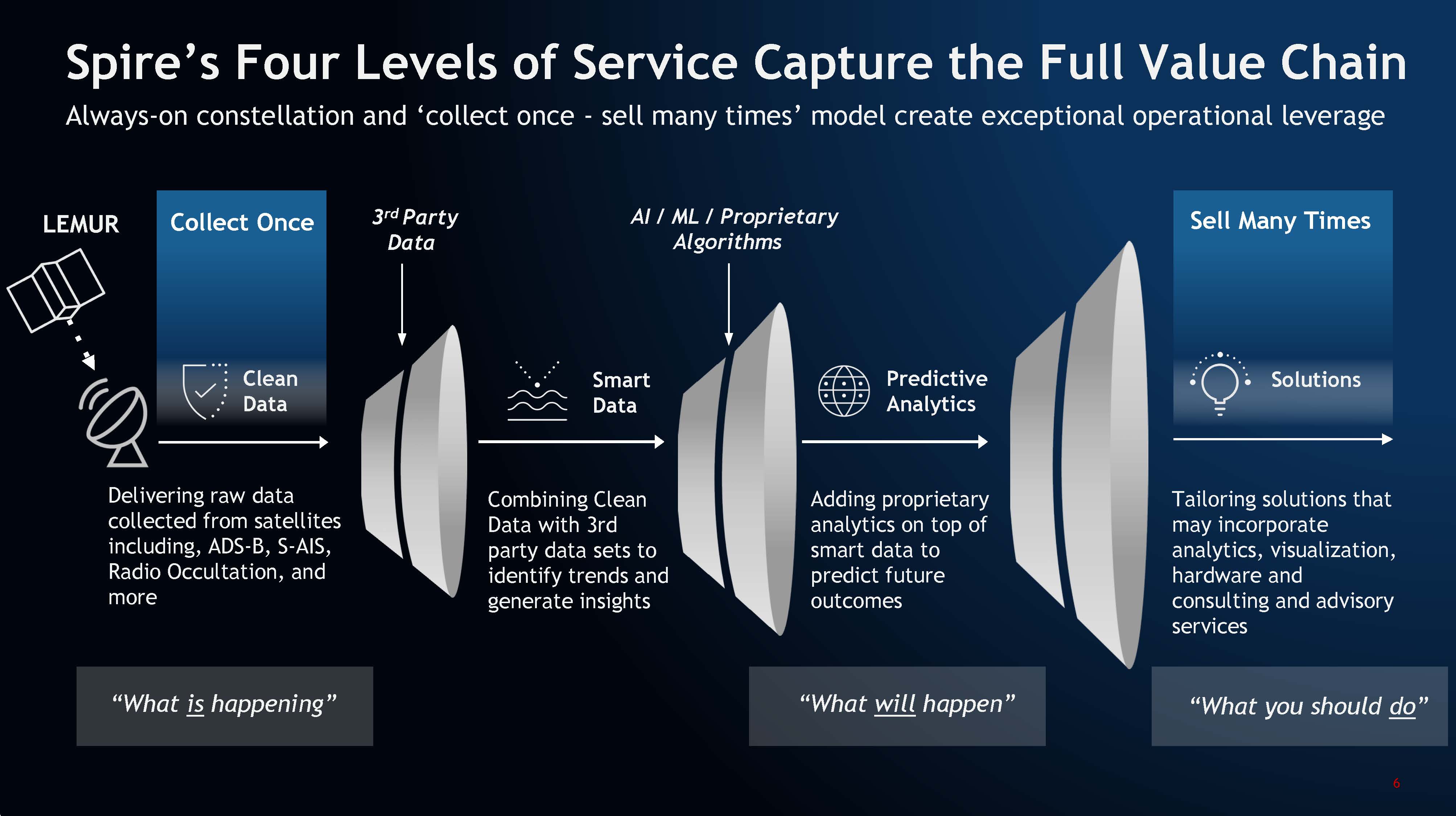
Our proprietary constellation of Low Earth Multi-Use Receiver (“LEMUR”) satellites collects and transmits data to our proprietary global ground station network. The data is then autonomously moved from ground stations to proprietary data warehouses for cleansing, standardization, fusion and analysis. Our customers receive proprietary data, analysis, and predictive data and solutions delivered seamlessly in real and near real-time.
For each data solution, we have the capability to offer customers a variety of features and additional value. The four forms of data we monetize are:
•Clean data: Clean and structured data directly from our proprietary satellites;
•Smart data: Clean data fused with third-party datasets and proprietary analysis to enhance value and provide insights;
•Predictive data: Big data, artificial intelligence (“AI”), and machine learning (“ML”) algorithms applied to fused data sets to create predictive analytics and insights; and
•Data solutions: Data-driven actionable recommendations to solve specific business problems, utilizing the full spectrum of our data analytics suite.
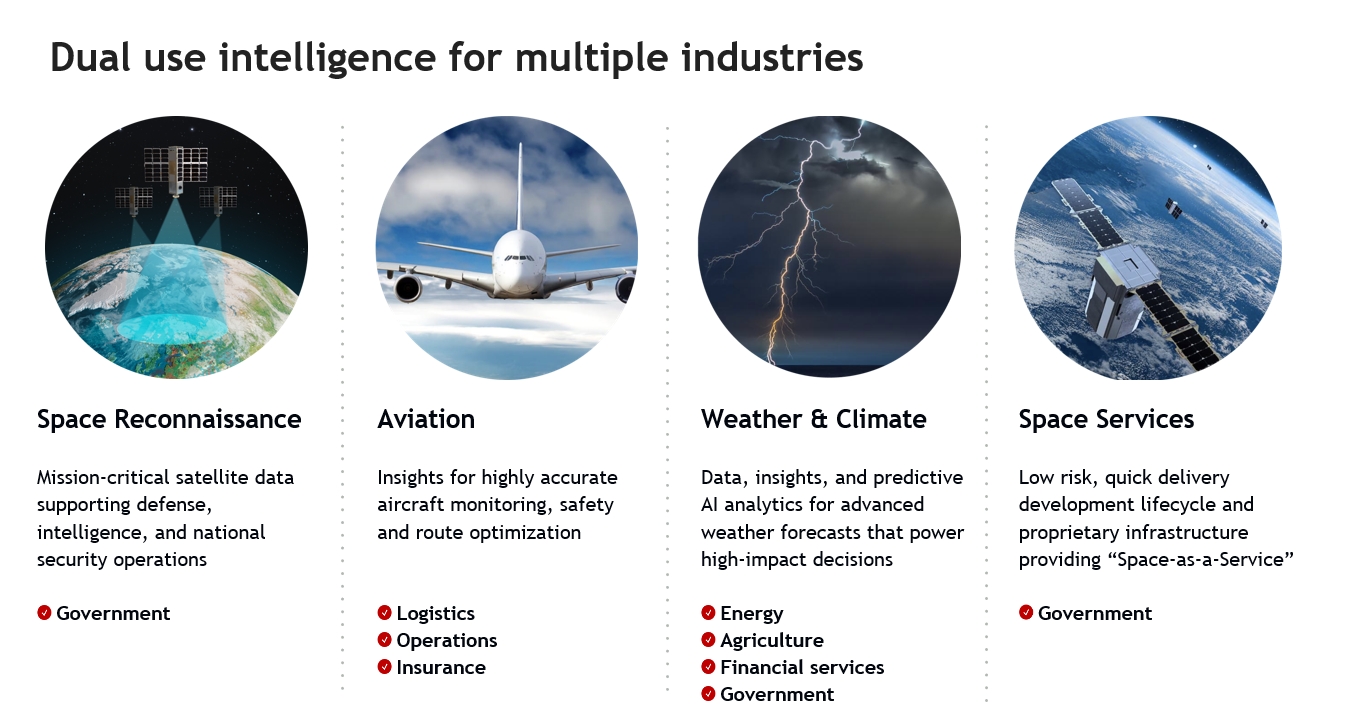
We monetize our proprietary solutions across a broad and growing range of current and target governments and industries including agriculture, logistics, financial services, insurance, aviation operations, energy, and academia, among others. The solutions we provide include space reconnaissance, aviation, weather and climate, and space services.
Space Reconnaissance
Over the past several years, geopolitical conflicts have brought the importance of global security to the world’s attention. Our satellites scan the RF spectrum across land, sea, and air, giving organizations the situational awareness they need to respond decisively to emerging threats. These mission-critical insights support defense, intelligence, and national security operations.
Key applications include:
•RF fingerprinting: Catalog and track unique signal behaviors to identify recurring emitters, detect spoofing, or monitor suspect transmissions over time.
•Very High Frequency/Ultra High Frequency (“VHF”/“UHF”) voice extracts: Recover audio from unencrypted communications in VHF and UHF bands, supporting voice-based threat assessment and analysis of hostile or suspicious activity.
•Signal detection & geolocation: Trigger intelligence, surveillance, and reconnaissance asset tasking or sensor activation with near-real-time event notifications for rapid coordination in complex or short-lived scenarios.
•RF Monitoring: Continuously monitor low-frequency RF activity with near global coverage from low earth orbit for persistent situation awareness, even in geographically challenging and remote regions.
•Jamming & spoofing detection: Monitor L-band global navigation satellite system (“GNSS”) signals to identify jamming, spoofing, and anomalous behavior near airports, along borders, or across maritime zones.
•Emitter geolocation: Locate interference sources using time difference of arrival, frequency difference of arrival, and doppler analysis, with high revisit rates for tracking mobile or low-power emitters in dynamic environments.
Aviation
We provide global satellite-based aircraft tracking data to power applications, drive decision making and improve cost efficiencies. We utilize International Civil Aviation Organization-backed Automatic Dependent Surveillance-Broadcast (“ADS-B”) aircraft tracking data to provide near real-time precision and situational awareness. Using ADS-B, customers can track the overall operational status of aviation assets and relevant weather conditions along a given aircraft’s flight path or in particular areas of interest around the world. Our versatile datasets include historical and near real-time aircraft position and status, aircraft type and airline data, and flight and airport information, delivered via our near real-time and historical data APIs. Our satellites capture global aircraft movements from space using ADS-B signals, even when the aircraft is flying over oceans, deserts, mountains and regions without available ground-based tracking. Key applications include:
•Flight tracking: We generate near real-time information on the movements of all ADS-B equipped aircrafts across continents and oceans for a large suite of regulatory and operations applications.
•Estimated time of arrival/on-time performance: Our versatile, near real-time aviation ADS-B data streams provide insight into both historical on-time performance and real-time estimated time of arrivals, which can benefit airline and airport operations.
•Air cargo and freight analytics: Tracking all cargo aircraft in near real-time can be leveraged for analysis of supply of air cargo capacity which aids in optimizing pricing and distribution.
•Analytics and market intelligence: Companies integrate live and historical flight and weather and climate data into innovative solutions for their customers and internal teams, driving more favorable outcomes through deeper insights.
•Predictive maintenance and aircraft management: By tracking aircraft usage and flight patterns, our data aids in the analysis allowing for less aircraft downtime and fewer schedule disruptions.
Weather and Climate
The world is continuing to see extreme weather events which can result in lost trading and business opportunities, and result in significant damage and cost. We believe that more accurate weather data, prediction technologies and analytics will play an increasingly important role in helping to devise strategies to respond to extreme weather events. We provide space-based data, AI-powered insights and predictive weather analytics to empower the world to optimize costs, increase safety, boost decarbonization and make optimal business decisions. By utilizing radio occultation technology (“RO”), we are able to offer improved global weather and Earth observation capabilities, capturing detailed temperature, humidity, and pressure information across the entire planet. Our satellite constellation collects near real-time data from every layer of the atmosphere, even at traditionally difficult high altitudes, polar areas, and remote oceanic regions. This data is used to power Spire's Global Weather forecasting system and enable enhanced forecast accuracy across the planet, especially improving the quality in areas that are traditionally under-observed. Through the use of Global Navigation Satellite System Reflectometry (“GNSS-R”), Spire captures information about precipitation, soil moisture and flooding, as well as ocean winds and wave roughness, and ice thickness,
extent and age on the polar caps. We also offer weather solutions including Deep Navigation Analytics™, a weather intelligence platform for the maritime industry; DeepVision™, an advanced weather visualization dashboard for global supply chain management; and High Resolution Weather Forecast, a regional high-resolution weather forecasting service designed to meet the critical demands of the energy and commodity markets.
These tools provide immense value to governments and commercial companies across the world, including the following sample of applications:
•Weather forecasting: Space-based RO data offers global measurements to greatly enhance the accuracy of weather forecasts, providing industries such as agriculture, energy and utilities, and supply chain analysis with highly detailed forecasting across their operational regions.
•Asset protection: Our data can help facilitate the risk mitigation of physical assets like power lines from storm damage.
•Crop yields: Customers can use our solutions to help optimize crop yields with optimal farm operations.
•Reducing losses and insurance: Provision of data can decrease losses related to inclement weather and provide enhanced customer experiences in insurance.
•Minimize supply chain disruptions: Reduce risks to cargo, ship and crew safety, optimize fuel consumption and manage operational costs with highly accurate weather forecasts for maritime, aviation and ground operations.
Space Services
Our Space Services solutions empower our customers to leverage our established infrastructure to put their businesses in space. These solutions are built on our vertically integrated capabilities, global ground station network, and cloud infrastructure to enable customers to access space efficiently. We provide customers fast, scalable, and reliable access to space data at a fraction of the cost and time it historically required by leveraging the same operational infrastructure we use for our own data and analytics solutions across aviation and weather and climate.
In doing so, customers are able to convert high capital expenditures typically recognized at the outset into affordable and recurring operating expenditures through a flexible subscription-based pricing model. Our launch schedule and end-to-end LEMUR design and manufacturing process allow customer sensors to progress from design to launch faster than the three to five year timelines under legacy satellite development. Our Space Services solution allows us to quickly and efficiently put satellites into service for our customers, while they focus on their core business.
Maritime
On April 25, 2025, we completed the sale of our maritime business. We retained certain maritime operations related to our U.S. federal government customers, including certain AIS-based vessel tracking services. We expect this business to decline over time as we focus on other strategic priorities.
Our Technology Platform
Our Constellation
We operate a large constellation of LEMUR nanosatellites along with a global network of ground stations. By operating our own satellites and ground stations, we are able to quickly and efficiently collect large volumes of data and make them available to our customers.
Key elements of our constellation include:
•Proprietary Satellite Space Platform: We have developed a configurable nanosatellite platform called LEMUR, which is used to deploy data-generating sensors into space and provide all necessary resources for them to be operated efficiently, including power, pointing, data communications and onboard processing. Our space operations experience includes deploying more than 200 LEMUR satellites since our inception. We expect to have more than 75 satellites operating in our constellation by the end of 2026.
•Software-defined radio frequency sensors: We have developed a number of software-defined-radio based sensors, including AIS receivers, ADS-B receivers, and GNSS radio occultation (“GNSS-RO”) receivers. These sensors are used to produce the proprietary datasets used in our data and analytics solutions.
•Ground station network: We have deployed and operate a network of more than 30 ground stations distributed around the globe. These ground stations allow seamless communications between LEMUR nanosatellite platforms (and their hosted sensors) and our cloud-based operations and data processing system.
•Automated operations system: We have developed a cloud-based automated operations system, which allows us and users of our Space Services solutions to operate sensors hosted on the LEMUR nanosatellite platform seamlessly through a web-based API. The operations system includes proprietary optimization algorithms which allow coordinated operations of multiple satellites, enabling us and our users to scale operations of constellations efficiently.
Sales and Marketing
Sales
We operate primarily a direct sales organization dispersed geographically to align with our existing customers along with reaching potential new customers worldwide. Our sales professionals are responsible for acquiring new customers along with managing and expanding business with our existing customers. The efforts are focused on sourcing and developing new customer relationships, maintaining customer relationships, increasing solution penetration, driving sales of additional solutions and furthering contract renewals. Our customer success and sales engineer teams, along with our sales team, manage our relationships with our customers.
Once a solution sale is made, our sales team leverages our land-and-expand model to generate incremental revenue through increased levels of adoption of our data by our customers. To drive such expansion in our existing customers, our sales team works closely with our sales engineers and marketing teams to foster customer success. Often, we find that initial customer success with our data results in key internal decision-makers upgrading their subscription packages, adding additional data sets, increasing the data coverage, adding additional solutions, or expanding their implementation throughout their organization and to new use cases.
Marketing
Our marketing team focuses on attracting, acquiring and retaining customers through outbound demand campaigns, building our brand reputation, increasing the awareness of our space-based data, predictive analytics and Space Services and the showcasing of customer successes. Our outbound demand campaigns include paid search, email, web and in-person customer events. Some of these targeted marketing efforts are focused on driving potential customers in search of solutions to our website. Supporting our sales professionals, our marketing team also develops messaging, solution positioning, thought leadership and other tools to help communicate the business value of our solutions. Our team also collaborates with our industry peers, suppliers, partners and customers when appropriate to celebrate successes and promote advancements within the new space economy.
Research and Development
Our research and development team consists of spacecraft engineering, software engineering, data science, meteorology, manufacturing, product engineering, external experts and management and is responsible for the design, architecture, creation and quality of our space platform and data solutions. We invest substantial resources in research and development to enhance our product portfolio and services. We believe the enhancement of our solutions and the timely development of technology, new services and features is essential to maintaining our competitive position, and we incorporate suggestions and feedback from our customers into our services.
Competition
Our space reconnaissance, aviation, weather and climate, and Space Services solutions are in markets that are fragmented and highly competitive and characterized by rapid changes in technology, customer requirements and industry standards and frequent introductions of improvements to existing offerings.
The principal competitive factors for companies in our verticals are:
•Data: global coverage, temporal and spatial resolution, accuracy, uniqueness, relevance and latency of data and analytics;
•Platform: speed, scale, reliability and relevance of API/user interface, ease of deployment and use, ability to ingest and manage a broad variety and large volume of data, ongoing innovation of services and customer support;
•Integration: quality of training and consulting;
•Cost: flexible packaging and total cost of ownership; and
•Business Strength: long-term business viability, customer satisfaction, brand awareness and reputation.
Some of our primary competitors include Aireon LLC in our aviation data vertical, PlanetiQ with respect to our radio occultation data services in our weather and climate data vertical, and HawkEye360 in our space reconnaissance vertical. We also compete with companies such as Muon Space for our Space Services solution.
We believe that we compare favorably with our competitors on the basis of the factors listed above. For additional information, see “Risk Factors—Risks Related to Our Industry and Business—We face competition and could face pricing pressure from, and lose market share to, our competitors, including as a result of rapid technological changes in the satellite industry or new service solutions, which could adversely affect our business.” in Part I, Item 1A of this Annual Report on Form 10-K.
Intellectual Property
Our success depends in part upon our ability to safeguard and protect our core technology and other intellectual property for our technology, inventions, improvements, proprietary rights, and other assets. We seek to accomplish that objective through establishing intellectual property rights in and protecting those assets through a combination of patents, patent applications, registered and unregistered trademarks, copyrights, trade secrets, license agreements, confidentiality procedures, non-disclosure agreements with third parties, and other contractual measures. We also license data and software from third parties for integration into our business, including open-source software and other software available on commercially reasonable terms.
Additionally, we rely upon unpatented trade secrets and confidential know-how and continuing technological innovation to develop and maintain our competitive position. We seek to protect our proprietary information, in part, by entering into confidentiality agreements with our employees, consultants, vendors and customers, and generally limiting access to and distribution of our proprietary information. However, we cannot assure you that the steps taken by us will prevent misappropriation of our technology. For additional information, see “Risk Factors—Risks Related to our Technology, Research and Development, Technical Infrastructure, and Operations—Any failure to obtain, maintain, protect, or enforce our intellectual property and proprietary rights could harm our business, financial condition, and results of operations.” in Part I Item A of this Annual Report on Form 10-K.
Despite our efforts to protect our proprietary rights, unauthorized parties may attempt to copy aspects of our offerings or obtain and use information that we regard as proprietary. Policing unauthorized use of our technology is difficult and time consuming. Third parties may independently develop the same or similar proprietary information or may otherwise gain access to our proprietary information. The laws, procedures and restrictions on which we rely may provide only limited protection, and any of our intellectual property rights may be challenged, invalidated, circumvented, infringed or misappropriated. In addition, the laws of some foreign countries do not protect our proprietary rights to the same extent as the laws of the U.S, and many foreign countries do not enforce these laws as diligently as government agencies and private parties in the U.S.
Our industry is characterized by the existence of a large number of patents and frequent claims and related litigation regarding patent and other intellectual property rights. From time to time, third parties may assert claims of infringement, misappropriation, and other violations of intellectual property against us or our customers, with whom our agreements may obligate us to indemnify against these claims.
Employees
As of December 31, 2025, we had 377 employees located in 9 countries, of which 372 were full-time employees. In addition, we engage contractors and third-party service providers in connection with certain projects. In certain countries in which we operate, we are subject to local labor law requirements which may automatically make employees subject to industry-wide collective bargaining agreements. None of our employees are currently represented by a labor union or covered by a collective bargaining agreement with respect to their employment with us. We have not experienced any work stoppages, and we consider our relations with our employees to be good.
Government Regulation and Compliance
Our business is subject to regulation by various federal, state, local and foreign governmental agencies, including agencies responsible for monitoring and enforcing laws and regulations related to the deployment and operation of satellites, ground stations, privacy and data protection, intellectual property, investment screening, labor and employment, worker classification, product safety, economic sanctions, anti-trust laws, anti-money laundering laws, anti-bribery laws, import and export controls, federal securities laws and tax laws and regulations.
Our business requires licenses and permits from the Federal Communications Commission (“FCC”) and review by other agencies of the U.S government as well as from non-U.S. regulators and governments. License approval can include an interagency review of safety, operational, radio frequency interference, national security, foreign policy and international obligations implications, as well as a review of foreign ownership. Our launch and operation of planned satellites may require regulatory authorizations from the FCC or a non-U.S. licensing jurisdiction. If we do not obtain required authorizations in the future, we will not be able to operate our planned satellites. If we obtain a required authorization but do not meet licensing requirements regarding the construction, launch and operation of a satellite, we may lose our authorization to operate a satellite using certain frequencies in an orbital location.
We hold FCC and foreign governmental licensing authority licenses, permits and approvals for our satellite constellations and earth stations. As we build out our satellite constellation, we may require new licenses, permits and approvals from the FCC, other governmental agencies and/or foreign governmental licensing authorities or modifications to existing licenses, permits and approvals. Changes to our satellite constellation and earth stations may also require prior approval from the FCC or other governmental authorities, which can take time.
Our business is also dependent on the use of satellite signals and on terrestrial communication bands. International allocations of radio frequency are made by the International Telecommunication Union (“ITU”). Any ITU or local change of allocation of radio frequency bands, including frequency band segmentation and sharing of spectrum, or other modifications of the permitted uses of relevant frequency bands, may materially and adversely affect the utility and reliability of our services and have significant negative impacts on our customers, both of which could reduce demand for our business.
In many cases, our data, services, and technology are or may in the future be subject to U.S. export control laws and regulations including the Export Administration Regulations (“EAR”) and International Traffic In Arms (“ITAR”), and subject to trade and economic sanctions maintained by the Office of Foreign Assets Control (“OFAC”). We are also subject to or may in the future be subject to export control and trade sanctions laws in other countries. As such, an export license may be required to export or re-export our data, services, and technology to certain countries or end-users, or for certain end-uses. Any failure to comply with export control laws could result in civil fines or suspension or loss of our export privileges, any of which could materially adversely affect our business, financial condition and results of operations.
The regulatory framework for privacy, data protection and data transfers worldwide is rapidly evolving and is likely to remain uncertain for the foreseeable future. By way of example, the California Consumer Privacy Act, as amended by the California Privacy Rights Act (the “CCPA”), gives California residents individual privacy rights to access and delete their personal information, opt out of certain personal information sharing, limit the use of their sensitive personal information, and receive detailed information about how their personal information is used. The CCPA provides for civil penalties for violations, as well as a private right of action for data breaches. The CCPA also established a new California agency, the California Privacy Protection Agency, which is authorized to issue new substantive regulations and has independent enforcement power alongside the California Attorney General. Comprehensive privacy legislation similar to the CCPA has been adopted in many other U.S. states. Any liability from failure to comply with the requirements of these laws could adversely affect our business, financial condition, and results of operations.
There also are a wide variety of privacy laws in other countries that may impact our operations, now or in the future. For example, in Europe, the General Data Protection Regulation (the “GDPR”) imposes stringent requirements regarding the collection, use, disclosure, storage, transfer, or other processing of personal data of individuals within the European Economic Area (the “EEA”), including providing information to individuals regarding data processing activities, implementing safeguards to protect the security and confidentiality of personal data, providing notification of data breaches, and taking certain measures when engaging third-party processors. Companies that must comply with the GDPR face increased compliance obligations and risk, including more robust regulatory enforcement of data protection requirements and potential fines for noncompliance of up to €20 million or 4% of the annual global revenue of the noncompliant company, whichever is greater. The GDPR also confers a private right of action in some circumstances on data subjects and consumer associations to lodge complaints with supervisory authorities, seek judicial remedies, and obtain compensation for damages resulting from violations of the GDPR. In addition, the GDPR increases the scrutiny of transfers of personal data from the EEA to the U.S. and other jurisdictions that the European Commission does not recognize as having “adequate” data protection laws.
Further, following the withdrawal of the United Kingdom from the European Union and the EEA and the end of the transition period, we have to comply with the GDPR and separately the GDPR as implemented in the United Kingdom, which, together with the amended UK Data Protection Act 2018, retains the GDPR in UK national law. The UK GDPR mirrors the fines under the GDPR and has the ability to fine up to the greater of €20 million/£17 million or 4% of global turnover. The relationship between the United Kingdom and the European Union and the EEA in relation to certain aspects of data protection law remains unclear, and it is unclear how United Kingdom data protection laws and regulations will develop in the medium to longer term. The European Commission has adopted an adequacy decision in favor of the United Kingdom, enabling data transfers from European Union member states to the United Kingdom without additional safeguards.
Our business is also subject to various laws and regulations relating to the protection of the environment and human health and safety, including those governing the management, storage and disposal of hazardous materials, such as fuels and batteries. We could incur significant costs, including cleanup costs, fines, sanctions, and third-party claims, as a result of violations of or in connection with liabilities under environmental laws and regulations.
For additional information regarding the laws and regulations to which we are subject and the risks to our business associated with such laws and regulations, see “Risk Factors” in Part I, Item 1A of this Annual Report on Form 10-K.
Available Information
Our website is located at www.spire.com, and our investor relations website is located at www.ir.spire.com. Copies of our Annual Report on Form 10-K, Quarterly Reports on Form 10-Q, Current Reports on Form 8-K and amendments to these reports filed or furnished pursuant to Section 13(a) or 15(d) of the Securities Exchange Act of 1934, as amended (the "Exchange Act"), are available free of charge on our investor relations website as soon as reasonably practicable after we file such material electronically with or furnish it to the Securities and Exchange Commission (the “SEC”). The SEC also maintains a website that contains our SEC filings at www.sec.gov.
We announce material information to the public about us, our products and services and other matters through a variety of means, including filings with the SEC, press releases, public conference calls, webcasts, the investor relations section of our website at www.ir.spire.com, and X account (@SpireGlobal), our Bluesky account (@spire.com) and our LinkedIn page in order to achieve broad, non-exclusionary distribution of information to the public and for complying with our disclosure obligations under Regulation FD.
The information disclosed by the foregoing channels could be deemed to be material information. As such, we encourage investors, the media, and others to follow the channels listed above and to review the information disclosed through such channels.
Any updates to the list of disclosure channels through which we will announce information will be posted on the investor relations page on our website.
Information contained on our website or connected thereto does not constitute part of, and is not incorporated by reference into, this Annual Report on Form 10-K.
Item 1A. Risk Factors.
Investing in our Class A common stock involves a high degree of risk. You should carefully consider the risks and uncertainties described below, together with all of the other information in this Annual Report on Form 10-K, including the sections titled “Management’s Discussion and Analysis of Financial Condition and Results of Operations” and our consolidated financial statements and related notes, before making a decision to invest in our Class A common stock. Our business, financial condition, results of operations, or prospects could also be harmed by risks and uncertainties not currently known to us or that we currently do not believe are material. If any of the risks actually occur, our business, financial condition, results of operations, and prospects could be adversely affected. In that event, the market price of our Class A common stock could decline, and you could lose part or all of your investment.
These disclosures reflect our beliefs and opinions as to factors that could materially and adversely affect us and our securities in the future. References to past events are provided by way of example only and are not intended to be a complete listing or a representation as to whether or not such factors have occurred in the past or their likelihood of occurring in the future.
Risks Related to Our Industry and Business
We may require additional capital to support business growth, and this capital might not be available on company favorable terms, if at all, or may be available only by diluting existing stockholders or putting excessive debt leverage and insolvency risk on the business.
Historically, we have funded our operations and capital expenditures primarily through equity issuances, debt and cash generated from our operations. Although we currently anticipate that our existing cash and cash equivalents and marketable securities will be sufficient to meet our cash needs for at least the next 12 months, we may require additional financing in the future, and we may not be able to obtain debt or equity financing on favorable terms, if at all. If we raise equity financing to fund operations or on an opportunistic basis, our stockholders may experience significant dilution of their ownership interests. If we obtain debt financing, the terms of such debt financing may include restrictive covenants, including restrictions on our ability to incur additional indebtedness, require us to maintain certain financial covenants, or restrict our ability to pay dividends and our operational flexibility or profitability. If we need additional capital and cannot raise it on acceptable terms, or at all, we may not be able to, among other things, develop new products, technologies and services, enhance our operating infrastructure, expand the markets in which we operate and potentially acquire complementary businesses and technologies or otherwise grow our business or respond to competitive pressures.
We have a history of net losses and may not be able to achieve or maintain revenue growth or profitability in the future.
Apart from a gain recognized in the second quarter of 2025 related to the sale of our maritime business, we have incurred net losses since our inception and have not generated net income from ongoing operations. We expect to continue incurring net losses in the near term as we invest in the growth of our business.
Although our total operating expenses are expected to decrease in 2026 as a result of the sale of our maritime business, operating expenses associated with our continuing operations have increased and may continue to increase as we invest in sales and marketing, research and development, and infrastructure to support revenue growth and other strategic priorities. These efforts may be more costly than we expect and may not result in increased revenue or growth in our business. Any failure to increase our revenue sufficiently to offset the increases in our operating expenses will limit our ability to achieve or maintain profitability in the future. Further, if we are unable to successfully address these risks and challenges as we encounter them, our business, financial condition, and results of operations could be adversely affected.
Uncertain macroeconomic and geopolitical conditions have negatively impacted, and may continue to impact, our business, financial condition, and results of operations.
Negative macroeconomic conditions in the U.S. or abroad, including elevated inflation, interest rate volatility, credit market disruptions, trade restrictions, the imposition of tariffs, changes in economic policy, delays in U.S federal budget appropriations, or geopolitical tensions, civil unrest, and armed conflicts may impact our infrastructure, including both ground stations and assets in space, and such conflicts have led and may in the future lead to decreased spending on our offerings and services and lengthen our sales cycles. These conditions can make it more difficult for us and our customers to forecast and plan business activities, and have caused and may in the future cause customers to delay or cancel projects, renegotiate contracts, or face
challenges in making timely payments, which could require us to increase our allowance for doubtful accounts. In addition, the imposition of international sanctions, as well as related global conflicts and security concerns have at times led to scheduling shifts or launch cancellations by third-party satellite launch providers, which delayed our revenue recognition for certain sales contracts. If those conflicts escalate further, or if new or increased sanctions or geopolitical tensions emerge, our operations, business relationships, and financial results could be further adversely affected. Further the U.S.' imposition and suspension of tariffs on a variety of countries, and retaliatory measures or other changes to trade policies, could impact trade volume, investment, technological exchange and other economic activities between major international economies, resulting in a material adverse effect on global economic conditions and the stability of global financial markets. Any changes in political, trade, regulatory, and economic conditions, including U.S. trade policies and any further increases in existing tariff rates, could have a material adverse effect on our business, financial condition, and results of operations.
If any of these factors continue or worsen, and/or if new macroeconomic or geopolitical issues arise, our results of operations and financial condition could be further negatively impacted. Any downturn of the general economy or industries in which we operate would adversely affect our business, financial condition, and results of operations.
We rely on a limited number of government customers to provide a significant portion of our revenue.
We have historically derived a significant portion of our revenue from contracts with governmental customers. Approximately 43% of revenue for the year ended December 31, 2025, was generated by three government customers. There can be no assurance that any contract with the government of any jurisdiction will not be terminated or suspended in the future, as such terminations or suspensions generally may be done at any time, with or without cause. For example, on March 2, 2026, we received from Public Services and Procurement Canada a Stop Work Order Notice, suspending work effectively immediately until further notice, pursuant to that certain contract, dated January 20, 2025, relating to the design and development of the WildFireSat constellation of satellites for the Canadian Space Agency. The Public Services and Procurement Canada has until August 29, 2026 to either cancel the stop order or terminate the contract, in whole or in part. See the risk factor titled, “Our contracts with government entities are subject to a number of risks and uncertainties” for additional information. Loss of one or more of our government customers, any significant decrease in sales to these customers, a full or partial government shutdown, or delays in government appropriations has in the past, and in the future could adversely affect our business, financial condition, and results of operations.
We face competition and could face pricing pressure from, and lose market share to, our competitors, including as a result of rapid technological changes in the satellite industry or new service solutions, which could adversely affect our business.
The industries in which we operate are fragmented, highly competitive, and characterized by rapid technological changes, evolving customer requirements, and frequent product and service innovations. We may face competition from companies using new service solutions, innovative technologies, including artificial intelligence, and equipment, including new low Earth orbit constellations, expansions of existing geostationary satellite systems, or other technologies. These developments could render our offerings less competitive or obsolete and require significant capital expenditures to maintain and enhance our platform features and services. Many of our existing competitors have, and some of our potential competitors could have, substantial competitive advantages including, but not limited to, access to greater resources. Increasing competition, an inability to respond to rapid industry change or adopt effective pricing strategies, or other pressures could compromise our ability to compete, reduce revenue, and impact margins.
Our business model of delivering data and analytics gathered from a custom constellation of satellites in space is still relatively new and has only recently gained market traction. Moreover, many established businesses are aggressively competing against us and have offerings with functionalities similar to those offered by us. We expect competition to increase as other established and emerging companies enter this market, as customer requirements evolve, and as new offerings and technologies are introduced. If we are unable to anticipate or effectively react to these competitive and technological challenges, our competitive position would weaken, and our business, financial condition, and results of operations would be adversely affected.
Our sales cycle can be long and unpredictable for certain channels and services, and our sales efforts require considerable time and expense.
Our quarterly results of operations fluctuate, in part, because of the resource-intensive nature of our sales efforts and the length and variability of our sales cycle for certain of our offerings, such as our project-based services, and for certain of our customers, such as government departments and agencies. The length of our sales cycle, from initial contact with our sales team to a contractual commitment from a customer, can also vary substantially from customer to customer and our sales cycle may
lengthen as we continue to focus our sales efforts on large enterprises and on our Space Services. In addition, our results of operations depend, in part, on subscription renewals from customers and increasing sales and upgrades to our existing customers, which may also be reduced or delayed. If a customer does not renew on time or as expected, or if we fail to cost-effectively acquire new customers or obtain renewals, upgrades, or expansions from our existing customers, our business, financial condition, and results of operations would be adversely affected. In addition, we may in the future make changes to our subscription model, which may affect the length of our sales cycle and our ability to predict the length of our sales cycle or the anticipated size of potential subscriptions.
We depend on our sales force to obtain new customers and to drive additional sales to existing customers. We believe that there is significant competition for sales personnel with the skills and technical knowledge that we require, and our ability to grow revenue depends, in part, on our ability to recruit, train, and retain sufficient numbers of sales personnel. If we are unable to attract, retain, motivate and adequately train sufficient numbers of effective sales personnel, if our sales personnel do not reach significant levels of productivity in a timely manner, or if our sales personnel are not successful in converting potential customers into new customers or increasing sales to our existing customer base, our business, financial condition, and results of operations would be adversely affected.
Our customers may depend on our technical support services to resolve issues relating to our platform. If we do not succeed in helping our customers quickly resolve issues or provide effective ongoing education related to our platform, our reputation could be harmed. To the extent that we are unsuccessful in hiring, training, and retaining adequate customer support resources, our ability to provide adequate and timely support to our customers, and our customers’ satisfaction with our platform, will be adversely affected. Our failure to provide and maintain high quality customer support would harm our reputation and brand and adversely affect our business, financial condition, and results of operations.
Our international operations and continued international expansion subject us to additional costs and risks, which could adversely affect our business, financial condition, and results of operations.
Our growth strategy depends, in part, on our continued international expansion. We are continuing to adapt to and develop strategies to address international markets, and to grow our manufacturing footprints in the U.S. and abroad, but there is no guarantee that such efforts will be successful. Efforts to expand our platform in certain countries may be complicated, constrained, or prohibited due to regulatory and legal requirements we must comply with in the U.S. or other jurisdictions that may conflict with one another. Our international sales and operations are subject to a number of risks, including, but not limited to: higher costs of doing business, greater difficulty enforcing and collecting on contracts, differing laws and regulations, foreign exchange fluctuations, recruiting and retaining talented and capable employees in foreign countries and maintaining our company culture and employee programs across all of our offices, difficulty obtaining regulatory or legal approvals, maintaining effective trade controls compliance, ensuring compliance with prohibitions on foreign national involvement in certain contracts, and other items. These and other factors could harm our ability to generate revenue outside of the U.S. and/or could result in increased expenses and liabilities, and consequently, adversely affect our business, financial condition, and results of operations.
Our business could be adversely affected by weather, climate, and other large-scale disruptive events.
We are vulnerable to a wide range of large-scale disruptive events, including natural disasters such as tsunamis, hurricanes, floods, wildfires, earthquakes, extreme weather events, and water shortages, as well as pandemics, acts of war or terrorism, political crises, power outages, and infrastructure failures. These events may impact our operations, the operations of our suppliers or launch partners, or critical infrastructure, including launch sites and manufacturing facilities. The frequency and severity of extreme weather events have increased and may continue to rise, potentially disrupting our launch schedules, supply chains, or our ability to fulfill customer contracts. These events could materially and adversely affect our business, financial condition, and results of operations.
Risks Related to our Technology, Research and Development, Technical Infrastructure, and Operations.
Satellites use highly complex technology and operate in the harsh environment of space and therefore are subject to significant operational risks while in orbit, including, but not limited to, failure to perform or performance at reduced levels of service because of major events, technological malfunctions, satellite deficiencies, or other performance failures.
Satellites in low earth orbit have a limited life cycle and could become compromised over their designated operational life span. We anticipate that our satellites will have an expected end-of-commercial-service life of three to four years. It is possible that
the actual commercial service lives of our satellites will be shorter than anticipated and there can be no assurance as to the actual useful life of a satellite or its individual components. Certain of our satellites are nearing the end of their expected useful lives. As they do so, the performance of each satellite could start to decline. We can offer no assurance that satellites will maintain their prescribed orbits or remain operational, and we may not have replacement satellites that are immediately available. In particular, the strength, timing, and intensity of the solar cycle may impact the longevity and operations of our satellites. The solar cycle, which occurs approximately every 11 years, governs fluctuations in the sun's magnetic activity. Increased solar activity leads to heightened atmospheric drag on satellites, accelerating their orbital decay and causing earlier deorbiting, which can render satellites inoperative or result in complete loss due to burn-up during re-entry into the lower atmosphere. Our ability to mitigate these solar cycle effects and maintain timely replenishment of our constellation may adversely affect our business financial condition and results of operations.
Exposure of our satellites to an unanticipated catastrophic event, such as a solar flare, meteor shower, coronal mass ejection, electrostatic storm, or collision with other objects could reduce the performance of, or completely destroy, the affected satellite and/or constellation. Other anomalies that may affect the actual commercial service lives of our satellites include mechanical, electrical or other failures due to manufacturing error or defect; equipment degradation during the satellite’s lifetime; deficiencies of control or communications software; insufficient hardware quality, durability, or reliability; attacks by malicious actors, including cyber-related events; and governmental discontinuation for periods of time the access to or operation of a satellite for any particular area on the Earth or restricting permission to transmit certain data.
We have experienced, and may in the future experience, some of these catastrophic events or anomalies. The effects of these catastrophic events and anomalies include, but are not limited to, failure of the satellite, degraded communications performance, reduced power available to the satellite, battery overcharging or undercharging and limitations on satellite communications capacity and data collection. Some of these effects may be increased during periods of greater message traffic and could result in our system requiring more than one attempt to send messages before they get through to our satellites. This could lead to increased messaging latencies or other adverse outcomes for the end user and reduced throughput for our system. Any single anomaly could materially and adversely affect our ability to utilize a satellite. Anomalies may also reduce the expected capacity, commercial operation and/or useful life of a satellite, thereby reducing the amount of space data collected, which, if material, could impact revenue or create additional expenses due to the need to provide replacement or back-up satellites or satellite capacity earlier than planned. In addition, if a satellite experiences an anomaly or malfunction, our backup satellite capacity may be insufficient to meet our customers’ needs or avoid service interruptions, and we may need to potentially blackout or reduce service to certain customers, which would adversely affect our relationships with our customers and result in loss of revenue.
Satellites have certain redundant systems, which can fail partially or in their entirety, and accordingly satellites may operate for extended periods without all redundant systems in operation, but with single points of failure. The failure of satellite components could cause damage to or loss of the use of a satellite before the end of its expected useful life. Satellites can temporarily go out of service and be recovered, or cease to function for reasons beyond our control, including the quality of design and construction, the supply of the battery, the expected gradual environmental degradation of solar panels, the durability of various satellite components and the orbits and space environments in which the satellites are placed and operated.
Most, if not all, failures cannot be corrected once the satellites are placed in orbit and may result in loss of customers, customer disputes, monetary losses, delays, and impairment of services.
Satellites are subject to significant launch risks, including, but not limited to, launch delays, launch failures, and damage or destruction during launch, the occurrence of which can materially and adversely affect our business, financial condition, and results of operations.
We are dependent on third-party launch service providers. Currently, the number of companies who offer launch services is limited, and if this sector fails to grow or experiences consolidation among current providers, we may not be able to secure space on a launch vehicle or may incur higher prices for such space. This could cause delays in our ability to meet our customers' needs or an increase in the price of our offers, adversely affecting our business, financial condition, and results of operations. The technology related to launch capabilities is evolving rapidly as existing launch providers iterate on their existing capabilities and new providers enter the market. Our launch partners may encounter launch, deployment, or in-orbit delays or failures, leading to damage or complete loss of our satellites, including customer assets. If a launch is delayed, which is common in our industry, our timing for the recognition of revenue tied to customer acceptance of project-based deliverables may similarly be delayed.
In addition, the loss of, or damage to, a satellite due to a launch failure could result in significant increased expenses from earlier than expected replacement satellites and delays in anticipated revenue. Any significant delay in the commencement of service of a satellite could delay or potentially permanently reduce the revenue anticipated to be generated by that satellite. In addition, if the loss of satellites was material, we might not be able to accommodate customers with sufficient data to meet minimum service level agreements until replacement satellites are available, which we may be unable to obtain in a timely manner. Appropriate launch windows for satellites in our industry are limited and may become more so as additional satellite networks and other spacecraft are launched and/or as space debris becomes more common. Coordinating with partners and regulators to reserve launch windows and prepare for launches may as a result become more difficult over time. An extended launch delay, limited availability of launch windows, delays in regulatory approvals, satellite damage or destruction during launch deployment, a launch failure, launch underperformance, or incorrect orbital placement could have a material adverse effect on our business, financial condition, and results of operations.
Technical malfunctions, performance failures, or other issues or difficulties with our ground stations could harm our business, financial condition, and results of operations.
The ongoing operations of our satellite constellation and data services rely on the functionality of our ground stations. We have in the past experienced and may in the future experience technical difficulties or mechanical issues with our ground stations, which may negatively impact service in the region covered by that ground station. Our ground stations are often located in remote regions of the world and not easily accessible and can be subject to restrictions on travel. Further, we rely, at times, on third parties to perform maintenance on and repair our ground stations. We may experience a partial or total loss of one or more of our ground stations due to disasters such as tsunamis, tornados, floods, hurricanes, other extreme or unusual weather events, earthquakes, fires, acts of war or terrorism, or other catastrophic events. A failure at one or more of our ground stations could cause a delayed, partial, or complete loss of service for our customers. We may experience a failure in the necessary equipment at our ground stations, or in the communication links between our ground stations. Additionally, our ground stations are located on property that is not owned by us. A failure at any of our ground stations, facilities, or in the communications links between our facilities, or in our ability to maintain and access our ground stations and underlying leases for any reason, could adversely affect our business, financial condition, and results of operations.
We rely on third parties for our supply of certain of our data, equipment, satellite components, software, and operational services, and any failure, delay, or interruption with these third parties could adversely affect our business, financial condition, and results of operations.
We purchase equipment and satellite components from third-party suppliers, and we depend on those suppliers to deliver and support our operations at the contracted specifications in order for us to continue to meet our service and contractual commitments to our customers. We may experience difficulty implementing, operating and maintaining equipment and satellite components, or when providing services using this equipment, if these suppliers do not meet their obligations to deliver and support the equipment and satellite components or if our arrangements with these third parties are terminated or modified resulting in delays, added expense, reduced quality of our data, or an inability to maintain or expand our business. This may lead to service interruptions or degradations in the services offered to our customers, which could cause our revenue to decline materially and could adversely affect our ability to market our services and generate future revenue and profit.
Further, our suppliers may become capacity-constrained or could face financial or other difficulties as a result of broader geopolitical, climate or economic events or conditions. We may experience operational delays and may have to evaluate replacement suppliers for our satellite components, equipment, and operational services. If we fail to effectively address these issues, we could suffer delays, which could reduce our ability to launch new satellites and manage and operate our business.
We also rely on a number of third-party data, software, cloud, and other service providers to manage and operate our business, including data obtained from third party satellites. The services provided by these third parties are critical to our ability to operate and maintain our business. For example, we outsource substantially all of the infrastructure relating to our platform to Amazon Web Services (“AWS”) and therefore our platform depends, in significant part, on the virtual cloud infrastructure
hosted in AWS. Our customers need to be able to access our platform at any time, without interruption or degradation of performance. Any disruption in these services, including as a result of a prolonged AWS service disruption affecting our
platform or a termination of our end-user license agreement with AWS, or an inability to obtain these services on commercially reasonable terms or at all, could adversely affect our business, financial condition, and results of operations.
We primarily manufacture our satellites in-house at a single manufacturing facility in the United Kingdom. Any impairment to this manufacturing facility, or our inability to grow manufacturing capabilities at other facilities, would materially affect our business, financial condition, and results of operations.
We primarily manufacture our satellites in-house at a single manufacturing facility in the United Kingdom. The availability of our services depends on the continuing operation of our satellite manufacturing infrastructure and operations. Any impairment such as downtime, damage to, or failure of our manufacturing facility could result in interruptions in our production of satellites, which could materially affect our business. Our manufacturing facility may become capacity-constrained or could face financial difficulties as a result of a surge in demand for additional satellites, a natural disaster, or other event. Our manufacturing site is vulnerable to damage or interruption from floods, fires, power loss, or aging infrastructure. An infrastructure failure could result in the destruction of satellites under construction or inventory, manufacturing delays, or additional costs incurred, and we do not maintain back-up manufacturing facilities or operations. We may not be able to replace or supplement the satellite manufacturing process through the growth of our manufacturing capability at other facilities or with third-party manufacturers, and even if we are able to do so, there could be a substantial period of time in which new satellites would not be manufactured.
Further, any new facility or relationship may involve higher costs and delays in development and delivery. We may also encounter technical challenges in successfully replicating the manufacturing processes in another facility or with a third party. The occurrence of any of the foregoing could result in lengthy interruptions in our production and launch of our satellites, which could materially affect our business, financial condition, and results of operations.
We engage in customer-funded or co-funded research and development arrangements (“R&D Services contracts”), which are generally partially co-funded by agencies like the European Space Agency (“ESA”) or National Aeronautics and Space Administration (“NASA”). The cost of providing the services and activities pursuant to these agreements initially exceed the revenue they generate. Even if technology is successfully developed pursuant to these R&D Services contracts and is eventually commercialized, it may never yield a profit.
We engage in R&D Services contracts to further several promising space technologies and solutions. These R&D Services contracts generally follow a co-funding structure. We usually fund a portion of the research ourselves and bill the customer, a government agency like ESA or NASA, the other portion, typically 50% of the total costs. Through this co-funding arrangement, the total costs of providing the related R&D Services exceed the revenue they generate. Even if technology is successfully developed pursuant to these R&D Services contracts and is eventually commercialized, it may never yield enough profit to recover all of the expenses incurred for these contracts. As a result, our ability to continue these activities may be jeopardized, particularly because of our negative cash flows from operation.
Any failure to obtain, maintain, protect, or enforce our intellectual property and proprietary rights could harm our business, financial condition, and results of operations.
Our success depends, in part, upon our ability to obtain, maintain, protect, and enforce our intellectual property rights, including our proprietary technology, know-how, and our brand. We also incorporate technology and terrestrial data sets from third parties into our platform, and our inability to maintain rights and access to such technology and data sets would harm our business and results of operations. We rely on a combination of patents, copyrights, trademarks, service marks, trade secret laws, and contractual provisions in an effort to obtain, establish, maintain and protect these rights. However, if we fail to protect or enforce our intellectual property rights or trade secrets adequately, our competitors might gain access to our proprietary technology and develop and commercialize similar services or technologies, we may not have access to the technology or data that we need, and our business, financial condition, results of operations, or prospects could be adversely affected. There can be no guarantee that others will not infringe on our trademarks or patents, independently develop offerings that are similar to our intellectual property or trade secrets, duplicate any of our offerings, or design around our patents or other intellectual property rights. Enforcing intellectual property claims can be difficult, expensive and time consuming, and the outcome is unpredictable. In addition, we may be required to license additional technology from third parties to develop and market new features, which may not be on commercially reasonable terms, or at all, and could adversely affect our ability to compete.
Furthermore, claims by others that we infringed their proprietary technology or other intellectual property rights would harm our business. Our success depends, in part, on our ability to develop and commercialize our services without infringing, misappropriating, or otherwise violating the intellectual property rights of third parties. However, we may not be aware if our services are infringing, misappropriating, or otherwise violating third-party intellectual property rights, including with respect to technology and data obtained by others for use by us, and such third parties may bring claims alleging such infringement, misappropriation, or violation. Defending against such claims can be difficult, expensive and time consuming, and the outcome
is unpredictable, which could materially affect our business, financial condition, and results of operations.
Our services and technology contain third-party open source software components, and failure to comply with the terms of the underlying open source software licenses could restrict our ability to deliver our platform or subject us to litigation or other actions.
Our technology includes software modules licensed to us by third-party authors under open source licenses, and we expect to continue to incorporate such open source software in our platform in the future. We also contribute to the open source developer community. Use and distribution of open source software may entail greater risks than use of third-party commercial software, as open source licensors generally do not provide support, warranties, indemnification, or other contractual protections regarding infringement claims or the quality or reliability of the code. Our inclusion of open source software in some of our technology may also require release of the source code, enabling others to compete more effectively. In addition, the public availability of such open source software may make it easier for others to compromise our services and technology.
The terms of many open source licenses have not been interpreted by U.S. or foreign courts, and there is a risk that these licenses could be construed to impose unanticipated conditions or restrictions on our platform. There is also a risk that we and our customers could be subject to lawsuits by parties claiming ownership of what we believe to be open source software.
Issues in the use of AI, including machine learning, in our geospatial data and analytics platforms may negatively affect our business.
AI is enabled by or integrated into some of our geospatial data and analytics platforms and is a growing element of our business offerings. As with many developing technologies, AI presents risks and challenges that could affect its further development, adoption, and use, and therefore our business. AI algorithms may be flawed. Datasets may be insufficient, of poor quality, or contain biased information. Inappropriate or controversial data practices by engineers and end-users of our systems could impair the acceptance of AI solutions and the use of our products. If the recommendations, forecasts, or analyses that AI applications assist in producing are deficient or inaccurate, we could be subjected to competitive harm, potential legal liability, and brand or reputational harm, and our business could be negatively affected. Additionally, AI technologies are subject to evolving laws, regulations, guidance, and industry standards, which may expose us to legal liability or regulatory risk, including with respect to third-party intellectual property, privacy, publicity, contractual, or other rights. Our enablement, integration or other use of AI may expose us to claims, demands, and proceedings and subject us to competitive harm, legal liability and brand or reputational harm, and our business could be negatively affected.
We depend on our management team and other highly skilled personnel, and we may fail to attract, retain, motivate, or integrate highly skilled personnel, which could adversely affect our business, financial condition, and results of operations.
Our future success depends, in part, on our ability to continue to attract and retain our management team and highly skilled personnel. The industry in which we operate is generally characterized by significant competition for personnel as well as high employee attrition. We may not be successful in attracting, retaining, training, or motivating qualified personnel to fulfill our current or future needs. Certain of our employees, including those in the U.S., work for us on an at-will basis, while employees in other jurisdictions may be subject to local employment laws, regulations, and contractual arrangements that may provide different rights and protections, and there is no assurance that any such employee will remain with us and it may be difficult for us to find suitable replacements on a timely basis, on competitive terms, or at all. We may also face risks related to labor relations and employee unionization, particularly in jurisdictions with strong worker protections, that could adversely affect our business. Our global workforce subjects us to varying labor, employment, and immigration laws and regulations in the jurisdictions in which we operate, which may increase the complexity and cost of managing our personnel and limit our flexibility in responding to business needs. In addition, from time to time, there may be changes in our senior management team that may be disruptive to our business. If our senior management team fails to work together effectively and to execute our plans and strategies, including as a result of recent executive transitions, our business, financial condition, and results of operations could be adversely affected.
Risks Related to Legal, Regulatory, Compliance, and Other Matters
Our business is subject to a wide range of laws and regulations, many of which are evolving, and failure to comply with such laws and regulations could harm our business, financial condition, and results of operations.
We operate in a highly dynamic legal and regulatory environment. The laws and regulations pertaining to our business are quickly evolving, including, but not limited to those regarding the launch, operation, and maintenance of satellites; licensing and permit requirements for data transmission, protection, and privacy; and contracting with public and governmental entities. Our business can be subject to potentially inconsistent laws and regulations across jurisdictions. Compliance with these laws and regulations imposes added costs on our business. We may not be able to maintain compliance with these laws and regulations. We may fail to provide services in accordance with the terms of our licenses or to operate our satellites or ground stations as required by our licenses and applicable laws and regulations. Changes in laws and regulations, or changes in governmental authorities’ interpretation, application, or enforcement of such, may prevent us from continuing to operate our business in the future as it is currently operated today or at all. It is not possible to predict whether there will be any future changes in the regulatory regimes to which we will be subject or the effect of any such future changes. These risks could subject us to investigations, fines, penalties, loss of licenses, sanctions, debarment, civil and criminal penalties, lawsuits, injunctions, or other adverse consequences which would adversely affect our business, financial condition, and results of operations.
Our ability to obtain or maintain licensing authorization for our platform is subject to government rules and processes which can cause delays or failures in obtaining authorizations requested. Further, regulators may adopt new rules and regulations which could impose new requirements impacting our business, financial condition, and results of operations. If we do not maintain regulatory authorizations for our existing satellites, associated ground facilities and terminals, and services we provide, or obtain authorizations for our future satellites, associated ground facilities and terminals, and services we provide, we may not be able to operate our existing satellites or expand our operations.
Further, because the regulatory schemes vary by country, we may be subject to regulations in foreign countries of which we are not presently aware that we are not in compliance with, and as a result could be subject to sanctions by a foreign government.
In the ordinary course of business, we have been involved, are currently involved, and may in the future become involved, in disagreements or disputes with our customers that could adversely affect our business, financial condition, and results of operations. In addition, we provide minimum service level commitments to certain of our customers, and our failure to meet these commitments could cause us to issue credits or pay penalties, which could harm our results of operations.
Such disagreements or disputes often relate to matters incidental to the ordinary course of our business, including, but not limited to, satellite performance, operational deviations, launch or subcontractor failures or changes, contract interpretation, and other items. For example, the non-performance or under-performance of equipment or components, including those provided by third parties, has led to such disagreements or disputes with our customers. We engage with our customers with the aim of favorably resolving disagreements or disputes, but there can be no assurance that such resolutions can be achieved and that litigation or other proceedings will not be commenced. For example, a Space Services customer has alleged it was not obligated to pay a note receivable based on an alleged breach of the underlying contract with our Space Services business (each, a “Space Services contract”), which is the subject of a pending arbitration proceeding. For additional information regarding this matter, see Part I, Item 3 and Note 10 to our consolidated financial statements included in Part II, Item 8 of this Annual Report on Form 10-K. These disagreements or disputes, whether meritorious or not, are frequently time-consuming, result in significant costs, harm our reputation, require significant management attention, and divert significant resources. Any of these consequences could adversely affect our business, financial condition, and results of operations.
Certain of our customer agreements currently, and new customer agreements may in the future, provide minimum service level commitments, such as specifications availability, functionality, and performance. Any failure of or disruption to our infrastructure could impact the performance of our platform and the availability of our services to customers. If we are unable to meet our stated service level commitments, we may be contractually obligated to provide affected customers with service credits or services at no or reduced cost, and, in certain cases, face contract termination with refunds of prepaid amounts related to unused subscriptions, which would adversely impact our business, financial condition, and results of operations.
We have been involved, are currently involved, and may in the future become involved, in claims, lawsuits, government investigations, and other proceedings that could adversely affect our business, financial condition, and results of operations.
From time to time, we have been involved, are currently involved, and may in the future become involved, in various legal proceedings relating to matters incidental to the ordinary course of our business, including intellectual property, commercial, employment, class action, whistleblower, and other litigation and claims, and governmental and other regulatory investigations and proceedings. For example, the restatement and related material weaknesses in our internal control over financial reporting (“ICFR”) have resulted in stockholder litigation against us, that was previously dismissed, and adverse regulatory consequences. In addition, in July 2025, we received a subpoena from the SEC seeking records relating to, among other matters, the restatement, our historical accounting policies and practices, our ICFR, disclosure controls and procedures, and material weaknesses therein, and the premature filing of our Annual Report on Form 10-K for the year ended December 31, 2024. Claims against us, whether meritorious or not, are frequently time-consuming, result in costly litigation, harm our reputation, require significant management attention, and divert significant resources. In addition, the expense of litigation and the timing of this expense from period to period are difficult to estimate and subject to change. The risk of litigation may be heightened among public companies, like us, that have previously undergone a merger with a special purpose acquisition company and that have restated their financial statements.
Determining reserves for pending litigation, arbitration or investigations is a complex and fact-intensive process that requires significant subjective judgment. It is possible that a resolution of one or more such proceedings or investigations could result in substantial damages, settlement costs, fines, and penalties that could adversely affect our business, financial condition, and results of operations. These proceedings or investigations could also result in harm to our reputation and brand, sanctions, consent decrees, injunctions, or other orders requiring a change in our business practices. Due to the risks, expenses, and uncertainties of litigation, we may, from time to time, settle disputes, even where we have meritorious claims or defenses, by agreeing to settlement agreements. This could adversely affect our business, financial condition, and results of operations.
Our contracts with government entities are subject to a number of risks and uncertainties.
Our services are incorporated into many different domestic and international government programs. Whether we contract directly with the U.S. government, a foreign government, or one of their respective agencies, or indirectly as a subcontractor or team member, our contracts and subcontracts with government entities are subject to special risks. For example, changes in government administration and national and international priorities, including changes driven by executive orders, could have a significant impact on national or international government spending priorities and the efficient handling of routine contractual matters. These changes could have a negative impact on our business in the future.
We may compete for government contracts in a competitive bidding process either directly with other suppliers or by aligning with a prime or subcontractor competing for a contract. Further, foreign governments may favor their domestic providers when awarding contracts. We may not be awarded the contract if the pricing or solution offering is not competitive, either at our level or the prime or subcontractor level. In addition, in the event we are awarded a contract, we are subject to protests by losing bidders of contract awards that can result in the reopening of the bidding process and changes in governmental policies or regulations and other political factors. In addition, we may be subject to multiple rebid requirements over the life of a government program in order to continue to participate in such program, which can result in the loss of the program or significantly reduce our revenue or margin from the program. Government program requirements for more frequent technology refreshes may lead to increased costs and lower long-term revenue.
Government contracts often contain provisions and are subject to laws and regulations that provide government customers with additional rights and remedies not typically found in commercial contracts. These rights and remedies may allow government customers to, among other things: modify contracts unfavorably for our business, such as by reducing orders; terminate contracts for convenience or on short notice; claim rights in our intellectual property or technology causing substantial loss or value; suspend or debar us from doing business with the applicable government; demand set-off amounts; control or prohibit the export of our services; or exercise other rights or remedies typically found in government contracts. The exercise of these rights or remedies would materially harm our business, financial condition, and results of operations. For example, government customers may terminate a contract with us either “for convenience” (for instance, due to a change in its perceived needs) or if we default due to our failure or the failure of a subcontractor to perform under the contract. Our recovery costs upon termination of such a contract may be limited depending on the basis for such termination. We have also received, and may in the future receive, stop work orders wherein work is suspended pending a review of the program.
We may need to invest additional capital to build out higher level security infrastructure at certain of our facilities to win contracts related to government programs with higher level security requirements. Failure to invest in such infrastructure may limit our ability to obtain new contracts with such government programs.
We have certain contracts which were awarded to us as part of the U.S. federal government’s small business program. As our revenue grows, we may be deemed to be “other than small,” which could reduce our eligibility for proposal opportunities or reduce our ability to secure new contracts.
We are dependent on the availability and unimpaired use of allocated bands within the radio frequency spectrum and failure to secure spectrum use rights to support our operations and future technological development could impede our growth. Further, our platform may be subject to harmful interference from new or modified spectrum uses.
Our platform is dependent on the use of satellite signals and on terrestrial communication bands. International allocations of radio frequency are made by the International Telecommunication Union (“ITU”). These allocations are further governed by radio regulations that have treaty status and which may be subject to modification every three to four years by the World Radiocommunication Conference. Each country also has regulatory authority over how each band is used in the country. In the U.S., the FCC and the National Telecommunications and Information Administration share responsibility for radio frequency allocations and spectrum usage regulations.
Any ITU or local reallocation of radio frequency bands, including frequency band segmentation and sharing of spectrum, or other modifications of the permitted uses of relevant frequency bands, may materially and adversely affect the utility and reliability of our platform and have significant negative impacts on our customers, both of which could reduce demand for our platform. We are licensed to uplink and downlink our data over certain bands. Other countries have considered proposals for use of frequencies used by our platform as well as adjacent bands that could cause harmful interference to our platform.
Our platform also uses other radio frequency bands, such as the GPS and Galileo frequencies, together with the GNSS signal, to provide enhanced GNSS capabilities, such as near real-time kinematics precision. The continuing availability of these non-GNSS radio frequencies is essential to provide enhanced GNSS products to our commercial and government markets. In addition, transmissions and emissions from other services and equipment operating in adjacent frequency bands or in-band may impair the utility and reliability of our platform. Any regulatory changes in spectrum allocation or in allowable operating conditions could have a material adverse effect on our business, financial condition, and results of operations.
We are subject to governmental export and import controls that would impair our ability to compete in international markets or subject us to liability if we do not maintain the required authorizations or compliance with applicable laws.
In many cases, our services are or may in the future be subject to U.S. export control laws and regulations including the EAR and ITAR, and subject to trade and economic sanctions maintained by OFAC. We are also subject to export control and trade sanctions laws and regulations in other jurisdictions in which we operate. As such, an export license may be required to export or re-export our technology and services to certain countries or end-users, or for certain end-uses. If we fail to comply with such laws and regulations, we could be subject to both civil and criminal penalties, including substantial fines, possible incarceration for employees and managers for willful violations, and the possible loss of our export or import privileges.
We are subject to anti-corruption, anti-bribery, anti-money laundering, and similar laws, the non-compliance with which could adversely affect our business, financial condition, results of operations, and growth prospects.
We have interactions with foreign officials, including in furtherance of sales to governmental entities. We sometimes leverage third parties to conduct our business abroad, and our third-party business partners, representatives, and agents may have direct or indirect interactions with officials and employees of government agencies or state-owned or affiliated entities. We cannot assure that all of our employees, business partners, third-party intermediaries, representatives, and agents will not take actions in violation of our policies and applicable law, for which we may be ultimately held responsible. Our exposure for violating these laws increases as our international presence expands and as we increase sales and operations in foreign jurisdictions. Violation of these laws could result in whistleblower complaints, adverse media coverage, investigations, loss of export privileges, severe criminal or civil sanctions, settlements, prosecution, enforcement actions, fines, damages, or suspension or debarment from government contracts, any of which could adversely affect our reputation, business, stock price, financial condition, results of operations, and growth prospects.
Domestic and international tax laws and regulations, and changes to such tax laws and regulations, could adversely affect our business, financial condition, and results of operations, and our ability to utilize our net operating loss carryforwards and certain other tax attributes to offset future taxable income may be limited.
As we expand the scale of our international business activities, U.S. or foreign taxation of such activities may increase our worldwide effective tax rate. Our international operations subject us to potentially adverse tax consequences. We generally conduct our international operations through subsidiaries and report our taxable income in various jurisdictions worldwide based upon our business operations in those jurisdictions. Our intercompany relationships are subject to complex transfer pricing regulations administered by taxing authorities in various jurisdictions. The relevant taxing authorities may disagree with our determinations as to the value of assets sold or acquired or income and expenses attributable to specific jurisdictions. If such a disagreement were to occur, and our position was not sustained, we could be required to pay additional taxes, interest, and penalties, which could result in one-time tax charges, higher effective tax rates and reduced cash flows.
As of December 31, 2025, we had $234.5 million of federal and $255.7 million of state net operating loss carryforwards (“NOLs”), available to reduce future taxable income. Of the approximately $234.5 million in U.S. federal NOLs, approximately $186.3 million will be carried forward indefinitely for U.S. federal tax purposes and approximately $48.2 million will begin to expire in 2036. Our $255.7 million of state NOLs will expire in various tax years beginning in 2033. It is possible that we will not generate taxable income in time to use NOLs before their expiration, or at all. In addition, our federal and state NOLs and certain tax attributes may be subject to significant limitations. As a result, even if we earn net taxable income in the future, our ability to use our or Legacy Spire’s NOLs and other tax attributes to offset such taxable income or tax liability may be subject to limitations, which could potentially adversely affect our cash flows and result in increased future income tax liability.
There is also a risk that due to federal or state regulatory changes, such as suspensions on the use of NOLs, tax credits or other tax attributes, possibly with retroactive effect, or other unforeseen reasons, our existing NOLs, tax credits or other tax attributes could expire or otherwise be unavailable to offset future income tax liabilities.
Any actual or perceived security or privacy breach or incident could adversely affect our business, financial condition, and results of operations.
The use of our platform involves the collection, storage, processing, and transmission of customers’ data. In addition, we collect, process, store, and transmit our own data as part of our business operations. Our data or our customers’ data may include personal data or confidential or proprietary information. Any security breaches or other incidents could result in loss of or unauthorized access to, damage to, disablement or encryption of, use or misuse of, disclosure of, modification of, or destruction or other unauthorized processing of, our data or our customers’ data, or disrupt our ability to operate our platform for a lengthy period of time. Any actual or perceived security breach or incident that we or our third-party service providers experience also could interrupt our operations, lead to loss of user confidence in us or decreased use of our platform or otherwise harm our reputation and brand, result in remediation and cybersecurity protection costs, result in lost revenue, lead to litigation and legal risks, increase our insurance premiums, result in other financial exposure, and otherwise damage our competitiveness, business, financial condition, and results of operations.
Our security measures or those of our third-party service providers could be insufficient or breached or otherwise fail as a result of third-party action, employee errors, technological limitations, defects, vulnerabilities in our offerings or those of our third-party service providers, malfeasance, or otherwise.
Risks Relating to Financial and Accounting Matters
Our current insurance does not protect us against all losses that we may experience, including, but not limited to, satellite related losses.
Our business is subject to a number of risks and hazards, including adverse conditions that could result in damage to equipment, personal injury or death, monetary losses, and possible legal liability. Our current insurance does not protect us against all satellite-related losses that we may experience or against business interruption, loss or delay of revenue. Our insurance coverage may not be adequate for liabilities incurred. In addition, changes in the regulatory environment could impose additional insurance requirements on us. Despite any insurance coverage which we currently have or may have in the future, the nature of these risks is such that liabilities might exceed policy limits, the liabilities might not be insurable, or we may elect not to insure against such liabilities due to high premium costs or other reasons, in which event we could incur significant costs.
We only carry third-party liability insurance outside of the U.S. Our existing third-party liability, launch, and in-orbit insurance policies may include, and any future policies may include, specified exclusions, deductibles and material change limitations. Typically, these insurance policies exclude coverage for damage or losses arising from acts of war, anti-satellite devices, electromagnetic or radio frequency interference, satellite health-related problems, and other similar potential risks for which exclusions are customary. Any claims under existing policies are subject to settlement with the insurers.
The price, terms, and availability of satellite insurance has increased significantly in recent years. Launch and in-orbit policies on satellites may not continue to be available on commercially reasonable terms or at all, or we may determine that it is not in our interest to purchase insurance in certain circumstances. To the extent we experience a launch or in-orbit failure that is not fully insured, our financial position would be harmed. In addition, higher premiums on insurance policies increase costs, thereby reducing our available cash. In addition to higher premiums, insurance policies may provide for higher deductibles, shorter coverage periods, higher loss percentages required for constructive total loss claims and additional satellite health-related policy exclusions. If we experience significant uninsured losses, such events could have a material adverse impact on our business.
Moreover, our insurance coverage may not be adequate for liabilities incurred or cover any indemnification claims against us relating to any security incident or breach or an insurer may deny coverage of claims. In the future, we may not be able to secure insurance for such matters on commercially reasonable terms, or at all. The successful assertion of one or more large claims against us that exceed available insurance coverage, or the occurrence of changes in our insurance policies, including premium increases or the imposition of large deductible or co-insurance requirements, could adversely affect our business, financial condition, and results of operations.
Our marketable securities portfolio is subject to credit, liquidity, market, and interest rate risks that could cause its value to decline significantly and materially adversely affect our business, financial condition, and results of operations.
We maintain a portfolio of marketable securities that was valued at approximately $57.0 million as of December 31, 2025. The investments in our portfolio are subject to credit, liquidity, market-price, and interest-rate risks that could materially and adversely affect our business, financial condition, and results of operations. Under our corporate investment policy, we seek to preserve principal, maintain liquidity, avoid excessive credit concentrations, and capture a market rate of return. However, the portfolio’s value may decline due to changes in interest rates, instability in the global financial markets that reduces the liquidity of securities in our portfolio, and other factors, including unexpected or unprecedented global or domestic events. Even with diversification and ongoing risk-profile monitoring, we could experience significant losses or reduced liquidity. If we increase our holdings in these securities, our exposure to such risks would grow, potentially exacerbating any adverse impact.
We face fluctuations in currency exchange rates, which could adversely affect our business, financial condition, and results of operations.
We are subject to fluctuations in currency exchange rates, and as we continue to expand internationally, we will become more exposed to such fluctuations. A portion of our operating expenses are incurred outside of the U.S. and denominated in foreign currencies. The fluctuations in currency exchange rates could increase the cost of expenses such as payroll, utilities, tax, and marketing expenses, as well as overseas capital expenditures. To date, we have not entered into any hedging transactions in an effort to reduce our exposure to foreign currency exchange risk. While we may decide to enter into hedging transactions in the future, the availability and effectiveness of these hedging transactions may be limited, and we may not be able to successfully hedge our exposure, which would adversely affect our business, financial condition, and results of operations.
Certain Space Services contracts are highly customized and require significant judgment in determining the appropriate accounting treatment, which could increase the risk of material misstatements in our consolidated financial statements.
Certain of our Space Services contracts are so highly customized and complex that significant judgment is required in determining the appropriate accounting treatment for such contracts. As a result, the risk of errors in our consolidated financial statements may be higher than the corresponding risk faced by other companies that do not have customized agreements. The restatement of our consolidated financial statements in our Annual Report on Form 10-K/A for the year ended December 31, 2023 and our Quarterly Report on Form 10-Q/A for the quarter ended March 31, 2024 is partially the result of accounting errors associated with certain of these Space Services contracts, and there continues to be risk of material misstatements related to such contracts in the future, which may adversely affect our business, financial condition, and results of operations.
We have identified material weaknesses in our ICFR that have resulted in the restatement of our financial statements as of and for the years ended December 31, 2023 and December 31, 2022, and as of the quarter ends and for the interim periods therein, and unaudited condensed consolidated financial statements for the three-month period ended, and as of, March 31, 2024, and in the revision of our financial statements as of and for the quarter and year ended December 31, 2024, and the quarter ended March 31, 2025, (collectively the “Affected Periods”). If we are unable to remediate these material weaknesses, or if we identify additional material weaknesses in the future or otherwise fail to maintain effective ICFR or disclosure controls and procedures, it may result in future material misstatements of our consolidated financial statements or cause us to fail to meet our periodic reporting obligations, which may adversely affect our business, financial condition, and results of operations.
We have identified material weaknesses in our ICFR, as more fully described in Part II, Item 9A of this Annual Report on Form 10-K.
Each of our material weaknesses could result in a misstatement of substantially all of our accounts or disclosures that would result in a material misstatement to the annual or interim consolidated financial statements that would not be prevented or detected.
We are taking certain measures to remediate these material weaknesses as described in Part II, Item 9A of this Annual Report on Form 10-K; however, such material weaknesses had not been remediated as of December 31, 2025. The material weaknesses will not be considered remediated until management completes the design and implementation of the measures described in Part II, Item 9A of this Annual Report on Form 10-K and the controls operate for a sufficient period of time and management has concluded, through testing, that these controls are effective. There can be no assurance as to when the material weaknesses will be remediated. At this time, we cannot provide an estimate of costs expected to be incurred in connection with implementing this remediation plan; however, these remediation measures will be time consuming, will result in us incurring significant costs, and will place significant demands on our financial and operational resources. In addition, due to the material weaknesses in ICFR, we also determined that our disclosure controls and procedures were ineffective as of December 31, 2025.
We cannot assure that the measures we have taken to date and may take in the future, will be sufficient to remediate the control deficiencies that led to our material weaknesses in ICFR or that they will prevent or avoid potential future material weaknesses to be identified in the future. The effectiveness of our ICFR is subject to various inherent limitations, including cost limitations, judgments used in decision making, assumptions about the likelihood of future events, the possibility of human error and the risk of fraud. Any failure to design, implement and maintain effective ICFR and effective disclosure controls and procedures, or any difficulties encountered in their implementation or improvement, may result in additional material misstatements of our consolidated financial statements or cause us to fail to meet our periodic reporting obligations, which may adversely affect our business, financial condition and results of operations.
Our failure to maintain an effective system of disclosure controls and ICFR has in the past impaired, and could impair in the future, our ability to produce timely and accurate financial statements or comply with applicable regulations.
As a public company, we are subject to the reporting requirements of the Exchange Act, the Sarbanes-Oxley Act of 2002 (the “Sarbanes-Oxley Act”), and the listing standards of the New York Stock Exchange (“NYSE”). Section 404(a) of the Sarbanes-Oxley Act requires, among other things, that we maintain effective disclosure controls and procedures and ICFR. We are required to provide an annual management report on the effectiveness of our ICFR. We are continuing to develop and refine our disclosure controls and other procedures that are designed to ensure that information required to be disclosed by us in the reports that we will file with the SEC is recorded, processed, summarized, and reported within the time periods specified in SEC rules and forms and that information required to be disclosed in reports under the Exchange Act is accumulated and communicated to our principal executive and financial officers. We have expended and anticipate that we will continue to expend resources to maintain and improve the effectiveness of our disclosure controls and procedures and ICFR.
Our current controls and any new controls that we develop may become inadequate because of changes in the conditions in our business, including increased complexity resulting from any further international expansion. Further, weaknesses in our disclosure controls and our ICFR have been identified, and others may be discovered in the future. Our failure to develop or maintain effective controls, or any difficulties encountered in their implementation or improvement, could cause us to fail to meet our reporting obligations and may result in a restatement of our financial statements for prior periods, such as the restatement of our financial statements for the Affected Periods. Our failure to implement and maintain effective ICFR in a timely manner or with adequate compliance could also adversely affect the results of periodic management evaluations and future annual independent registered public accounting firm attestation reports regarding the effectiveness of our ICFR.
Ineffective disclosure controls and procedures and ICFR could also have a material adverse effect on our business and cause investors to lose confidence in our reported financial and other information.
Our metrics and estimates used to evaluate our performance and to make results of operations projections could be subject to real or perceived inaccuracies that may harm our reputation and negatively affect our business.
We regularly review and may adjust our processes for calculating our metrics and estimates used to make projections about our results of operations, evaluate our growth, measure our performance, and make strategic decisions. Our analysis is based on data such as: renewal and upsell rates, number of new customers, average selling prices, sales pipeline analysis, sales quota targets and expected achievement, bookings, billings, number of satellites to be built and launched, number of ground stations to be built and put into service, headcount that is required to support the business, and non-headcount spending that is required to support the business. These metrics are calculated using internal company data and have not been evaluated by a third party, and our estimates are inherently subject to assumptions and forward-looking projections. Our metrics and estimates may differ from estimates published by third parties or from similarly titled metrics of our competitors due to differences in methodology or the assumptions on which we rely. While we believe our assumptions and the data underlying our metrics and estimates are reasonable, these metrics and estimates may not be accurate and the conditions supporting our metrics and estimates may change at any time, thereby reducing the predictive accuracy of these underlying factors. For example, our metrics and estimates of, and the expected growth rate for, our total addressable market may prove to be inaccurate. Even if the markets in which we compete achieve the size estimates and growth we have forecasted, our business could fail to grow at similar rates, if at all. If securities analysts or investors do not consider our metrics or estimates to be accurate representations of our business, or if we discover material inaccuracies in our metrics or estimates, then the market price of our Class A common stock could decline, our reputation and brand could be harmed, and our actual results might diverge from our results of operations projections.
Risks Related to Our Common Stock and Reporting Status
Delaware law and our certificate of incorporation and bylaws contain certain provisions, including anti-takeover provisions, that limit the ability of stockholders to take certain actions and could delay or discourage takeover attempts that stockholders may consider favorable and therefore depress the trading price of our Class A common stock.
These provisions could also make it difficult for stockholders to take certain actions, including electing directors who are not nominated by the current members of our board of directors or taking other corporate actions, including effecting changes in our management. Among other things, our certificate of incorporation and bylaws include provisions regarding:
•a dual-class common stock structure, which provides our founders, Peter Platzer, Theresa Condor, Joel Spark and Jeroen Cappaert (“Legacy Spire Founders”), with the ability to determine or significantly influence the outcome of matters requiring stockholder approval, even if they own significantly less than a majority of the outstanding common stock;
•our board of directors is classified into three classes of directors with staggered three-year terms and directors are only able to be removed from office for cause;
•authorizing “blank check” preferred stock, which could be issued by our board of directors without stockholder approval and may contain voting, liquidation, dividend, and other rights superior to our common stock;
•limiting the liability of, and providing indemnification to, our directors and officers;
•prohibiting cumulative voting in the election of directors;
•providing that vacancies on our board of directors may only be filled by a majority of directors then in office, even though less than a quorum;
•prohibiting the ability of our stockholders to call special meetings;
•establishing an advance notice procedure for stockholder proposals to be brought before an annual meeting, including proposed nominations of persons for election to our board of directors; and
•specifying that special meetings of our stockholders can be called only by a majority of our board of directors, the chairperson of our board of directors, or our president.
These provisions may frustrate or prevent any attempts by our stockholders to replace or remove our current management by making it more difficult for stockholders to replace members of our board of directors, which is responsible for appointing the
members of our management. In addition, because we are incorporated in Delaware, we are governed by provisions which generally prohibit a Delaware corporation from engaging in any of a broad range of business combinations with any “interested” stockholder for a period of three years following the date on which the stockholder became an “interested” stockholder.
Our bylaws provide, subject to limited exceptions, that the Court of Chancery of the State of Delaware will be the sole and exclusive forum for certain stockholder litigation matters, which could limit our stockholders’ ability to obtain a chosen judicial forum for disputes with us or our directors, officers, employees, or stockholders.
Our bylaws require, to the fullest extent permitted by law, that the sole and exclusive forum for any derivative actions brought in our name, actions against directors, officers, and employees for breach of fiduciary duty, actions arising pursuant to any provision of the Delaware General Corporation Law or our certificate of incorporation or bylaws, and actions asserting a claim governed by the internal affairs doctrine is the Court of Chancery in the State of Delaware or, if that court does not have jurisdiction, the federal district court for the District of Delaware. In addition, our bylaws provide that the federal district courts of the U.S. shall be the exclusive forum for the resolution of any complaint asserting a cause of action under the Securities Act of 1933, as amended (the “Securities Act”) in connection with any offering of our securities. Any person or entity purchasing or otherwise acquiring any interest in our securities shall be deemed to have notice of and consented to the forum provisions in our bylaws. These choice of forum provisions may limit a stockholder’s ability to bring a claim in a judicial forum of its choosing for disputes with us or any of our directors, officers, other employees or stockholders, which may discourage lawsuits with respect to such claims. Alternatively, if a court were to find the choice of forum provisions contained in our bylaws to be inapplicable or unenforceable in an action, we may incur additional costs associated with resolving such action in other jurisdictions.
The dual class structure of our common stock has the effect of concentrating voting power with the Legacy Spire Founders, which will limit an investor’s ability to influence the outcome of important transactions, including a change in control. Additionally, two of the Legacy Spire Founders, Peter Platzer and Theresa Condor, are husband and wife, which may further concentrate the influence of the Legacy Spire Founders and limit an investor’s ability to influence the Company.
The dual class structure of our common stock will limit your ability to influence the outcome of matters submitted to our stockholders for approval, including the election of our board of directors, the adoption of amendments to our certificate of incorporation and bylaws, and the approval of any merger, consolidation, sale of all or substantially all of our assets, or other major corporate transaction. Our Class A common stock has one vote per share and our Class B common stock that is held only by our Legacy Spire Founders has nine votes per share. Accordingly, the Class B common stock held by the Legacy Spire Founders represents approximately 29.1% of the voting power of our outstanding capital stock in the aggregate as of December 31, 2025. Additionally, the Class A common stock and Class B common stock held by two of the Legacy Spire Founders, Peter Platzer and Theresa Condor, who are husband and wife, represents approximately 22.5% of the voting power of our outstanding capital stock in the aggregate as of December 31, 2025. As a result, Peter Platzer and Theresa Condor and the other Legacy Spire Founders will be able to determine or significantly influence any action requiring the approval of our stockholders, including the election of our board of directors, the adoption of amendments to our certificate of incorporation and bylaws, and the approval of any merger, consolidation, sale of all or substantially all of our assets, or other major corporate transaction. The Legacy Spire Founders may have interests that differ from yours and may vote in a way with which you disagree, and which may be adverse to your interests. This concentrated control may have the effect of delaying, preventing, or deterring a change in control, could deprive our stockholders of an opportunity to receive a premium for their capital stock as part of a sale of the Company, and might ultimately affect the market price of our Class A common stock. Further, the separation between voting power and economic interests could cause conflicts of interest between the Legacy Spire Founders and our other stockholders, which may result in the Legacy Spire Founders undertaking, or causing us to undertake, actions that would be desirable for themselves but would not be desirable for our other stockholders.
We are subject to the continued listing standards of the NYSE and our failure to satisfy these requirements could result in delisting, which would adversely impact our stock price, liquidity, and ability to obtain capital.
The NYSE will consider suspending dealings in, or delisting, securities of an issuer that does not meet its continued listing standards. We have in the past received from NYSE written notice of noncompliance with certain continued listing standards. For example, on November 25, 2025, we received written notice from NYSE that we were not in compliance with the NYSE’s continued listing standards as set forth in Section 802.01E of the NYSE Listed Company Manual due to the Company’s failure to timely file with the SEC its Quarterly Report on Form 10-Q for the quarter ended September 30, 2025. While we filed such Form 10-Q with the SEC on December 17, 2025, there can be no assurance that we will be able to satisfy the NYSE continued listing requirements in the future. A delisting from NYSE of our Class A common stock could adversely affect our reputation,
limit our ability to raise funds through the sale of equity or securities convertible into equity and the terms of any such fundraising, and adversely impact the liquidity and market price of our Class A common stock.
Until the filing of our Quarterly Report on Form 10-Q for the quarter ended March 31, 2026, we expect to continue to utilize the reduced disclosure requirements applicable to “smaller reporting companies” could make our securities less attractive to investors and may make it more difficult to compare our performance with other public companies.
We are permitted to comply with the reduced disclosure requirements available to a “smaller reporting company” as defined in Item 10(f)(1) of the Securities Act, including providing only two years of audited financial statements. Taking advantage of such reduced disclosure obligations may make comparison of our financial statements with other public companies difficult.
Item 1B. Unresolved Staff Comments
Not applicable.
Item 1C. Cybersecurity.
Cybersecurity Risk Management and Strategy
We recognize the importance of continuously monitoring and assessing material risks from cybersecurity threats, as defined in Item 106(a) of Regulation S-K. To address these risks, we maintain a comprehensive risk management framework designed to enable rapid response to identified threats and to mitigate the potential impact of cybersecurity incidents. Among the cybersecurity risks we face are unauthorized access to sensitive information, breaches of critical systems that could result in loss of constellation control, and denial-of-service attacks on critical systems, although these examples are not exhaustive.
Cybersecurity risk management is integrated into our broader enterprise risk management framework, which undergoes regular review by our Chief Technology Officer (“CTO”), senior management team, and Board of Directors. We hold an ISO 27001:2013 certification related to our information security management system (“ISMS”), which encompasses the assets, technologies, personnel, and processes supporting our corporate IT environment, as well as the satellite command and control systems, data uplink and downlink pipelines, and ground stations used in our radio frequency collection and data products.
Our cybersecurity incident response procedures are detailed in internal policies and include remediation plans tailored to the scope and severity of each incident. Remediation generally involves incident analysis, isolation and eradication of the threat, and post-incident review. Upon detection of a cybersecurity incident, our IT Security Team reports the event to our legal and compliance teams, which then provide guidance on any required notifications or reporting obligations.
We conduct regular risk assessments across regulatory compliance, technical operations, business operations, and product/contract deliverables. These risks are managed, documented, and tracked through our ISMS and related processes. Risks are internally evaluated and categorized according to their perceived likelihood and potential impact on the confidentiality, integrity, and availability of our systems, consistent with the ISO 27005 international standard for information security risk management. We also engage third-party penetration testers, assessors, vendors, and auditors to support external network vulnerability scanning, penetration testing, internal and external audits, threat intelligence, and employee training. In addition, we employ a range of self-hosted and SaaS-based tools to aid in vulnerability identification, mitigation, and remediation.
We rank and prioritize identified risks and vulnerabilities for mitigation based on the factors described above. Risk mitigation and minimization efforts include regular software patching and updates; restricting connections to sensitive and critical systems to only those that are necessary; prompt response to newly discovered exploitable vulnerabilities; implementation of enhanced auditing and monitoring controls; and periodic security assessments of critical systems.
We evaluate the cybersecurity posture of third-party service providers, vendors, and suppliers at least annually, as well as whenever such parties implement significant changes to products or operations. We maintain ongoing communications with these partners through email, chat services, ticketing systems, and regular meetings to identify and remediate any identified vulnerabilities promptly.
We also require all employees to complete mandatory cybersecurity training designed to help them identify, avoid, and mitigate cybersecurity threats. These trainings address a broad array of topics, including insider threats, phishing, spoofing, and related risks.
As of the date of this Annual Report on Form 10-K, we have not experienced any cybersecurity threat or incident that has materially affected, or is reasonably likely to materially affect, our business strategy, results of operations, or financial condition. However, there can be no assurance that we will not experience such an incident in the future. We seek to incorporate industry best practices into our cybersecurity program and continue to invest in additional controls to enhance the resiliency of our networks and prevent cybersecurity incidents. For a discussion of how cybersecurity threats could materially affect us, including potential impacts on our business strategy, results of operations, and financial condition, please refer to the section titled “Risk Factors” in this Annual Report on Form 10-K.
Cybersecurity Governance
Our cybersecurity program is overseen by the Company’s CTO, working in close collaboration with the CEO and our legal and compliance teams. The CTO possesses a strong technical background and maintains current knowledge of cybersecurity risk management best practices and our Company’s risk management framework. Our legal and compliance teams, which support cybersecurity efforts, draw on extensive prior experience as well as ongoing participation in training sessions and industry events.
The CTO provides regular briefings to the full Board of Directors on our cybersecurity and information security posture. The Board of Directors is also informed of all material cybersecurity incidents and the outcomes of any third-party assessments. In addition, the Board of Directors has designated one member—with experience in assessing and managing cybersecurity risk—to lead Board-level oversight of cybersecurity matters. This includes monitoring cybersecurity best practices and briefing the full Board of Directors on significant industry developments.
Day-to-day risk management and oversight of the Company’s cybersecurity posture fall to the Director of Information Security and IT, who reports directly to the CTO, along with the cybersecurity professionals on that team. These individuals possess extensive experience in networking, cloud and on-premise infrastructure, software development, corporate IT, threat intelligence, Linux system administration, and data center operations. They are responsible for approving and implementing security operations, developing the security program, and managing governance, risk, and compliance matters related to cybersecurity.
Item 2. Properties
Our corporate headquarters is located in Vienna, Virginia, where we currently lease approximately 8,319 square feet under a lease agreement that expires in June 2029. We also lease and license facilities in Boulder, Colorado; Luxembourg, Luxembourg; Glasgow, Scotland; Cambridge, Ontario; and Munich, Germany. Additionally, we operate over 30 ground stations to transmit our satellite data across the globe.
As the business grows and we add employees, we will evaluate our need to expand our facilities or add new facilities in different geographic locations. We believe that suitable additional or alternative space will be available as needed to accommodate any such growth. We expect to incur additional expenses in connection with such new or expanded facilities.
Item 3. Legal Proceedings
From time to time, we are involved in various legal proceedings arising from the normal course of business activities. Although the ultimate outcome of pending matters is not presently determinable, management believes that the resolution of all such pending matters, based on an assessment of the current facts and circumstances, will not have a material adverse effect on our business, results of operations, financial condition or cash flows; however, there can be no assurance that the ultimate resolution of these matters will not materially adversely affect our business, results of operations, financial condition or cash flows.
Space Services Customer Dispute
On September 20, 2024, NorthStar Earth & Space, Inc., a Space Services customer, initiated arbitration before the Court of International Arbitration of the International Chamber of Commerce (“ICC”) against Legacy Spire, seeking approximately $15.0
million in damages for alleged breaches of a Space Services contract entered into on March 1, 2022, to build a constellation of satellites focused on space-situational awareness and debris monitoring. On October 30, 2024, Legacy Spire denied all claims and asserted a counterclaim seeking approximately $5.0 million in damages.
Separately, on October 22, 2024, Legacy Spire filed a motion for summary judgment in the Supreme Court of the State of New York, New York County, seeking to enforce the customer’s payment obligations under a promissory note, which became due on October 20, 2024, issued in connection with the Space Services contract. Legacy Spire sought payment of approximately $5.1 million, consisting of $4.5 million in principal, $0.6 million in interest, along with 14% interest per annum. The customer subsequently removed the action to the U.S. District Court for the Southern District of New York, and filed a motion to compel arbitration of the claim and stay the case pending the outcome of the arbitration. On February 24, 2025, the court granted the customer’s motion, compelling arbitration of all disputes arising from the note and staying the court proceedings pending the outcome of the arbitration.
On February 24, 2025, the customer filed a Revised Request for Arbitration, seeking damages in the sum of $45.9 million, alleging additional breach of contract, willful misconduct and fraudulent misrepresentation claims against us, which we deny in full.
In January 2026, the arbitral tribunal held an evidentiary hearing, the outcome of which remains pending. The Company believes that it has strong factual and legal defenses to NorthStar's claims and that damages sought by NorthStar are speculative, without evidentiary support, and contrary to the terms of the Space Services contract. At this time, we cannot predict the ultimate outcome of this matter.
SEC Investigation
In July 2025, we received a subpoena from the SEC seeking records relating to, among other matters, (i) the restatement of our consolidated financial statements as of and for the years ended December 31, 2023 and 2022, the unaudited condensed consolidated financial information as of the quarter ends and for the interim periods in the years ended December 31, 2023 and 2022, and the unaudited condensed consolidated financial statements as of and for the quarter ended March 31, 2024; (ii) our historical accounting policies and practices; (iii) our internal control over financing reporting, disclosure controls and procedures, and material weaknesses therein; and (iv) the premature filing of our Annual Report on Form 10-K for the year ended December 31, 2024. We are in the process of producing records responsive to the subpoena and are cooperating with the SEC’s investigation; however, we cannot predict the ultimate outcome or timing of the investigation, or its impact on our business, financial condition and results of operations.
Item 4. Mine Safety Disclosures
Not applicable.
PART II
Item 5. Market for Registrant's Common Equity, Related Stockholder Matters, and Issuer Purchases of Equity Securities
Market Information for Common Stock
Our Class A common stock is listed on the NYSE under the symbol “SPIR”. Our Class B common stock is not listed on any market.
Holders of Record
As of February 28, 2026, there were 136 holders of record of our Class A common stock. The actual number of stockholders is greater than this number of record holders and includes stockholders who are beneficial owners but whose shares are held in street name by brokers and other nominees.
As of February 28, 2026, there were four holders of record of our Class B common stock. All shares of our Class B common stock are beneficially owned by Peter Platzer, Theresa Condor, Jeroen Cappaert and William Joel Spark, or their affiliates.
Dividend Policy
We have never declared or paid any cash dividends on our capital stock, and do not intend to pay cash dividends to our stockholders in the foreseeable future. We expect to retain all available funds and any future earnings to fund the growth and development of our business. Investors should not purchase our common stock with the expectation of receiving cash dividends. Any future determination to declare dividends will be made at the discretion of our board of directors and will depend on our financial condition, results of operations, capital requirements, general business conditions, and other factors that our board of directors may deem relevant.
Repurchases of Securities
None.
Unregistered Sales of Equity Securities and Use of Proceeds
None.
Item 6. [Reserved]
Item 7. Management’s Discussion and Analysis of Financial Condition and Results of Operations
You should read the following discussion and analysis of our financial condition and results of operations in conjunction with our audited consolidated financial statements as of and for the years ended December 31, 2025 and 2024 and the related notes appearing in Part II, Item 8 of this Annual Report on Form 10-K. In addition to historical consolidated financial information, the following discussion and analysis contains forward-looking statements that involve risks, uncertainties and assumptions. Our actual results could differ materially from those anticipated by these forward-looking statements as a result of many factors. We discuss factors that we believe could cause or contribute to these differences below and elsewhere in this Annual Report on Form 10-K, including those set forth in the sections titled “Risk Factors” and “Special Note Regarding Forward-Looking Statements.” Unless the context otherwise requires, all references to “the Company,” “we,” “us,” or “our” and similar terms refer to Spire and its subsidiaries.
Overview
We are a global provider of space-based data, analytics, and space services, offering unique datasets and powerful insights about Earth so that organizations can make decisions with confidence in a rapidly changing world. We build, own, and operate a fully deployed constellation of multi-purpose nanosatellites that observe the Earth in real time using RF technology. The data acquired by our satellites provide global weather intelligence, aircraft and ship movements, and spoofing and jamming
detection to help predict how these patterns affect economies, global security, business operations, and the environment. Additionally, we deliver space-based intelligence through a mission-ready satellite network and military-grade analytics. Our platform supports persistent signal monitoring, source detection, and asset tasking across any global region of interest. We also offer Space Services solutions that enable our customers to deploy and scale their own constellation, by leveraging our proven space platform, global ground station network, end-to-end manufacturing facility, and extensive launch partnership network.
We operate in the “listening” (radio frequency) satellite market. We do not operate in the “looking” (imagery) or “talking” (communications) satellite markets.
Our Data Solution Offerings
Our proprietary constellation of Low Earth Multi-Use Receiver (“LEMUR”) satellites collects and transmits data to our proprietary global ground station network. The data is then autonomously moved from ground stations to proprietary data warehouses for cleansing, standardization, fusion and analysis. Our customers receive proprietary data, analysis, and predictive data and solutions delivered seamlessly in real and near real-time.
For each data solution, we have the capability to offer customers a variety of features and additional value. The four forms of data we monetize are:
•Clean data: Clean and structured data directly from our proprietary satellites;
•Smart data: Clean data fused with third-party datasets and proprietary analysis to enhance value and provide insights;
•Predictive data: Big data, artificial intelligence (“AI”), and machine learning (“ML”) algorithms applied to fused data sets to create predictive analytics and insights; and
•Data Solutions: Data-driven actionable recommendations to solve specific business problems, utilizing the full spectrum of our data analytics suite.
We monetize our proprietary solutions across a broad and growing range of current and target governments and industries including agriculture, logistics, financial services, insurance, aviation operations, energy, and academia, among others. The solutions we provide include space reconnaissance, aviation, weather and climate, and space services.
•Space Reconnaissance: Mission critical satellite data supporting intelligence, and national security operations;
•Aviation: Insights for highly accurate aircraft monitoring, safety and route optimization;
•Weather and Climate: Data, insights, and predictive AI analytics for advanced weather forecasts that power high impact decisions:
•Space Services: Low risk, quick delivery development life cycle and proprietary infrastructure providing space-as-a-service; and
•Maritime: Precise space-based data used for highly accurate ship monitoring, ship safety, and route optimization, the majority of which was sold in the Maritime Transaction.
We also offer research and development services (“R&D Services”) to third parties, for the advancement of contracted satellite technologies. In addition to providing R&D Services, we grant the counterparty a license to the developed intellectual property.
Highlights for the Year Ended December 31, 2025
•We announced the successful two-way laser communication between our satellites in space.
•We announced the launch of AI weather models built on NVIDIA Omniverse Blueprint for Earth-2.
•We completed the sale of our maritime business and eliminated all debt for the company.
•We announced that Myriota Pty Ltd expanded its agreement with us to scale its Internet of Things constellation with 16 more satellites.
•We announced the launch of our new space-based radio frequency intelligence capabilities for defense and security.
•We were awarded a $2.5 million nine-month National Oceanic and Atmospheric Administration (“NOAA”) contract for satellite weather data.
•We were awarded an $11.2 million one-year NOAA contract for global navigation satellite system RO data.
•We were awarded a €3 million renewal contract from European Organisation for the Exploitation of Meteorological Satellites for satellite weather data, covering a one-year term.
•We were awarded a contract by Deloitte to deliver advanced satellite capabilities, expanding their on-orbit cyber and data operations,
•We were selected by the Missile Defense Agency for a scalable homeland innovative enterprise layered defense indefinite delivery, indefinite quantity contract.
Recent Developments
Sale of Maritime Business
On April 25, 2025, we completed the sale of our maritime business to Kpler Holding SA for approximately $238.9 million. The sale did not include any portion of our satellite network or operations. As part of the transaction, a portion of the proceeds was used to settle a prior dispute with L3Harris pursuant to a settlement agreement providing for the full and complete resolution and release of all disputes asserted in connection with the A&R L3 Harris Agreement between exactEarth and L3 Harris, and to repay all outstanding obligations under our financing agreements, including the Blue Torch and SIF loan facilities. For additional information, see Note 6 and Note 7 to our consolidated financial statements included in Part II, Item 8 of this Annual Report on Form 10-K.
Key Factors Affecting Our Financial Performance
We believe that our current and future performance depends on many factors, including, but not limited to, those described below. While these areas present significant opportunity, they also present risks that we must manage to achieve successful results. For additional information, see “Risk Factors” in Part I, Item 1A of this Annual Report on Form 10-K. If we are unable to address these risks, our business and results of operations could be adversely affected.
Expansion of and Further Penetration of Our Customer Base
We employ a “land and expand” business model that focuses on efficiently acquiring new customers (“land”) and then growing our relationships with these customers over time (“expand”). We have the ability to offer customers additional data sets and a variety of enhanced features that potentially grow the value of the services for which our customers contract with us. Our future revenue growth and profitability are dependent upon our ability to continue to land new customers and then expand adoption of our solutions within their organizations.
Expansion into New Industries and Geographies
As our solutions grow, we continue to focus on further penetration of current and target governments and industries including agriculture, logistics, financial services, insurance, aviation operations, energy and academia, among others. We are also investing sales and marketing resources into additional geographies. Our revenue growth is dependent upon our ability to continue to expand into new industries and geographies. The costs associated with these expansions may adversely affect our results of operations.
Investment in Growth
We continue investing in growing our business and capitalizing on our market opportunities while balancing the uncertainties from the macro-economic environment and geopolitical factors. We intend to continue to add headcount to our global sales and marketing teams to acquire new customers and to increase sales to existing customers. We also intend to add headcount as needed to our research and development teams to increase satellite design, manufacturing and checkout speed as well as improve latency, reliability and satellite life. The costs of these investments may adversely affect our results of operations, but we believe that these investments will contribute to our long-term growth.
Impact of Foreign Exchange Rates
Our reporting currency is the U.S. Dollar. The functional currencies of our foreign operating subsidiaries is the local currency in which each subsidiary operates, including the Euro, the British Pound, the Singapore Dollar and the Canadian Dollar.
The U.S. Dollar weakened against these local functional currencies for the year ended December 31, 2025 compared with the year ended December 31, 2024. Approximately one-third of our sales are denominated in foreign currencies, so a weaker U.S. Dollar generally has a positive effect on revenue. Conversely, operating expenses are primarily incurred outside the U.S., so a weaker U.S. Dollar increases expenses. For additional information, see Note 2 to our consolidated financial statements included in Part II, Item 8 of this Annual Report on Form 10-K.
The financial statements of these subsidiaries are translated into U.S. Dollars using exchange rates in effect at each balance sheet date for assets and liabilities and average exchange rates during the period for revenue and expenses. To the extent we experience significant currency fluctuations, our results of operations may be impacted.
Macroeconomic and Geopolitical Impact
The macroeconomic environment may cause existing or potential customers to re-evaluate their decision to purchase our offerings, at times resulting in additional customer discounts, extended payment terms, and longer sales cycles. In particular, delays in approving appropriations bills and recent government funding disruptions have and may continue to negatively affect the timing of certain U.S. federal government orders. Negative macroeconomic conditions, including elevated inflation, interest rate volatility, credit market disruptions, trade restrictions and tariffs, and geopolitical tensions, civil unrest, or armed conflicts, have and may continue to affect customer purchasing patterns, occasionally resulting in selective project delays or extended sales cycles. Although imposition of tariffs or other trade restrictions have not had a material impact on our business, they could create future supply-chain disruptions or cost pressures. For additional information, see “Risk Factors—Risks Related to Our Industry and Business—Uncertain macroeconomic and geopolitical conditions have negatively impacted, and may continue to impact, our business, financial condition, and results of operations.” in Part I, Item 1A of this Annual Report on Form 10-K.
Key Business Metrics
We primarily use remaining performance obligations (“RPO”) and Adjusted EBITDA to help us evaluate our business, identify trends, and make strategic decisions. For further information regarding Adjusted EBITDA, see “Non-GAAP Financial Measures” below.
Remaining Performance Obligations
RPO represents the total amount of contracted revenue that has not yet been recognized, which includes contract liabilities and non-cancelable contracted amounts that will be invoiced and recognized as revenue in future periods.
As of December 31, 2025, we expect to recognize our RPO over the following future periods (in thousands):
|
|
|
|
|
|
|
|
|
|
|
December 31, 2025 |
|
1 to 12 months(1) |
|
$ |
75,573 |
|
|
|
37 |
% |
13 to 24 months |
|
|
60,219 |
|
|
|
30 |
% |
25 to 36 months |
|
|
43,792 |
|
|
|
22 |
% |
37 to 48 months |
|
|
13,908 |
|
|
|
7 |
% |
Remaining |
|
|
8,267 |
|
|
|
4 |
% |
Total |
|
$ |
201,759 |
|
|
|
100 |
% |
(1) In March 2026, we received notice from our customer to suspend work under a contract. The contract has not been terminated, and our customer has until August 29, 2026 to either cancel the suspension or terminate the contract. Contracted future revenue related to this contract is included in the remaining performance obligations disclosed above. As a result, approximately $15.3 million of revenue previously expected to be recognized within the next 12 months may be delayed to future periods or may not be recognized.
Components of Results of Operations
Revenue
We derive revenue from providing data, insights and access to our cloud-based technology platform sold on a subscription basis. Some of our customer arrangements include additional performance obligations that encompass the delivery of specific goods, services or intellectual property apart from the ongoing services provided on a subscription basis, which may impact the timing of revenue recognition. Additionally, some of our customer arrangements include material rights to receive discounted subscription services in the future, which impacts the timing of revenue recognition.
Subscription periods for our solutions generally range from one to two years and are typically non-cancelable, with customers having the right to terminate their agreements only if we materially breach our obligations under the agreement. Our subscription fees are typically billed either monthly or quarterly in advance. For additional information related to our revenue recognition, see Notes 2 and 3 to our consolidated financial statements included in Part II, Item 8 of this Annual Report on Form 10-K.
Cost of Revenue
Cost of revenue consists primarily of personnel costs, depreciation, hosted infrastructure and high-power computing costs, third-party operating and royalty costs associated with delivering data and services to customers, costs associated with R&D Services, allocated overhead costs and amortization of purchased intangibles (e.g., customer relationships and developed technology). Overhead costs primarily include allocable amounts of utilities, rent, depreciation expense on assets used directly in revenue-producing activities, indirect materials, production and test administration expenses, and repairs and maintenance.
Operating Expenses
Research and Development. Research and development expenses consist primarily of employee-related expenses, third-party consulting fees, and computing costs. Our research and development efforts are focused on improving our satellite technology, developing new data sets, developing new algorithms, enhancing our smart and predictive analytics, and enhancing the ease of use and utility of our space-based data solutions.
Sales and Marketing. Sales and marketing expenses consist primarily of employee-related expenses, sales commissions, marketing and advertising costs, costs incurred in the development of customer relationships, brand development costs, travel-related expenses, allowance for current expected credit losses, and amortization of purchased intangibles.
General and Administrative. General and administrative expenses consist of employee-related expenses for personnel in our executive, finance and accounting, facilities, legal, human resources, and management information systems functions, as well as other administrative employees. In addition, general and administrative expenses include costs related to external legal fees, corporate insurance, accounting, tax and audit fees, office facilities, software subscription, and other corporate.
Loss on Decommissioned Satellites and Other Assets Write-offs. Loss on decommissioned satellites consists of the write-off of remaining capitalized costs related to the manufacture and launch of satellites that are deorbited, decommissioned, or otherwise fail before the end of their useful lives. Other assets write-offs primarily consist of assets not placed into service and deemed obsolete without future economic benefit.
Allowance for Current Expected Credit Loss on Notes Receivable. Allowance for current expected credit loss on notes receivable consists of the reserve recorded for expected credit losses on a note receivable and related accrued interest due from a Space Services customer.
Other Income (Expense)
Interest Income. Interest income includes interest earned on our cash balances and short-term marketable securities.
Interest Expense. Interest expense primarily includes interest costs associated with our debt and amortization of deferred financing costs.
Gain on Sale of a Business. The gain on the sale of our maritime business reflects the excess of the sale proceeds over the net book value of the assets sold, net of transaction costs and other related adjustments.
Loss on Extinguishment of Debt. Loss on extinguishment of debt includes applicable premium, exit fee, legal fees, and other fees associated with the payoff of existing debt.
Change in Fair Value of Contingent Earnout Liability. Change in fair value of contingent earnout liability includes mark-to-market adjustments to reflect changes in the fair value of the contingent earnout liability.
Change in Fair Value of Warrant Liabilities. Change in fair value of warrant liabilities includes mark-to-market adjustments to reflect changes in the fair value of warrant liabilities and the exchange of warrants for common stock.
Issuance of Stock Warrants. Issuance of stock warrants includes expense related to the value of the right to purchase Company shares.
Foreign Exchange Gain/Loss. Foreign exchange gain/loss consists of the net effect of realized and unrealized foreign currency gains and losses resulting from changes in the currency exchange rates for transactions denominated in non-functional currency relative to each subsidiary’s functional currency. We use the local currency as our functional currency for our subsidiaries in Luxembourg, the United Kingdom, Singapore, Germany, and Canada.
Other Expense, Net. Other expense, net consists primarily of tax credits, grant income, share of equity investment loss, write-off of certain prepaid assets, and liquidated damages paid to investors in the 2025 Private Placement (as defined in “Liquidity and Capital Resources” below).
Income Tax Provision
The provision for income taxes consists of federal income taxes in the U.S. and income taxes in certain foreign jurisdictions. We do not provide for income taxes on undistributed earnings of our foreign subsidiaries since we intend to invest these earnings outside of the U.S. permanently. We account for income taxes using the asset and liability method, whereby deferred tax assets and liabilities are recognized based on differences between the financial reporting and tax bases of assets and liabilities and are measured using the enacted rates and laws that will be in effect when the differences are expected to reverse.
Results of Operations
The following tables set forth selected consolidated statements of operations data for each of the periods indicated:
|
|
|
|
|
|
|
|
|
|
|
Year Ended December 31, |
|
(in thousands) |
|
2025 |
|
|
2024 |
|
Revenue |
|
$ |
71,553 |
|
|
$ |
110,451 |
|
Cost of revenue |
|
|
42,390 |
|
|
|
70,576 |
|
Gross profit |
|
|
29,163 |
|
|
|
39,875 |
|
Operating expenses: |
|
|
|
|
|
|
Research and development |
|
|
36,672 |
|
|
|
29,237 |
|
Sales and marketing |
|
|
15,334 |
|
|
|
22,696 |
|
General and administrative |
|
|
64,009 |
|
|
|
49,744 |
|
Loss on decommissioned satellites and other assets write-offs |
|
|
9,129 |
|
|
|
3,447 |
|
Allowance for current expected credit loss on notes receivable |
|
|
— |
|
|
|
4,026 |
|
Total operating expenses |
|
|
125,144 |
|
|
|
109,150 |
|
Loss from operations |
|
|
(95,981 |
) |
|
|
(69,275 |
) |
Other income (expense): |
|
|
|
|
|
|
Interest income |
|
|
2,436 |
|
|
|
1,547 |
|
Interest expense |
|
|
(7,418 |
) |
|
|
(20,358 |
) |
Gain on sale of a business |
|
|
154,305 |
|
|
|
— |
|
Loss on extinguishment of debt |
|
|
(12,008 |
) |
|
|
— |
|
Change in fair value of contingent earnout liability |
|
|
1,455 |
|
|
|
(1,235 |
) |
Change in fair value of warrant liabilities |
|
|
3,193 |
|
|
|
(5,254 |
) |
Issuance of stock warrants |
|
|
— |
|
|
|
(2,399 |
) |
Foreign exchange gain (loss) |
|
|
10,583 |
|
|
|
(4,314 |
) |
Other expense, net |
|
|
(1,649 |
) |
|
|
(1,912 |
) |
Total other income (expense), net |
|
|
150,897 |
|
|
|
(33,925 |
) |
Income (loss) before income taxes |
|
|
54,916 |
|
|
|
(103,200 |
) |
Income tax provision |
|
|
3,611 |
|
|
|
159 |
|
Net income (loss) |
|
$ |
51,305 |
|
|
$ |
(103,359 |
) |
Revenue
|
|
|
|
|
|
|
|
|
|
|
|
|
|
|
Year Ended December 31, |
|
|
% |
|
(dollars in thousands) |
|
2025 |
|
|
2024 |
|
|
Change |
|
Revenue |
|
$ |
71,553 |
|
|
$ |
110,451 |
|
|
|
(35 |
)% |
Total revenue decreased by $38.9 million, or 35%, for the year ended December 31, 2025 compared with 2024. The decline was primarily driven by a $24.6 million reduction following the Maritime Transaction. Revenue also decreased by $9.6 million due to revenue recognized in 2024 upon the satisfaction of a performance obligation for a Space Services customer, with no comparable revenue recognized in 2025. In addition, revenue decreased by $2.7 million due to lower activity under NASA’s earth observation weather data award and by approximately $1.9 million as a result of reduced purchases of space-based data.
Our diversification across government and commercial customers worldwide strengthens our business by providing multiple sources of demand and reducing reliance on any single customer or geographic region. The following tables present revenue disaggregated between government and commercial customers and by geographic region.
Revenue by customer type:
|
|
|
|
|
|
|
|
|
|
|
|
|
|
|
|
|
|
|
Year Ended December 31, |
|
(dollars in thousands) |
|
2025 |
|
|
2024 |
|
Commercial |
|
$ |
40,693 |
|
|
|
57 |
% |
|
$ |
70,510 |
|
|
|
64 |
% |
Government |
|
|
30,860 |
|
|
|
43 |
% |
|
|
39,941 |
|
|
|
36 |
% |
Total revenue |
|
$ |
71,553 |
|
|
|
100 |
% |
|
$ |
110,451 |
|
|
|
100 |
% |
Revenue by geographic region:
|
|
|
|
|
|
|
|
|
|
|
|
|
|
|
|
|
|
|
Year Ended December 31, |
|
(dollars in thousands) |
|
2025 |
|
|
2024 |
|
Americas |
|
$ |
44,338 |
|
|
|
62 |
% |
|
$ |
62,711 |
|
|
|
57 |
% |
EMEA |
|
|
22,819 |
|
|
|
32 |
% |
|
|
39,706 |
|
|
|
36 |
% |
Asia Pacific |
|
|
4,396 |
|
|
|
6 |
% |
|
|
8,034 |
|
|
|
7 |
% |
Total revenue |
|
$ |
71,553 |
|
|
|
100 |
% |
|
$ |
110,451 |
|
|
|
100 |
% |
Cost of Revenue
|
|
|
|
|
|
|
|
|
|
|
|
|
|
|
Year Ended December 31, |
|
|
% |
|
(dollars in thousands) |
|
2025 |
|
|
2024 |
|
|
Change |
|
Cost of revenue |
|
$ |
42,390 |
|
|
$ |
70,576 |
|
|
|
(40 |
)% |
Gross profit |
|
|
29,163 |
|
|
|
39,875 |
|
|
|
(27 |
)% |
Gross margin |
|
|
41 |
% |
|
|
36 |
% |
|
|
5 |
% |
Cost of revenue decreased by $28.2 million, or 40%, for the year ended December 31, 2025, compared with 2024. This decrease was primarily due to lower satellite operations expense of $8.5 million, depreciation expense of $7.8 million, personnel costs of $7.7 million, and software expense of $3.9 million.
The reduction in satellite operations expense was primarily due to launch-related costs recognized in 2024 in connection with a Space Services contract that did not recur in 2025. The decrease in depreciation expense reflects accelerated depreciation recorded in 2024 due to increased solar activity during the current solar cycle, which shortened the estimated useful lives of certain satellites and resulted in those satellites becoming fully depreciated during 2024. These events did not recur in 2025. Personnel costs declined due to lower R&D Services activity in 2025. The decrease in software expense was primarily attributable to the Maritime Transaction.
Gross margin for the years ended December 31, 2025 and 2024 was 41% and 36%, respectively. This increase was primarily driven by the reduction in cost of revenue described above.
Operating Expenses
Operating expenses consist of our research and development, our sales and marketing, our general and administrative expenses, loss on decommissioned satellites and other assets write-offs, and allowance for current expected credit loss on notes receivable. As we continue to invest in our growth, including through hiring additional personnel, we expect our operating expenses to increase in absolute dollars as revenue grows; however, we expect our operating expenses as a percentage of revenue to decrease over time.
Research and Development
|
|
|
|
|
|
|
|
|
|
|
|
|
|
|
Year Ended December 31, |
|
|
% |
|
(dollars in thousands) |
|
2025 |
|
|
2024 |
|
|
Change |
|
Research and development |
|
$ |
36,672 |
|
|
$ |
29,237 |
|
|
|
25 |
% |
Percentage of total revenue |
|
|
51 |
% |
|
|
26 |
% |
|
|
|
Research and development expenses increased $7.4 million, or 25%, for the year ended December 31, 2025, compared with 2024. This increase was due to higher personnel costs of $7.4 million and equipment expenses of $1.4 million, partially offset by a $1.3 million decrease in professional services. The increase in personnel costs was driven by lower R&D Services activity, which reduced the proportion of costs allocated to cost of revenue. The increase in equipment expenses was related to software and web hosting, which increased due to greater platform development during the period.
Sales and Marketing
|
|
|
|
|
|
|
|
|
|
|
|
|
|
|
Year Ended December 31, |
|
|
% |
|
(dollars in thousands) |
|
2025 |
|
|
2024 |
|
|
Change |
|
Sales and marketing |
|
$ |
15,334 |
|
|
$ |
22,696 |
|
|
|
(32 |
)% |
Percentage of total revenue |
|
|
21 |
% |
|
|
21 |
% |
|
|
|
Sales and marketing expenses decreased $7.4 million, or 32%, for the year ended December 31, 2025, compared with 2024. This decrease was driven by a $5.9 million reduction in personnel costs and a $0.6 million reduction in professional services expenses. The decline in personnel costs was due to lower headcount following the Maritime Transaction and lower stock-based compensation. The decrease in professional services was primarily due to reduced spending on public relations and external marketing support due to the Maritime Transaction and the transition of public relations activities in-house.
General and Administrative
|
|
|
|
|
|
|
|
|
|
|
|
|
|
|
Year Ended December 31, |
|
|
% |
|
(dollars in thousands) |
|
2025 |
|
|
2024 |
|
|
Change |
|
General and administrative |
|
$ |
64,009 |
|
|
$ |
49,744 |
|
|
|
29 |
% |
Percentage of total revenue |
|
|
89 |
% |
|
|
45 |
% |
|
|
|
General and administrative expenses increased $14.3 million, or 29%, for the year ended December 31, 2025, compared with 2024. This increase was due to higher professional services expenses of $7.7 million and increased personnel costs of $6.3 million. The increase in professional services expenses was primarily due to higher third-party accounting, legal, and consulting fees associated with the Maritime Transaction and legal proceedings. For additional information regarding legal proceedings, see Part I, Item 3 of this Annual Report on Form 10-K. The increase in personnel costs was driven by higher stock-based compensation expense of $3.0 million due to employee separations, an increase of $2.1 million in bonus expense, and an increase of $1.1 million in severance expense, which were all related to the Maritime Transaction.
Loss on Decommissioned Satellites and Other Assets Write-offs
|
|
|
|
|
|
|
|
|
|
|
|
|
|
|
|
Year Ended December 31, |
|
|
|
% |
|
(dollars in thousands) |
|
2025 |
|
|
2024 |
|
|
|
Change |
|
Loss on decommissioned satellites and other assets write-offs |
|
$ |
9,129 |
|
|
$ |
3,447 |
|
|
|
|
165 |
% |
Percentage of total revenue |
|
|
13 |
% |
|
|
3 |
% |
|
|
|
|
Loss on decommissioned satellites and other assets write-offs increased $5.7 million, or 165%, for the year ended December 31, 2025, compared with 2024. Of this increase, $2.9 million was due to a non-cash charge recorded in 2025 resulting from the disposal of obsolete construction-in-process materials, for which there was no comparable expense in 2024. In addition, losses on decommissioned satellites increased by $2.8 million, driven by the deorbiting of three satellites and the decision to discontinue support for three underperforming satellites in 2025.
Due to the nature of these events, we cannot predict the magnitude or frequency of future decommissioning losses.
Allowance for Current Expected Credit Loss on Notes Receivable
|
|
|
|
|
|
|
|
|
|
|
|
|
|
|
|
Year Ended December 31, |
|
% |
|
(dollars in thousands) |
|
2025 |
|
|
2024 |
|
|
|
Change |
|
Allowance for current expected credit loss on notes receivable |
|
$ |
— |
|
|
$ |
4,026 |
|
|
|
|
(100 |
)% |
Percentage of total revenue |
|
|
— |
% |
|
|
4 |
% |
|
|
|
|
Allowance for current expected credit loss on notes receivable decreased by $4.0 million, or 100%, for the year ended December 31, 2025, compared with 2024. This decrease reflects that the notes receivable had been fully reserved as of December 31, 2024, and no additional credit loss expense was recorded in 2025.
Other Income (Expense)
|
|
|
|
|
|
|
|
|
|
|
|
|
|
|
Year Ended December 31, |
|
|
% |
|
(dollars in thousands) |
|
2025 |
|
|
2024 |
|
|
Change |
|
Interest income |
|
$ |
2,436 |
|
|
$ |
1,547 |
|
|
|
57 |
% |
Interest expense |
|
$ |
(7,418 |
) |
|
$ |
(20,358 |
) |
|
|
(64 |
)% |
Gain on sale of a business |
|
$ |
154,305 |
|
|
$ |
— |
|
|
* |
|
Loss on extinguishment of debt |
|
$ |
(12,008 |
) |
|
$ |
— |
|
|
* |
|
Change in fair value of contingent earnout liability |
|
$ |
1,455 |
|
|
$ |
(1,235 |
) |
|
|
(218 |
)% |
Change in fair value of warrant liabilities |
|
$ |
3,193 |
|
|
$ |
(5,254 |
) |
|
|
(161 |
)% |
Issuance of stock warrants |
|
$ |
— |
|
|
$ |
(2,399 |
) |
|
|
(100 |
)% |
Foreign exchange gain (loss) |
|
$ |
10,583 |
|
|
$ |
(4,314 |
) |
|
|
(345 |
)% |
Other expense, net |
|
$ |
(1,649 |
) |
|
$ |
(1,912 |
) |
|
|
(14 |
)% |
*Not meaningful
Interest income increased by $0.9 million, or 57%, for the year ended December 31, 2025, compared with 2024. This increase was due to a higher average balance of marketable securities during the year ended December 31, 2025 compared to the year ended December 31, 2024. Prior to the Maritime Transaction, we did not hold marketable securities, and such balances increased following the closing. The average balance of marketable securities was $48.4 million and $11.4 million for the years ended December 31, 2025 and 2024, respectively.
Interest expense decreased by $12.9 million, or 64%, for the year ended December 31, 2025, compared with 2024, due to the repayment of our outstanding debt on April 25, 2025.
Gain on sale of a business was $154.3 million for the year ended December 31, 2025, with no comparable amount recognized for the year ended December 31, 2024. The gain was driven by the excess of proceeds from the Maritime Transaction over the net book value of the assets sold, net of transaction costs and other related adjustments. For additional information, see Note 6 to our consolidated financial statements included in Part II, Item 8 of this Annual Report on Form 10-K.
Loss on extinguishment of debt was $12.0 million for the year ended December 31, 2025, with no comparable amount recognized for the year ended December 31, 2024. The loss resulted from the repayment and termination of our existing debt facilities, including approximately $10.5 million related to the Blue Torch credit facility and $1.5 million related to the SIF loan, and included applicable premiums, exit fees, legal fees, and other associated costs. For additional information, see Note 7 to our consolidated financial statements included in Part II, Item 8 of this Annual Report on Form 10-K.
Change in fair value of contingent earnout liability was a gain of $1.5 million for the year ended December 31, 2025 compared to a loss of $1.2 million for the year ended December 31, 2024, representing an improvement of $2.7 million year-over-year. The gain in 2025 was primarily due to a decrease in the liability’s fair value resulting from a decline in the price of our Class A common stock, while the loss in 2024 was driven by an increase in the liability’s fair value resulting from a higher stock price and volatility. The liability is scheduled to expire in August 2026, and the probability of achieving the earnout target is considered to be zero. For additional information, see Note 9 to our consolidated financial statements in Part II, Item 8 of this Annual Report.
Change in fair value of warrant liabilities was a gain of $3.2 million for the year ended December 31, 2025 compared to a loss of $5.3 million for the year ended December 31, 2024, representing an improvement of $8.5 million year-over-year. The gain in 2025 was primarily due to a decrease in the liability’s fair value resulting from a decline in the price of our Class A common stock. In addition, all warrants other than the Urgent Warrants were exercised on or before June 20, 2025; as a result, those warrants no longer impact changes in fair value of warrant liabilities subsequent to that date. The loss in 2024 was primarily due to the increase in the price of our Class A common stock related to warrants issued to Blue Torch. For additional information regarding our warrants and the definition of Urgent Warrants, see Note 9 to our consolidated financial statements included in Part II, Item 8 of this Annual Report on Form 10-K.
Issuance of stock warrant expense decreased by $2.4 million, or 100%, for the year ended December 31, 2025, compared with 2024. The expense recorded in 2024 related to warrants issued in connection with a definitive Securities Purchase Agreement with institutional investors, and no comparable expense was recognized in 2025.
We recognized a foreign exchange gain of $10.6 million for the year ended December 31, 2025, compared to a loss of $4.3 million for the year ended December 31, 2024, representing a year-over-year improvement of $14.9 million. The gain in 2025
was primarily driven by the remeasurement of intercompany balances denominated in U.S. dollars held by our Luxembourg, Germany, and U.K. entities and owed to our U.S. entity resulting from the weakening of the U.S. dollar relative to the Euro and British Pound Sterling. The loss in 2024 was primarily due to the remeasurement of intercompany balances between our Luxembourg entity and the U.S. entity denominated in U.S. dollars, resulting from the strengthening of the U.S. dollar relative to the Euro.
Other expense, net decreased $0.3 million, or 14% for the year ended December 31, 2025, compared to 2024. This decrease was due to an increase of $0.4 million in tax credits, a decrease of $0.4 million in equity investment losses, a decrease of $0.4 million in loss on asset disposals, and a decrease of $0.3 million related to the Maritime Transaction. These net decreases to other expense were partially offset by expense of $1.2 million in liquidated damages related to the 2025 Private Placement. For additional information regarding the 2025 Private Placement, see Note 12 to our consolidated financial statements included in Part II, Item 8 of this Annual Report on Form 10-K.
Income Taxes
|
|
|
|
|
|
|
|
|
|
|
|
|
|
|
Year Ended December 31, |
|
|
% |
|
(dollars in thousands) |
|
2025 |
|
|
2024 |
|
|
Change |
|
Income tax provision |
|
$ |
3,611 |
|
|
$ |
159 |
|
|
|
2,171 |
% |
Income tax provision was $3.6 million for the year ended December 31, 2025, compared to $0.2 million for the year ended December 31, 2024, reflecting an increase primarily due to taxable income recognized on the gain on the sale of the maritime business.
On July 4, 2025, the One Big Beautiful Bill Act (“OBBBA”) was enacted in the U.S. The OBBBA includes significant provisions, such as the permanent extension of certain expiring provisions of the Tax Cuts and Jobs Act, modifications to the international tax framework and the restoration of favorable tax treatment for certain business provisions. The legislation has multiple effective dates, with certain provisions effective in 2025 and others implemented through 2027. We believe the tax changes included in the OBBBA will not materially impact our income tax provision.
Non-GAAP Financial Measures
We believe that in addition to our results determined in accordance with Generally Accepted Accounting Principles (“GAAP”), non-GAAP earnings before interest, taxes, depreciation, and amortization (“EBITDA”) is useful in evaluating our business, results of operations, and financial condition. We believe that this non-GAAP financial measure may be helpful to investors because it provides consistency and comparability with past financial performance and facilitates period-to-period comparisons of operations, as this eliminates the effects of certain variables that we do not believe reflect our underlying business performance. In addition to our GAAP measures, we use this non-GAAP financial measure internally for budgeting and resource allocation purposes and in analyzing our financial results.
We define EBITDA as net income (loss), plus depreciation and amortization expense, plus interest, net, and plus income tax provision. EBITDA has limitations as an analytical tool and should not be considered in isolation or as a substitute for analysis of our results as reported under GAAP.
We define Adjusted EBITDA as earnings before interest, taxes, depreciation and amortization, further adjusted for any gain on sale of a business, loss on extinguishment of debt, change in fair value of contingent earnout liability, change in fair value of warrant liabilities, issuance of stock warrants, foreign exchange (gain) loss, other expense, net, stock-based compensation, mergers and acquisition related expenses, loss on decommissioned satellites and other assets write-offs, other unusual and infrequent costs, and other acquisition accounting amortization. We believe Adjusted EBITDA can be useful in providing an understanding of the underlying results of operations and trends, an enhanced overall understanding of our financial performance and prospects for the future. While Adjusted EBITDA is not a recognized measure under GAAP, management uses this financial measure to evaluate and forecast business performance. Adjusted EBITDA is not intended to be a measure of liquidity or cash flows from operations or a measure comparable to net income (loss) as it does not take into account certain requirements, such as capital expenditures and related depreciation, interest payments, tax benefits, stock-based compensation, other unusual and infrequent costs, and other acquisition accounting amortization.
Adjusted EBITDA is not a presentation made in accordance with GAAP, and our use of the term Adjusted EBITDA may vary from the use of similarly titled measures by others in our industry due to the potential inconsistencies in the method of calculation and differences due to items subject to interpretation.
The presentation of non-GAAP financial information should not be considered in isolation or as a substitute for, or superior to, the financial information prepared and presented in accordance with GAAP. Investors should note that the excluded items may have had, and may in the future have, a material impact on our reported financial results. Investors should read this discussion and analysis of our financial condition and results of operations together with the consolidated financial statements and the related notes thereto also included within.
For the reasons set forth below, we believe that excluding the following items provides information that is helpful in understanding our results of operations, evaluating our future prospects, comparing our financial results across accounting periods, and comparing our financial results to our peers, many of which provide similar non-GAAP financial measures.
•Gain on sale of a business. We exclude this as a material unusual item that does not reflect the ongoing operational results of our business.
•Loss on extinguishment of debt. We exclude this item because these charges are not indicative of the ongoing servicing of our debt and do not reflect the core operating performance of our business.
•Change in fair value of warrant liabilities and contingent earnout liabilities. We exclude these non-cash gains and losses because they do not reflect the underlying operating performance of the business.
•Issuance of stock warrants. We exclude these charges because they are non-cash in nature and do not reflect the underlying operating performance of the business.
•Foreign exchange (gain) loss. We incur foreign currency gains and losses on foreign currency denominated receivables and payables. As we do not hedge these currency exposures, realized and unrealized foreign currency gains and losses result from fluctuations in exchange rates. Since such gains and losses are driven by macroeconomic factors and can vary significantly between periods, we believe their exclusion is useful to management and investors in evaluating the performance of our ongoing operations on a period-to-period basis.
•Other expense, net. We exclude other expense, net because it includes non-operating items and other gains and losses that are not reflective of our core operating performance and may fluctuate between periods, such as debt prepayment penalties, legal settlements, equity investment losses, and gains or losses on asset disposals.
•Stock-based compensation. We exclude these expenses primarily because they are non-cash charges used when we assess operating expenses and budgeting. Moreover, because of varying valuation methodologies and the award types under ASC Topic 718, we believe excluding stock-based compensation expenses allows investors to better compare our recurring core business results of operations and those of other companies.
•Loss on decommissioned satellites and other assets write-offs. We exclude these charges because they represent the accelerated write-off of assets that would otherwise be accounted for as depreciation and would be excluded as part of our EBITDA calculation.
•Other unusual and infrequent costs. We exclude these items because they are not reflective of our ongoing operating results. Examples include accounting, legal and other professional fees associated with the financial restatement; legal fees related to the SEC subpoena received in July 2025, and a Space Services customer dispute, and liquidated damages associated with the Registration Rights Agreement entered into with the purchasers in the 2025 Private Placement (as defined in “Liquidity and Capital Resources” below).
•Other acquisition accounting amortization. We exclude non-cash amortization of purchased data rights and certain purchased technologies as these expenses are the result of acquisition accounting and are not indicative of our core operating performance.
The following table outlines the reconciliation from net income (loss) to Adjusted EBITDA for the periods indicated:
|
|
|
|
|
|
|
|
|
|
|
Year Ended December 31, |
|
(in thousands) |
|
2025 |
|
|
2024 |
|
Net income (loss) |
|
$ |
51,305 |
|
|
$ |
(103,359 |
) |
Depreciation & amortization |
|
|
12,405 |
|
|
|
21,729 |
|
Interest, net |
|
|
4,982 |
|
|
|
18,811 |
|
Income tax provision |
|
|
3,611 |
|
|
|
159 |
|
EBITDA |
|
|
72,303 |
|
|
|
(62,660 |
) |
Adjustments to EBITDA: |
|
|
|
|
|
|
Gain on sale of a business |
|
|
(154,305 |
) |
|
|
— |
|
Loss on extinguishment of debt |
|
|
12,008 |
|
|
|
— |
|
Change in fair value of contingent earnout liability |
|
|
(1,455 |
) |
|
|
1,235 |
|
Change in fair value of warrant liabilities |
|
|
(3,193 |
) |
|
|
5,254 |
|
Issuance of stock warrants |
|
|
— |
|
|
|
2,399 |
|
Foreign exchange (gain) loss |
|
|
(10,583 |
) |
|
|
4,314 |
|
Other expense, net |
|
|
1,649 |
|
|
|
1,912 |
|
Stock-based compensation |
|
|
18,702 |
|
|
|
19,990 |
|
Loss on decommissioned satellites and other assets write-offs |
|
|
9,129 |
|
|
|
3,447 |
|
Other unusual and infrequent costs |
|
|
15,876 |
|
|
|
7,336 |
|
Other acquisition accounting amortization |
|
|
218 |
|
|
|
675 |
|
Adjusted EBITDA |
|
$ |
(39,651 |
) |
|
$ |
(16,098 |
) |
Limitations on the Use of Non-GAAP Financial Measures
There are limitations to using non-GAAP financial measures because non-GAAP financial measures are not prepared in accordance with GAAP and may be different from non-GAAP financial measures provided by other companies.
The non-GAAP financial measures are limited in value because they exclude certain items that may have a material impact upon our reported financial results. In addition, they are subject to inherent limitations as they reflect the exercise of judgments by management about which items are adjusted to calculate our non-GAAP financial measures. We compensate for these limitations by analyzing current and future results on a GAAP basis as well as a non-GAAP basis and also by providing GAAP measures in our public disclosures. Some of these limitations are:
•Although depreciation and amortization are non-cash charges, the assets being depreciated and amortized may have to be replaced in the future, and Adjusted EBITDA does not reflect cash capital expenditure requirements for such replacements or for new capital expenditure requirements;
•Adjusted EBITDA does not reflect the significant interest expense, or the cash requirements necessary to service interest or principal payments, on our former debt;
•Adjusted EBITDA does not reflect income tax payments that may represent a reduction in cash available to us; and
•Adjusted EBITDA does not reflect decommissioned satellites and other assets write-offs and does not reflect the cash capital expenditure requirements for the replacements of lost satellites. While these expenses could occur in a given year, the existence and magnitude of these costs could vary greatly and are unpredictable.
Non-GAAP financial measures should not be considered in isolation from, or as a substitute for, financial information prepared in accordance with GAAP. We encourage investors and others to review our financial information in its entirety, not to rely on any single financial measure to evaluate our business, and to view our non-GAAP financial measures in conjunction with the most directly comparable GAAP financial measures.
Liquidity and Capital Resources
As of December 31, 2025, our principal sources of liquidity to fund our operations are from cash and cash equivalents of $24.8 million and marketable securities of $57.0 million, primarily attributable to proceeds of $109.5 million from the Maritime Transaction and proceeds of $37.3 million from the 2025 Private Placement (as defined below).
Of the $24.8 million of cash and cash equivalents, approximately $13.9 million was held outside of the U.S., with the remaining $10.9 million held in the U.S. These amounts compare to cash and cash equivalents of $19.2 million as of December 31, 2024, of which $14.4 million was held outside of the U.S. and the remaining $4.8 million was held in the U.S. The cash and cash equivalent amounts are exclusive of restricted cash, which totaled $0.5 million as of each of December 31, 2025 and 2024.
Since our inception, we have been in an operating cash flow deficit as we have made significant investments in our technology infrastructure, built out our research and development foundation, grown sales and marketing resources to drive revenue, and scaled general and administrative functions to enable operating effectiveness.
We monitor our cash balances, anticipated revenue, operating expenses, and capital expenditures, and we prepare a going concern assessment to ensure we have sufficient resources for at least the next twelve months. Our key assumptions include timely customer collections, expected costs, and access to financing. Changes in these assumptions could materially affect our liquidity.
We believe our current cash balances and expected inflows are sufficient to meet our operational and capital needs for the next twelve months.
2025 Private Placement
On March 12, 2025, we entered into a Securities Purchase Agreement (the “2025 Securities Purchase Agreement”) with the purchasers named therein for the private placement (the “2025 Private Placement”) of (i) 4,843,750 shares of Class A common stock at a purchase price of $8.00 per share and (ii) pre-funded warrants (the “Pre-Funded Warrants”) to purchase 156,250 shares of Class A common stock at a purchase price of $7.9999 per Pre-Funded Warrant. The Pre-Funded Warrants had an exercise price of $0.0001 per share of Class A common stock, were exercisable immediately, and remained outstanding until fully exercised. The aggregate net proceeds for the 2025 Private Placement were $37.3 million, after deducting offering expenses. The 2025 Private Placement closed on March 14, 2025. As of December 31, 2025, all Pre-Funded Warrants had been exercised on a cashless basis.
Maritime Transaction
On April 25, 2025, we completed the sale of our maritime business to Kpler Holding SA for approximately $238.9 million. The sale did not include any portion of our satellite network or operations. As part of the transaction, a portion of the proceeds was used to settle a prior dispute with L3Harris pursuant to a settlement agreement providing for the full and complete resolution and release of all disputes asserted in connection with the A&R L3 Harris Agreement between exactEarth and L3 Harris, and to repay all outstanding obligations under our financing agreements, including the Blue Torch and SIF loan facilities.
For additional details regarding the terms associated with our financing arrangements, see Note 7 to our consolidated financial statements included in Part II, Item 8 of this Annual Report on Form 10-K.
Equity Distribution Agreement
On September 14, 2022, we entered into the Equity Distribution Agreement with Canaccord Genuity LLC, as sales agent. In accordance with the terms of the Equity Distribution Agreement, we may offer and sell shares of our Class A common stock having an aggregate offering price of up to $85.0 million from time to time through the agent pursuant to a registration statement on Form S-3, which became effective on September 26, 2022. As of December 31, 2025, approximately $76.8 million of shares remained unsold; however, due to late filings of our Quarterly Reports on Form 10-Q for the quarters ended June 30, 2024, September 30, 2024, June 30, 2025, and September 30, 2025, and the expiration of the applicable registration statement, no further sales can be made under the agreement.
Cash Flows
The following table summarizes our net cash used in operating activities, net cash provided by (used in) investing activities, and net cash (used in) provided by financing activities for the periods indicated:
|
|
|
|
|
|
|
|
|
|
|
Year Ended December 31, |
|
(in thousands) |
|
2025 |
|
|
2024 |
|
Net cash used in operating activities |
|
$ |
(59,829 |
) |
|
$ |
(18,453 |
) |
Net cash provided by (used in) investing activities |
|
$ |
151,193 |
|
|
$ |
(14,231 |
) |
Net cash (used in) provided by financing activities |
|
$ |
(74,902 |
) |
|
$ |
18,998 |
|
Cash Flows from Operating Activities
Our largest source of operating cash inflows is cash collections from our customers. Our primary uses of cash from operating activities are for employee-related expenditures, expenses related to our technology infrastructure (including ground stations costs), expenses related to our computing infrastructure (including computing power, database storage and content delivery costs), building infrastructure costs (including leases for office space), fees for third-party services, and marketing program costs.
Net cash used in operating activities was $59.8 million for the year ended December 31, 2025. This reflected our net income of $51.3 million, adjustments for non-cash items of $124.9 million, and a net decrease of $13.7 million in operating assets and liabilities. Non-cash items primarily consisted of a $154.3 million gain on sale of a business, $23.7 million of transaction costs related to the sale of a business, and a $3.2 million change in fair value of warrant liabilities, partially offset by $18.7 million of stock-based compensation expense, $12.4 million of depreciation and amortization expense, a $12.0 million loss on extinguishment of debt, a $9.3 million loss on decommissioned satellites and other assets write-offs, and $3.1 million of amortization of operating lease right-of-use assets. Changes in operating assets and liabilities primarily included an $8.9 million decrease in accounts receivable, net, due to lower sales following the sale of the maritime business, a $5.1 million increase in other accrued expenses, and a $2.9 million increase in contract liabilities, partially offset by a $2.9 million increase in other current assets and a $2.4 million decrease in operating lease liabilities.
Net cash used in operating activities was $18.5 million for the year ended December 31, 2024. This reflected our net loss of $103.4 million, adjustments for non-cash items of $63.7 million and a net decrease of $21.2 million in net operating assets. Non-cash items primarily consisted of $21.7 million of depreciation and amortization expense, $20.0 million of stock-based compensation expense, $5.3 million change in fair value of warrant liabilities, $4.8 million of amortization of operating lease right-of-use assets, $4.2 million of other, net, a $4.0 million loss on decommissioned satellites and other assets write-offs, $2.4 million related to issuance of stock warrants, and a $1.2 million change in fair value of contingent earnout liability. Changes in operating assets and liabilities primarily included a $12.4 million decrease in other current assets, a $8.1 million increase in other accrued expenses, a $3.1 million decrease in contract assets, a $2.7 million increase in contract liabilities, a $2.6 million increase in accounts payable, and a $2.0 million decrease in other long-term assets, partially offset by a $5.0 million increase in accounts receivable, net, and a $4.7 million decrease in operating lease liabilities.
Cash Flows from Investing Activities
Cash flows from investing activities primarily relate to proceeds from the sale of a business and maturities of short-term investments, as well as purchases of short-term investments and capital assets.
The following table summarizes our net cash used in investing activities for capital expenditures, broken down by source of spend:
|
|
|
|
|
|
|
|
|
|
|
|
|
|
|
Year Ended December 31, |
|
|
% |
|
(dollars in thousands) |
|
2025 |
|
|
2024 |
|
|
Change |
|
Spire platform / infrastructure |
|
$ |
9,534 |
|
|
$ |
4,692 |
|
|
|
103 |
% |
Customer funded (Space Services) |
|
|
23,242 |
|
|
|
21,889 |
|
|
|
6 |
% |
Total capital expenditures |
|
$ |
32,776 |
|
|
$ |
26,581 |
|
|
|
23 |
% |
Net cash provided by investing activities was $151.2 million for the year ended December 31, 2025. This primarily reflected the proceeds from the sale of the maritime business, net of cash of $238.9 million, and $65.5 million of maturities of short-term investments, partially offset by purchases of $120.5 million of short-term investments and $32.8 million of property and equipment.
Net cash used in investing activities was $14.2 million for the year ended December 31, 2024. The net cash used in investing activities was driven by purchases of $30.1 million in short-term investments and $26.6 million of investment in property and equipment, partially offset by $42.5 million in maturities of short-term investments.
Cash Flows from Financing Activities
Cash flows from financing activities primarily relate to proceeds from the issuance of Class A common stock and payments on long-term debt and related fees.
Net cash used in financing activities was $74.9 million for the year ended December 31, 2025. The net cash used in financing activities was driven by payments on long-term debt of $105.7 million and applicable premium, exit fees, legal and other fees of $9.1 million, partially offset by $37.3 million of proceeds from the 2025 Private Placement, proceeds from the exercise of stock options of $1.8 million, and proceeds from our employee stock purchase plan of $0.8 million.
Net cash provided by financing activities was $19.0 million for the year ended December 31, 2024. The net cash provided by financing activities was driven by proceeds from the securities purchase agreements with Signal Ocean Ltd. and certain institutional investors of $37.9 million, proceeds from our employee stock purchase plan of $0.9 million, and proceeds from exercise of stock options of $0.3 million, partially offset by payments on long-term debt of $20.1 million.
For additional information regarding the terms of our former credit facilities and notes, see Note 7 to our consolidated financial statements included in Part II, Item 8 of this Annual Report on Form 10-K.
Critical Accounting Policies and Estimates
Our consolidated financial statements are prepared in accordance with GAAP. In the preparation of these consolidated financial statements, we are required to make certain estimates and assumptions that affect the reported amounts of assets, liabilities, revenue, costs and expenses and related disclosures. On an ongoing basis, we evaluate our estimates and assumptions. Our actual results may differ from these estimates under different assumptions or conditions.
We believe that of our significant accounting policies, which are described in the notes to the consolidated financial statements, the following accounting policies involve a greater degree of judgment and estimates. Accordingly, these are the policies we believe are the most critical to aid in fully understanding and evaluating our consolidated financial condition and results of operations.
Revenue Recognition
Our contracts with customers may include promises to transfer multiple solutions and services to a customer. A performance obligation is a promise in a contract with a customer to transfer solutions or services that are capable of being distinct, whereby the customer can benefit from the solution or service either on its own or with other available resources, and are distinct in the context of the contract, whereby the transfer of the solution or service is separately identifiable from other promises in the contract. Determining whether solutions and services are distinct performance obligations that should be accounted for separately or combined as a single performance obligation involves significant judgment that requires us to assess the nature of the promise and value delivered to the customer. Certain of our contracts contain multiple project-based solutions and services promised to a customer over various phases (e.g., scoping, development, manufacturing, testing, launch, and/or satellite operations), which we assess at contract inception to determine which of the solutions and services promised in a contract are distinct in order to identify individual performance obligations.
For contracts containing multiple performance obligations, we allocate the transaction price based on the relative standalone selling price (“SSP”) of each performance obligation. Determining SSP requires significant judgment, particularly where observable standalone sales do not exist. In these cases, SSP is generally estimated using a cost-plus margin approach, which requires us to estimate expected costs and apply an appropriate margin that reflects market conditions, value delivered to the customer, and entity-specific factors.
For certain project-based performance obligations, primarily for our R&D Services, we recognize revenue over time using the percentage-of-completion method, using an input measure, specifically the cost incurred to date over the total expected cost of the contract. This approach requires significant estimates, including total contract costs, labor hours and project timelines.
Revisions to these estimates are recognized on a cumulative catch-up basis and may materially impact revenue and profitability in the period of change. From time to time, we revise our estimates of total costs for these contracts. For the year ended December 31, 2025, changes in estimated total costs for contracts recognized under the percent-of-completion method resulted in revenue reductions of $1.6 million.
We recognize revenue over time for our data subscription services and the data delivery associated with Space Services contracts. For these services we generally use straight-line, time-based measures such as subscription service periods or operational satellite days delivered. For Space Services involving satellites in varying sizes and different operational commencement dates, the output measure of progress is measured based on satellite days consumed and a weighting factor determined based on the contract value of different satellites.
We have certain contracts which are satisfied at a point in time, primarily for the delivery of discrete quantities of data or upon delivery of a completed study or report. For such contracts, we recognize revenue upon delivery of the related data, study or report.
Accounting Pronouncements Recently Adopted and Not Yet Adopted
See Note 2 to our consolidated financial statements included in Part II, Item 8 of this Annual Report on Form 10-K for recently adopted accounting pronouncements and new accounting pronouncements not yet adopted as of the date of this Annual Report on Form 10-K.
Smaller Reporting Company Status
We are currently permitted to comply with the disclosure obligations applicable to a “smaller reporting company” as defined in Item 10(f)(1) of Regulation S-K. However, based on our fiscal year 2024 revenue and our non-affiliate float as of June 30, 2025, we will no longer be a smaller reporting company and will no longer be permitted to provide scaled disclosure beginning with our Quarterly Report on Form 10-Q for the quarter ended March 31, 2026.
Item 7A. Quantitative and Qualitative Disclosures About Market Risk
Foreign currency exchange risk
Our results of operations and cash flows are subject to fluctuations due to changes in foreign currency exchange rates, particularly changes in the Euro, British Pound Sterling, Singapore Dollar, and Canadian Dollar and may be adversely affected in the future due to changes in foreign currency exchange rates. We continue to experience foreign currency fluctuations primarily due to the periodic re-measurement of our foreign currency monetary account balances that are denominated in currencies other than the functional currency of the entities in which they are recorded. Changes in exchange rates may negatively affect our revenue and other results of operations as expressed in U.S. dollars. We do not currently engage in foreign exchange hedging contracts. As we continue to expand our international presence, we will assess options for mitigating foreign exchange risk.
We have experienced and may continue to experience fluctuations in our net income (loss) as a result of gains or losses related to revaluing certain asset and current liability balances that are denominated in currencies other than the functional currency of the entities in which they are recorded. For the years ended December 31, we recorded a gain of $10.6 million in 2025 and a loss of $4.3 million in 2024. A hypothetical 10% strengthening or weakening of the U.S. Dollar relative to the currencies in which our revenue and expenses are denominated would have resulted in an increase or decrease in our reported pre-tax loss for 2025 of approximately $2.0 million.
Interest rate sensitivity
As of December 31, 2025, we had cash and cash equivalents of $24.8 million and short-term marketable securities of $57.0 million. The cash and cash equivalents and short-term marketable securities are held for working capital purposes or strategic investment purposes.
Inflation Risk
We are exposed to inflation risk. Inflationary factors, such as increases in component parts, labor, and other overhead expenses, could impair our operating results. Although there has been a significant increase in inflation in recent years, it has not had a substantial impact on our results of operations for years ended December 31, 2025 or 2024. However, higher inflation in the future may negatively affect our operating and capital expenditures, which we may be unable to fully pass through to our customers.
Item 8. Financial Statements and Supplemental Data
INDEX TO CONSOLIDATED FINANCIAL STATEMENTS
Report of Independent Registered Public Accounting Firm
To the Board of Directors and Stockholders of Spire Global, Inc.
Opinion on the Consolidated Financial Statements
We have audited the accompanying consolidated balance sheet of Spire Global, Inc. and subsidiaries (the Company) as of December 31, 2025, the related consolidated statement of operations, comprehensive income, changes in stockholders’ equity, and cash flows for the year ended December 31, 2025, and the related notes (collectively, the consolidated financial statements). In our opinion, the consolidated financial statements present fairly, in all material respects, the financial position of the Company as of December 31, 2025, and the results of its operations and its cash flows for the year ended December 31, 2025, in conformity with U.S. generally accepted accounting principles.
Basis for Opinion
These consolidated financial statements are the responsibility of the Company’s management. Our responsibility is to express an opinion on these consolidated financial statements based on our audit. We are a public accounting firm registered with the Public Company Accounting Oversight Board (United States) (PCAOB) and are required to be independent with respect to the Company in accordance with the U.S. federal securities laws and the applicable rules and regulations of the Securities and Exchange Commission and the PCAOB.
We conducted our audit in accordance with the standards of the PCAOB. Those standards require that we plan and perform the audit to obtain reasonable assurance about whether the consolidated financial statements are free of material misstatement, whether due to error or fraud. The Company is not required to have, nor were we engaged to perform, an audit of its internal control over financial reporting. As part of our audit, we are required to obtain an understanding of internal control over financial reporting but not for the purpose of expressing an opinion on the effectiveness of the Company’s internal control over financial reporting. Accordingly, we express no such opinion.
Our audit included performing procedures to assess the risks of material misstatement of the consolidated financial statements, whether due to error or fraud, and performing procedures that respond to those risks. Such procedures included examining, on a test basis, evidence regarding the amounts and disclosures in the consolidated financial statements. Our audit also included evaluating the accounting principles used and significant estimates made by management, as well as evaluating the overall presentation of the consolidated financial statements. We believe that our audit provides a reasonable basis for our opinion.
Critical Audit Matter
The critical audit matter communicated below is a matter arising from the current period audit of the consolidated financial statements that was communicated or required to be communicated to the audit committee and that: (1) relates to accounts or disclosures that are material to the consolidated financial statements and (2) involved our especially challenging, subjective, or complex judgments. The communication of a critical audit matter does not alter in any way our opinion on the consolidated financial statements, taken as a whole, and we are not, by communicating the critical audit matter below, providing a separate opinion on the critical audit matter or on the accounts or disclosures to which it relates.
Estimates used to recognize revenue for a select group of research and development contracts
As discussed in Note 2 to the consolidated financial statements, the Company offers research and development services to third parties for the advancement of contracted satellite technologies. For the Company’s research and development contracts, revenue is recognized over time utilizing an input method based on costs incurred as the best approximation of progress completed to date.
For a select group of research and development contracts, we identified the assessment of the estimates used to recognize revenue as a critical audit matter. Specifically, the estimated amount of costs to complete the contract, which is an input into the amount of revenue recognized during the period, includes estimates of costs, including labor hours, materials for the work to be performed, and sub-contractor services and materials. The evaluation of these assumptions required a high level of subjective auditor judgment due to the nature of the individual contracts and related contract performance risks. Specifically, changes to these assumptions could have had a significant impact on the revenue recorded during the period.
The following are the primary procedures we performed to address this critical audit matter. Based on the nature of the individual contracts, for certain contracts, we evaluated cost assumptions by:
•reading the underlying contract and any related amendments to obtain an understanding of the contractual requirements and related performance obligation(s)
•assessing costs incurred to date and the relative progress toward satisfying the performance obligation(s) of the contract
•assessing the estimated costs at completion to contract terms and considering historical results and trends
•comparing the Company’s historical estimates of costs to actual costs incurred to assess the Company’s ability to estimate accurately
•assessing, if relevant, the estimated costs at completion by considering predecessor contracts and programs
•inquiring of financial and operational personnel of the Company to identify factors that should be considered within the estimated costs at completion or indications of potential management bias
•inspecting correspondence, if any, between the Company and the customer regarding actual to date and expected performance.
We have served as the Company’s auditor since 2025.
McLean, Virginia
March 19, 2026
Report of Independent Registered Public Accounting Firm
To the Board of Directors and Stockholders of Spire Global, Inc.
Opinion on the Financial Statements
We have audited the accompanying consolidated balance sheet of Spire Global, Inc. and its subsidiaries (the "Company") as of December 31, 2024, and the related consolidated statements of operations, of comprehensive income (loss), of changes in stockholders’ equity and of cash flows for the year then ended December 31, 2024, including the related notes (collectively referred to as the "consolidated financial statements").
In our opinion, the consolidated financial statements present fairly, in all material respects, the financial position of the Company as of December 31, 2024, and the results of its operations and its cash flows for the year then ended in conformity with accounting principles generally accepted in the United States of America.
Substantial Doubt about the Company’s Ability to Continue as a Going Concern
The accompanying consolidated financial statements have been prepared assuming that the Company will continue as a going concern. As discussed in Note 2 (not presented herein) to the consolidated financial statements appearing under Item 8 of the Company’s 2024 Annual Report on Form 10-K/A, the Company has a history of operating losses and negative cash flows from operations since inception that raise substantial doubt about its ability to continue as a going concern. Management’s plans in regard to these matters are also described in Note 2 (not presented herein). The consolidated financial statements do not include any adjustments that might result from the outcome of this uncertainty.
Basis for Opinion
These consolidated financial statements are the responsibility of the Company’s management. Our responsibility is to express an opinion on the Company’s consolidated financial statements based on our audit. We are a public accounting firm registered with the Public Company Accounting Oversight Board (United States) (PCAOB) and are required to be independent with respect to the Company in accordance with the U.S. federal securities laws and the applicable rules and regulations of the Securities and Exchange Commission and the PCAOB.
We conducted our audit of these consolidated financial statements in accordance with the standards of the PCAOB. Those standards require that we plan and perform the audit to obtain reasonable assurance about whether the consolidated financial statements are free of material misstatement, whether due to error or fraud.
Our audit included performing procedures to assess the risks of material misstatement of the consolidated financial statements, whether due to error or fraud, and performing procedures that respond to those risks. Such procedures included examining, on a test basis, evidence regarding the amounts and disclosures in the consolidated financial statements. Our audit also included evaluating the accounting principles used and significant estimates made by management, as well as evaluating the overall presentation of the consolidated financial statements. We believe that our audit provides a reasonable basis for our opinion.
/s/ PricewaterhouseCoopers LLP
Washington, District of Columbia
April 4, 2025, except for the effects of the revision discussed in Note 2 to the consolidated financial statements, as to which the date is March 19, 2026
We served as the Company’s auditor from 2019 to 2025.
Spire Global, Inc.
Consolidated Balance Sheets
(In thousands, except share and per share amounts)
|
|
|
|
|
|
|
|
|
|
|
December 31, |
|
|
|
2025 |
|
|
2024 |
|
Assets |
|
|
|
|
|
|
Current assets |
|
|
|
|
|
|
Cash and cash equivalents |
|
$ |
24,813 |
|
|
$ |
19,206 |
|
Marketable securities |
|
|
56,969 |
|
|
|
— |
|
Accounts receivable, net (including allowance of $169 and $148 as of
December 31, 2025 and 2024, respectively) |
|
|
4,178 |
|
|
|
11,926 |
|
Contract assets |
|
|
1,778 |
|
|
|
785 |
|
Other current assets |
|
|
6,036 |
|
|
|
3,278 |
|
Assets classified as held for sale |
|
|
— |
|
|
|
56,963 |
|
Total current assets |
|
|
93,774 |
|
|
|
92,158 |
|
Property and equipment, net |
|
|
80,806 |
|
|
|
63,338 |
|
Operating lease right-of-use assets |
|
|
10,798 |
|
|
|
11,074 |
|
Goodwill |
|
|
15,450 |
|
|
|
14,735 |
|
Other intangible assets |
|
|
9,079 |
|
|
|
10,161 |
|
Other long-term assets, including restricted cash |
|
|
1,085 |
|
|
|
2,109 |
|
Total assets |
|
$ |
210,992 |
|
|
$ |
193,575 |
|
Liabilities and Stockholders’ Equity |
|
|
|
|
|
|
Current liabilities |
|
|
|
|
|
|
Accounts payable |
|
$ |
14,866 |
|
|
$ |
11,592 |
|
Long-term debt, current portion |
|
|
— |
|
|
|
93,936 |
|
Contract liabilities, current portion |
|
|
35,160 |
|
|
|
22,037 |
|
Other accrued expenses |
|
|
22,266 |
|
|
|
16,361 |
|
Liabilities associated with assets classified as held for sale |
|
|
— |
|
|
|
7,667 |
|
Total current liabilities |
|
|
72,292 |
|
|
|
151,593 |
|
Contract liabilities, non-current |
|
|
14,207 |
|
|
|
23,489 |
|
Warrant liability |
|
|
106 |
|
|
|
13,641 |
|
Operating lease liabilities, net of current portion |
|
|
8,755 |
|
|
|
9,598 |
|
Other long-term liabilities |
|
|
2,704 |
|
|
|
6,941 |
|
Total liabilities |
|
|
98,064 |
|
|
|
205,262 |
|
Commitments and contingencies (Note 10) |
|
|
|
|
|
|
Stockholders’ equity |
|
|
|
|
|
|
Common stock, $0.0001 par value, 1,000,000,000 Class A and 15,000,000 Class
B shares authorized, 33,107,807 Class A and 1,507,325 Class B shares issued
and outstanding at December 31, 2025; 25,711,165 Class A and 1,507,325 Class B
shares issued and outstanding at December 31, 2024 |
|
|
3 |
|
|
|
3 |
|
Additional paid-in capital |
|
|
605,700 |
|
|
|
536,725 |
|
Accumulated other comprehensive loss |
|
|
(5,435 |
) |
|
|
(9,770 |
) |
Accumulated deficit |
|
|
(487,340 |
) |
|
|
(538,645 |
) |
Total stockholders’ equity (deficit) |
|
|
112,928 |
|
|
|
(11,687 |
) |
Total liabilities and stockholders’ equity |
|
$ |
210,992 |
|
|
$ |
193,575 |
|
The accompanying notes are an integral part of these consolidated financial statements.
Spire Global, Inc.
Consolidated Statements of Operations
(In thousands, except share and per share amounts)
|
|
|
|
|
|
|
|
|
|
|
Year Ended December 31, |
|
|
|
2025 |
|
|
2024 |
|
Revenue |
|
$ |
71,553 |
|
|
$ |
110,451 |
|
Cost of revenue |
|
|
42,390 |
|
|
|
70,576 |
|
Gross profit |
|
|
29,163 |
|
|
|
39,875 |
|
Operating expenses: |
|
|
|
|
|
|
Research and development |
|
|
36,672 |
|
|
|
29,237 |
|
Sales and marketing |
|
|
15,334 |
|
|
|
22,696 |
|
General and administrative |
|
|
64,009 |
|
|
|
49,744 |
|
Loss on decommissioned satellites and other assets write-offs |
|
|
9,129 |
|
|
|
3,447 |
|
Allowance for current expected credit loss on notes receivable |
|
|
— |
|
|
|
4,026 |
|
Total operating expenses |
|
|
125,144 |
|
|
|
109,150 |
|
Loss from operations |
|
|
(95,981 |
) |
|
|
(69,275 |
) |
Other income (expense): |
|
|
|
|
|
|
Interest income |
|
|
2,436 |
|
|
|
1,547 |
|
Interest expense |
|
|
(7,418 |
) |
|
|
(20,358 |
) |
Gain on sale of a business |
|
|
154,305 |
|
|
|
— |
|
Loss on extinguishment of debt |
|
|
(12,008 |
) |
|
|
— |
|
Change in fair value of contingent earnout liability |
|
|
1,455 |
|
|
|
(1,235 |
) |
Change in fair value of warrant liabilities |
|
|
3,193 |
|
|
|
(5,254 |
) |
Issuance of stock warrants |
|
|
— |
|
|
|
(2,399 |
) |
Foreign exchange gain (loss) |
|
|
10,583 |
|
|
|
(4,314 |
) |
Other expense, net |
|
|
(1,649 |
) |
|
|
(1,912 |
) |
Total other income (expense), net |
|
|
150,897 |
|
|
|
(33,925 |
) |
Income (loss) before income taxes |
|
|
54,916 |
|
|
|
(103,200 |
) |
Income tax provision |
|
|
3,611 |
|
|
|
159 |
|
Net income (loss) |
|
$ |
51,305 |
|
|
$ |
(103,359 |
) |
Income (loss) per share: |
|
|
|
|
|
|
Basic |
|
$ |
1.66 |
|
|
$ |
(4.28 |
) |
Diluted |
|
$ |
1.49 |
|
|
$ |
(4.28 |
) |
Shares used in computing income (loss) per share: |
|
|
|
|
|
|
Basic |
|
|
30,910,259 |
|
|
|
24,159,770 |
|
Diluted |
|
|
31,950,850 |
|
|
|
24,159,770 |
|
The accompanying notes are an integral part of these consolidated financial statements.
Spire Global, Inc.
Consolidated Statements of Comprehensive Income (Loss)
(In thousands)
|
|
|
|
|
|
|
|
|
|
|
Year Ended December 31, |
|
|
|
2025 |
|
|
2024 |
|
Net income (loss) |
|
$ |
51,305 |
|
|
$ |
(103,359 |
) |
Other comprehensive income (loss): |
|
|
|
|
|
|
Foreign currency translation adjustments |
|
|
4,303 |
|
|
|
(5,213 |
) |
Net unrealized gain (loss) on investments
(net of tax) |
|
|
32 |
|
|
|
(1 |
) |
Comprehensive income (loss) |
|
$ |
55,640 |
|
|
$ |
(108,573 |
) |
The accompanying notes are an integral part of these consolidated financial statements.
Spire Global, Inc.
Consolidated Statements of Changes in Stockholders’ Equity
(In thousands, except share amounts)
|
|
|
|
|
|
|
|
|
|
|
|
|
|
|
|
|
|
|
|
|
|
|
|
|
|
|
|
|
Common Stock |
|
|
Additional
Paid in |
|
|
Accumulated
Other
Comprehensive |
|
|
Accumulated |
|
|
Total
Stockholders' |
|
|
|
|
Shares |
|
|
Par Value |
|
|
Capital |
|
|
Loss |
|
|
Deficit |
|
|
Equity |
|
Balance, December 31, 2023 |
|
|
|
22,604,676 |
|
|
$ |
2 |
|
|
$ |
477,624 |
|
|
$ |
(4,556 |
) |
|
$ |
(435,286 |
) |
|
$ |
37,784 |
|
Release of Restricted Stock Units
and Performance Stock Units |
|
|
|
1,444,087 |
|
|
|
— |
|
|
|
— |
|
|
|
— |
|
|
|
— |
|
|
|
— |
|
Issuance of common stock under
Employee Stock Purchase Plan |
|
|
|
146,829 |
|
|
|
— |
|
|
|
895 |
|
|
|
— |
|
|
|
— |
|
|
|
895 |
|
Exercise of stock options |
|
|
|
46,707 |
|
|
|
|
|
|
335 |
|
|
|
|
|
|
|
|
|
335 |
|
Stock-based compensation |
|
|
|
— |
|
|
|
— |
|
|
|
19,990 |
|
|
|
— |
|
|
|
— |
|
|
|
19,990 |
|
Issuance of common stock under
Securities Purchase Agreements, net |
|
|
|
2,976,191 |
|
|
|
1 |
|
|
|
37,881 |
|
|
|
— |
|
|
|
— |
|
|
|
37,882 |
|
Net loss |
|
|
|
— |
|
|
|
— |
|
|
|
— |
|
|
|
— |
|
|
|
(103,359 |
) |
|
|
(103,359 |
) |
Foreign currency translation
adjustments |
|
|
|
— |
|
|
|
— |
|
|
|
— |
|
|
|
(5,213 |
) |
|
|
— |
|
|
|
(5,213 |
) |
Net unrealized loss on
investments (net of tax) |
|
|
— |
|
|
|
— |
|
|
|
— |
|
|
|
(1 |
) |
|
|
— |
|
|
|
(1 |
) |
Balance, December 31, 2024 |
|
|
|
27,218,490 |
|
|
|
3 |
|
|
|
536,725 |
|
|
|
(9,770 |
) |
|
|
(538,645 |
) |
|
|
(11,687 |
) |
Release of Restricted Stock Units
and Performance Stock Units |
|
|
|
1,535,709 |
|
|
|
— |
|
|
|
— |
|
|
|
— |
|
|
|
— |
|
|
|
— |
|
Issuance of common stock under
Employee Stock Purchase Plan |
|
|
|
102,505 |
|
|
|
— |
|
|
|
807 |
|
|
|
— |
|
|
|
— |
|
|
|
807 |
|
Exercise of stock options |
|
|
|
241,532 |
|
|
|
— |
|
|
|
1,827 |
|
|
|
— |
|
|
|
— |
|
|
|
1,827 |
|
Stock-based compensation |
|
|
|
— |
|
|
|
— |
|
|
|
18,702 |
|
|
|
— |
|
|
|
— |
|
|
|
18,702 |
|
Issuance of common stock under the
Securities Purchase Agreements, net |
|
|
|
4,843,750 |
|
|
|
— |
|
|
|
36,047 |
|
|
|
— |
|
|
|
— |
|
|
|
36,047 |
|
Exercise of warrants |
|
|
|
673,146 |
|
|
|
— |
|
|
|
11,592 |
|
|
|
— |
|
|
|
— |
|
|
|
11,592 |
|
Net income |
|
|
|
— |
|
|
|
— |
|
|
|
— |
|
|
|
— |
|
|
|
51,305 |
|
|
|
51,305 |
|
Foreign currency translation
adjustments |
|
|
|
— |
|
|
|
— |
|
|
|
— |
|
|
|
4,303 |
|
|
|
— |
|
|
|
4,303 |
|
Net unrealized gain on
investments (net of tax) |
|
|
— |
|
|
|
— |
|
|
|
— |
|
|
|
32 |
|
|
|
— |
|
|
|
32 |
|
Balance, December 31, 2025 |
|
|
|
34,615,132 |
|
|
$ |
3 |
|
|
$ |
605,700 |
|
|
$ |
(5,435 |
) |
|
$ |
(487,340 |
) |
|
$ |
112,928 |
|
The accompanying notes are an integral part of these consolidated financial statements.
Spire Global, Inc.
Consolidated Statements of Cash Flows
(In thousands)
|
|
|
|
|
|
|
|
|
|
|
Year Ended December 31, |
|
|
|
2025 |
|
|
2024 |
|
Cash flows from operating activities |
|
|
|
|
|
|
Net income (loss) |
|
$ |
51,305 |
|
|
$ |
(103,359 |
) |
Adjustments to reconcile net income (loss) to net cash used in operating activities: |
|
|
|
|
|
|
Depreciation and amortization |
|
|
12,405 |
|
|
|
21,729 |
|
Stock-based compensation |
|
|
18,702 |
|
|
|
19,990 |
|
Amortization of operating lease right-of-use assets |
|
|
3,084 |
|
|
|
4,843 |
|
Change in fair value of warrant liabilities |
|
|
(3,193 |
) |
|
|
5,254 |
|
Change in fair value of contingent earnout liability |
|
|
(1,455 |
) |
|
|
1,235 |
|
Issuance of stock warrants |
|
|
— |
|
|
|
2,399 |
|
Loss on decommissioned satellites and disposal of assets |
|
|
9,281 |
|
|
|
4,023 |
|
Loss on extinguishment of debt |
|
|
12,008 |
|
|
|
— |
|
Gain on sale of a business |
|
|
(154,305 |
) |
|
|
— |
|
Transaction costs on sale of a business |
|
|
(23,744 |
) |
|
|
— |
|
Other, net |
|
|
2,349 |
|
|
|
4,199 |
|
Changes in operating assets and liabilities: |
|
|
|
|
|
|
Accounts receivable, net |
|
|
8,915 |
|
|
|
(5,034 |
) |
Contract assets |
|
|
(846 |
) |
|
|
3,119 |
|
Other current assets |
|
|
(2,936 |
) |
|
|
12,445 |
|
Other long-term assets |
|
|
1,361 |
|
|
|
1,954 |
|
Accounts payable |
|
|
1,607 |
|
|
|
2,649 |
|
Contract liabilities |
|
|
2,899 |
|
|
|
2,748 |
|
Other accrued expenses |
|
|
5,117 |
|
|
|
8,073 |
|
Operating lease liabilities |
|
|
(2,375 |
) |
|
|
(4,720 |
) |
Other long-term liabilities |
|
|
(8 |
) |
|
|
— |
|
Net cash used in operating activities |
|
|
(59,829 |
) |
|
|
(18,453 |
) |
Cash flows from investing activities |
|
|
|
|
|
|
Purchases of short-term investments |
|
|
(120,479 |
) |
|
|
(30,147 |
) |
Maturities of short-term investments |
|
|
65,500 |
|
|
|
42,497 |
|
Purchase of property and equipment |
|
|
(32,776 |
) |
|
|
(26,581 |
) |
Proceeds from sale of a business, net of cash |
|
|
238,948 |
|
|
|
— |
|
Net cash provided by (used in) investing activities |
|
|
151,193 |
|
|
|
(14,231 |
) |
Cash flows from financing activities |
|
|
|
|
|
|
Proceeds from Securities Purchase Agreements, net |
|
|
37,297 |
|
|
|
37,881 |
|
Payments on long-term debt |
|
|
(105,742 |
) |
|
|
(20,113 |
) |
Payments on long-term debt closing fees |
|
|
(9,091 |
) |
|
|
— |
|
Proceeds from exercise of stock options |
|
|
1,827 |
|
|
|
335 |
|
Proceeds from employee stock purchase plan |
|
|
807 |
|
|
|
895 |
|
Net cash (used in) provided by financing activities |
|
|
(74,902 |
) |
|
|
18,998 |
|
Effect of foreign currency translation on cash, cash equivalents and restricted cash |
|
|
(10,754 |
) |
|
|
3,737 |
|
Net increase (decrease) in cash, cash equivalents and restricted cash |
|
|
5,708 |
|
|
|
(9,949 |
) |
Cash, cash equivalents and restricted cash |
|
|
|
|
|
|
Beginning balance |
|
|
19,684 |
|
|
|
29,633 |
|
Ending balance |
|
$ |
25,392 |
|
|
$ |
19,684 |
|
Supplemental disclosure of cash flow information |
|
|
|
|
|
|
Cash paid for interest |
|
$ |
6,919 |
|
|
$ |
14,149 |
|
Income taxes paid |
|
$ |
997 |
|
|
$ |
210 |
|
Non-cash operating, investing and financing activities |
|
|
|
|
|
|
Property and equipment purchased but not yet paid |
|
$ |
2,959 |
|
|
$ |
2,264 |
|
Right-of-use assets obtained in exchange for lease liabilities |
|
$ |
2,510 |
|
|
$ |
490 |
|
The accompanying notes are an integral part of these consolidated financial statements.
Spire Global, Inc.
Notes to Consolidated Financial Statements
December 31, 2025 and 2024
Spire Global, Inc. (“Spire” or the “Company”), founded in August 2012, is a global provider of space-based data and analytics that offers its customers unique datasets and insights about Earth from the ultimate vantage point. The Company collects this space-based data through its proprietary constellation of multi-purpose nanosatellites. The Company designs, manufactures, integrates, and operates its own satellites and ground stations to deliver unique end-to-end comprehensive solutions.
The Company is headquartered in Vienna, Virginia, and has wholly owned operating subsidiaries in the United States (“U.S.”), United Kingdom, Luxembourg, Singapore, Germany, and Canada.
On August 16, 2021, Spire Global Subsidiary, Inc. (formerly known as Spire Global, Inc.) (“Legacy Spire”) closed its previously announced merger with NavSight Holdings, Inc. (“NavSight”), a special purpose acquisition company. As a result, Legacy Spire continued as the surviving corporation and a wholly owned subsidiary of NavSight (the “Merger,” and such consummation, the “Closing”). NavSight then changed its name to Spire Global, Inc. and Legacy Spire changed its name to Spire Global Subsidiary, Inc.
On April 25, 2025, the Company completed the sale of its maritime business to Kpler Holding SA for approximately $238.9 million (the “Maritime Transaction”). The sale did not include any portion of its satellite network or operations. As part of the transaction, a portion of the proceeds was used to settle a prior dispute with L3Harris Technologies, Inc. (“L3Harris”) pursuant to a settlement agreement providing for the full and complete resolution and release of all disputes asserted in connection with the A&R L3 Harris Agreement between exactEarth and L3 Harris, and to repay all outstanding obligations under the Company's financing agreements, including the Blue Torch Finance LLC (“Blue Torch”) and Strategic Innovation Fund (“SIF”) loan facilities.
2.Summary of Significant Accounting Policies
Basis of Presentation
The consolidated financial statements and accompanying notes have been prepared in accordance with accounting principles generally accepted in the U.S. (“GAAP”) and regulations of the U.S. Securities and Exchange Commission (the "SEC"). The Company’s consolidated financial statements include the accounts of Spire Global, Inc. and its wholly owned subsidiaries. All significant intercompany accounts and transactions have been eliminated in consolidation.
Revision of Previously Issued Financial Statements
As previously disclosed in Note 2 to the condensed consolidated financial statements included in the Quarterly Report on Form 10-Q for the quarter ended June 30, 2025, the Company identified an immaterial revision to previously issued financial statements for the year ended December 31, 2024.
Specifically, there was an understatement of stock-based compensation expense affecting cost of revenue, research and development, and sales and marketing expenses. In connection with the Maritime Transaction, the Company failed to record a portion of accelerated stock-based compensation in the year ended December 31, 2024 resulting in an aggregate understatement of $0.5 million. This also resulted in an understatement of additional paid-in capital at December 31, 2024.
The Company evaluated the error and concluded that it was not material to the previously issued financial statements. However, the Company has elected to correct the error by revising the annual financial statements as of and for the year ended December 31, 2024 in this Annual Report on Form 10-K.
This error had no impact on the consolidated statements of changes in stockholders’ equity or statements of comprehensive loss for the year ended December 31, 2024, other than the impact to net loss for the period. The error also had no impact on total cash flows from operating, investing, or financing activities for the year ended December 31, 2024.
Spire Global, Inc.
Notes to Consolidated Financial Statements
December 31, 2025 and 2024
The tables below provide information about the adjustments as of and for the year ended December 31, 2024.
|
|
|
|
|
|
|
|
|
|
|
|
|
|
|
December 31, 2024 |
|
Consolidated Balance Sheet |
|
As Previously Reported |
|
|
Adjustments |
|
|
Revised |
|
Additional paid-in capital |
|
$ |
536,184 |
|
|
$ |
541 |
|
|
$ |
536,725 |
|
Accumulated deficit |
|
$ |
(538,104 |
) |
|
$ |
(541 |
) |
|
$ |
(538,645 |
) |
Total stockholders’ equity |
|
$ |
(11,687 |
) |
|
$ |
— |
|
|
$ |
(11,687 |
) |
Total liabilities and stockholders’ equity |
|
$ |
193,575 |
|
|
$ |
— |
|
|
$ |
193,575 |
|
|
|
|
|
|
|
|
|
|
|
|
|
|
|
|
Year Ended December 31, 2024 |
|
Consolidated Statements of Operations |
|
As Previously Reported |
|
|
Adjustments |
|
|
Revised |
|
Cost of revenue |
|
$ |
70,560 |
|
|
$ |
16 |
|
|
$ |
70,576 |
|
Gross profit |
|
$ |
39,891 |
|
|
$ |
(16 |
) |
|
$ |
39,875 |
|
Research and development |
|
$ |
29,188 |
|
|
$ |
49 |
|
|
$ |
29,237 |
|
Sales and marketing |
|
$ |
22,220 |
|
|
$ |
476 |
|
|
$ |
22,696 |
|
Total operating expenses |
|
$ |
108,625 |
|
|
$ |
525 |
|
|
$ |
109,150 |
|
Loss from operations |
|
$ |
(68,734 |
) |
|
$ |
(541 |
) |
|
$ |
(69,275 |
) |
Loss before income taxes |
|
$ |
(102,659 |
) |
|
$ |
(541 |
) |
|
$ |
(103,200 |
) |
Net loss |
|
$ |
(102,818 |
) |
|
$ |
(541 |
) |
|
$ |
(103,359 |
) |
Basic and diluted net loss per share |
|
$ |
(4.26 |
) |
|
$ |
(0.02 |
) |
|
$ |
(4.28 |
) |
Revision of previously issued Interim Financial Statements (unaudited)
As previously disclosed in Note 2 to the condensed consolidated financial statements included in the Quarterly Report on Form 10-Q for the quarter ended June 30, 2025, the Company identified immaterial revisions to previously issued financial statements for the three months ended March 31, 2025.
The revision related to the understatement of general and administrative expenses in the three months ended March 31, 2025. Specifically, legal expenses of $1.8 million related to the Maritime Transaction were incurred during the first quarter of 2025 but were not accrued as a component of other accrued expenses in current liabilities.
Additionally, the stock-based compensation matter described above also impacted the March 31, 2025 interim financial statements, resulting in an aggregate understatement of expenses of $1.0 million.
These errors had no impact on the condensed consolidated statements of changes in stockholders’ equity or statements of comprehensive loss for the three months ended March 31,2025, other than the impact to net loss for the period. The errors also had no impact on total cash flows from operating, investing, or financing activities for the period.
The tables below provide information about the adjustments as of and for the three months ended March 31, 2025.
|
|
|
|
|
|
|
|
|
|
|
|
|
|
|
March 31, 2025 |
|
Unaudited Condensed Consolidated Balance Sheet |
|
As Previously Reported |
|
|
Adjustments |
|
|
Revised |
|
Other accrued expenses |
|
$ |
21,985 |
|
|
$ |
1,840 |
|
|
$ |
23,825 |
|
Total current liabilities |
|
$ |
161,730 |
|
|
$ |
1,840 |
|
|
$ |
163,570 |
|
Total liabilities |
|
$ |
203,291 |
|
|
$ |
1,840 |
|
|
$ |
205,131 |
|
Additional paid-in capital |
|
$ |
576,758 |
|
|
$ |
1,559 |
|
|
$ |
578,317 |
|
Accumulated deficit |
|
$ |
(558,761 |
) |
|
$ |
(3,399 |
) |
|
$ |
(562,160 |
) |
Total stockholders’ equity |
|
$ |
5,555 |
|
|
$ |
(1,840 |
) |
|
$ |
3,715 |
|
Total liabilities and stockholders’ equity |
|
$ |
208,846 |
|
|
$ |
— |
|
|
$ |
208,846 |
|
Spire Global, Inc.
Notes to Consolidated Financial Statements
December 31, 2025 and 2024
|
|
|
|
|
|
|
|
|
|
|
|
|
|
|
Three Months Ended March 31, 2025 |
|
Unaudited Condensed Consolidated Statements of Operations |
|
As Previously Reported |
|
|
Adjustments |
|
|
Revised |
|
Cost of revenue |
|
$ |
15,092 |
|
|
$ |
72 |
|
|
$ |
15,164 |
|
Gross profit |
|
$ |
8,784 |
|
|
$ |
(72 |
) |
|
$ |
8,712 |
|
Research and development |
|
$ |
8,509 |
|
|
$ |
150 |
|
|
$ |
8,659 |
|
Sales and marketing |
|
$ |
4,735 |
|
|
$ |
796 |
|
|
$ |
5,531 |
|
General and administrative |
|
$ |
15,810 |
|
|
$ |
1,840 |
|
|
$ |
17,650 |
|
Total operating expenses |
|
$ |
34,214 |
|
|
$ |
2,786 |
|
|
$ |
37,000 |
|
Loss from operations |
|
$ |
(25,430 |
) |
|
$ |
(2,858 |
) |
|
$ |
(28,288 |
) |
Loss before income taxes |
|
$ |
(20,663 |
) |
|
$ |
(2,858 |
) |
|
$ |
(23,521 |
) |
Net loss |
|
$ |
(20,657 |
) |
|
$ |
(2,858 |
) |
|
$ |
(23,515 |
) |
Loss per share: |
|
|
|
|
|
|
|
|
|
Basic |
|
$ |
(0.77 |
) |
|
$ |
(0.11 |
) |
|
$ |
(0.88 |
) |
Diluted |
|
$ |
(0.77 |
) |
|
$ |
(0.11 |
) |
|
$ |
(0.88 |
) |
Reclassifications
Certain prior year periods amounts have been reclassified to conform with the current year period's presentation. These reclassifications had no impact on previously reported net income (loss).
Liquidity Risks and Uncertainties
The Company has a history of operating losses and negative cash flows from operations since inception. During the year ended December 31, 2025, the Company used $59.8 million in cash for operating activities and fully repaid its outstanding long-term debt. In connection with the closing of the Maritime Transaction, the Company received net cash proceeds of $109.5 million and an additional $37.3 million, net of offering expenses, from the 2025 Private Placement (defined in Note 9). These proceeds enhanced the Company's cash position and are expected to support its liquidity needs.
The Company previously disclosed substantial doubt about its ability to continue as a going concern in its Annual Report on Form 10-K/A for the year ended December 31, 2024; however, the Company has concluded that it has sufficient liquidity to continue as a going concern for at least twelve months from the issuance date of these consolidated financial statements. As of December 31, 2025, the Company had cash and cash equivalents of $24.8 million and investments in short-term marketable securities of $57.0 million, which, together with its expected future financial results, are anticipated to provide sufficient working capital to support ongoing operations over that period. Although the Company continues to incur operating losses, excluding the gain on the Maritime Transaction, and negative cash flows, management's evaluation of these conditions supports its conclusion that current liquidity is sufficient for ongoing operations.
Segment Information
The Company operates as one reportable and operating segment, which relates to the sale of subscription-based data, insights, predictive analytics and related project-based services to global customers across a range of industries. The Company’s chief operating decision maker is its chief executive officer, who reviews financial information presented on a consolidated basis for purposes of making operating decisions, assessing financial performance and allocating resources.
Use of Estimates
The preparation of financial statements in conformity with GAAP requires management to make estimates and assumptions that affect the reported amounts of assets and liabilities, disclosures of contingent assets and liabilities at the dates of the consolidated financial statements, and the reported amounts of revenue and expenses during the reporting period. Management’s significant estimates include assumptions for revenue recognition, which requires estimates of total costs used in measuring the progress of completion for the cost-based input method; allowance for current expected credit losses; realizability of deferred income tax assets; fair value of equity awards, contingent earnout liabilities, and warrant liabilities; the useful lives of property and equipment; and the Company's incremental borrowing rate used in accounting for operating leases. Actual results could differ from those estimates.
Spire Global, Inc.
Notes to Consolidated Financial Statements
December 31, 2025 and 2024
Foreign Currency Translation
The Company’s foreign subsidiaries, each of which has defined its functional currency as the local currency of the country in which it operates, translate their assets and liabilities into U.S. dollars at the exchange rate as of each balance sheet date, and translate their results from operations at the average exchange rate for each period. The resulting translation adjustments are included as a component of accumulated other comprehensive loss in the consolidated balance sheets, accumulated other comprehensive loss in the consolidated statements of changes in stockholders' equity and as other comprehensive income (loss) in the consolidated statements of comprehensive income (loss). Gains and losses from foreign currency transactions are included in other expense, net in the consolidated statements of operations.
Fair Value Measurements
To account for fair value measurements and disclosures, a fair value hierarchy was established that prioritizes the inputs to valuation techniques used to measure fair value. Fair value is the price that would be received to sell an asset or paid to transfer a liability in an orderly transaction between market participants at the measurement date (an exit price). The level of an asset or liability within the fair value hierarchy is based on the lowest level of any input that is significant to the fair value measurement.
The Company uses the following valuation techniques to measure fair value for its assets and liabilities:
•Level 1: Quoted prices in active markets for identical assets or liabilities.
•Level 2: Significant other observable inputs other than quoted prices included in Level 1, such as quoted prices for similar assets and liabilities in active markets, quoted prices for identical or similar assets and liabilities in markets that are not active, or other inputs that are observable or can be corroborated by observable market data.
•Level 3: Unobservable inputs reflecting management’s assumptions, consistent with reasonably available assumptions made by other market participants. These valuations require significant judgment.
Cash, Cash Equivalents, Marketable Securities and Restricted Cash
The Company considers all highly liquid investments with an original maturity of three months or less to be cash equivalents. Restricted cash included in other long-term assets, including restricted cash in the consolidated balance sheets, represents amounts pledged as guarantees or collateral for financing arrangements and lease agreements, as contractually required.
Marketable debt securities are classified as available-for-sale and as short-term or long-term based on contractual maturity. Unrealized gains and losses on marketable debt securities are recognized in accumulated other comprehensive loss, and interest is included in interest income in the consolidated statements of operations.
The following table shows components of cash, cash equivalents, and restricted cash reported in the consolidated balance sheets and in the consolidated statements of cash flows as of the years then ended (in thousands):
|
|
|
|
|
|
|
|
|
|
|
December 31, |
|
|
|
2025 |
|
|
2024 |
|
Cash and cash equivalents |
|
$ |
24,813 |
|
|
$ |
19,206 |
|
Restricted cash included in other long-term assets |
|
|
579 |
|
|
|
478 |
|
|
|
$ |
25,392 |
|
|
$ |
19,684 |
|
Accounts Receivable and Notes Receivable
Accounts receivable are stated at the amounts management expects to collect from outstanding balances. An allowance for current expected credit losses is recorded based on historical loss experience, consideration of current and future economic conditions, and evaluation of a customer’s current and future financial condition. Increases and decreases in the allowance for current expected credit losses are included as a component of sales and marketing expense in the consolidated statements of operations. Recoveries of accounts receivable for which an allowance exists, or those that were previously written off, are recorded when received. The Company recorded expenses for credit losses of $0.2 million on accounts receivables for the year ended December 31, 2025.
Spire Global, Inc.
Notes to Consolidated Financial Statements
December 31, 2025 and 2024
Notes receivable and interest on notes receivable are recorded in other current assets in the consolidated balance sheets. Notes receivable are stated at the amounts management expects to be paid based on management's knowledge of the customer's financial position. The Company recorded provision for current expected credit loss of $0 and $4.0 million in the consolidated statements of operations for the years ended December 31, 2025 and 2024, respectively.
The Company generally grants credit to its customers on an unsecured basis. The Company does not have any off-balance sheet credit exposure related to its customers.
Concentrations Risk
Credit Risk
Financial instruments that potentially subject the Company to concentrations of credit risk consist of cash, cash equivalents and restricted cash, marketable securities, notes receivable, and accounts receivable. The Company has not experienced any losses on such accounts, and management believes that the Company’s risk of loss is remote.
The Company typically has cash accounts in excess of Federal Deposit Insurance Corporation insurance coverage limits. Additionally, the Company invests in highly rated, investment-grade securities with the objective of minimizing the principal loss and limiting credit exposure to any single issuer. The Company’s investment policy requires securities to be investment grade and limits the amount of credit exposure to any one issuer.
As of December 31, 2025, substantially all of the Company's marketable securities and certain cash equivalents, totaling $65.1 million, are held with a single banking institution, representing a concentration of credit risk. The Company did not hold any marketable securities as of December 31, 2024. The maximum exposure to loss is limited to the carrying amount of this cash and these marketable securities. The Company monitors the financial condition of the institution and believes the risk of loss is mitigated by its financial strength and the liquidity of the investments.
The Company has a $4.5 million note receivable and a $0.7 million accrued interest balance outstanding relating to one customer. Both the note and the accrued interest are on nonaccrual status as of December 31, 2025 and 2024. The Company has an allowance for current expected credit loss on the note receivable and accrued interest balance for the full amount as of each of December 31, 2025 and 2024 (Note 10).
Geographic Risk
The Company also operates globally, and a substantial portion of its assets are located in certain geographic regions. As of December 31, 2025 and 2024, the allocation of the Company's assets by region was as follows:
|
|
|
|
|
|
|
|
|
|
|
December 31, |
|
|
|
2025 |
|
|
2024 |
|
EMEA |
|
|
|
|
|
|
United Kingdom |
|
|
33 |
% |
|
|
43 |
% |
Germany |
|
|
23 |
% |
|
|
9 |
% |
Luxembourg |
|
|
17 |
% |
|
|
10 |
% |
|
|
|
73 |
% |
|
|
62 |
% |
Americas |
|
|
|
|
|
|
U.S. |
|
|
27 |
% |
|
|
27 |
% |
Canada |
|
|
0 |
% |
|
|
11 |
% |
|
|
|
27 |
% |
|
|
38 |
% |
Total |
|
|
100 |
% |
|
|
100 |
% |
Customer Risk
The Company has a concentration of contractual revenue arrangements with various government agencies. Government agencies under common control are reported as a single customer. The Company had one customer which represented 24% of total revenue for each of the years ended December 31, 2025 and 2024. The one customer consists of multiple U.S. government
Spire Global, Inc.
Notes to Consolidated Financial Statements
December 31, 2025 and 2024
agencies, of which only one government agency represented greater than 10% of total revenue for the years ended December 31, 2025 and 2024.
The following table represents 10% or more of the Company’s total accounts receivable:
|
|
|
|
|
|
|
|
|
|
|
Year Ended December 31, |
|
|
|
2025 |
|
|
2024 |
|
Customer A |
|
|
34 |
% |
|
* |
|
Customer B |
|
|
11 |
% |
|
* |
|
Customer C |
|
* |
|
|
|
13 |
% |
Customer D |
|
* |
|
|
|
13 |
% |
* No one customer accounted for more than 10% of the Company's total accounts receivable.
Vendor Risk
The Company relies on certain vendors for specific purchases; however, no individual vendor accounted for more than 10% of total purchases for the years ended December 31, 2025 and 2024. The Company believes its reliance on its vendors could be shifted over a period of time to alternative vendors should such a change be necessary. If the Company were unable to obtain alternative vendors due to factors beyond its control, its operations could be disrupted until alternative vendors were secured.
The Company is also dependent on third parties to launch its satellites into space. Any launch delay, malfunction, or failure could adversely impact revenue and the Company's ability to satisfy minimum service level agreements until replacement satellites are available. The Company also incorporates technology and terrestrial data sets from third parties into its platform, and its inability to maintain rights and access to such technology and data sets would materially harm its business and results of operations.
Property and Equipment
Property and equipment are stated at cost, less accumulated depreciation and amortization. In-service satellites and related launch costs are capitalized based on the commission date of the underlying asset. Capitalized launch costs for each satellite are allocated based on the total cost of the launch divided by the number of satellites included on that launch. In-service ground stations and related costs are capitalized once signals are transmitted with in-service satellites. Components and parts used in satellite manufacturing that are scrapped or consumed during testing are expensed as incurred. In the event of a failed launch or deployment of satellites, the related equipment impairment and launch costs are expensed.
The Company also capitalizes and amortizes certain software costs incurred in connection with developing internal-use software during the project development stage so long as management with the relevant authority authorizes the project, it is probable the project will be completed, and the software will be used to perform the function intended. Costs incurred for enhancements that are expected to result in additional significant functionality are capitalized and amortized over the estimated useful life of the enhancement. Costs related to preliminary project activities and post-implementation operational activities are expensed as incurred. Internal-use software, which consists primarily of the Company’s enterprise software used to build and operate the Company’s satellites, is stated at cost less accumulated amortization. Significant refurbishments, renewals and improvements are capitalized.
General maintenance and repairs are expensed as incurred. When long-lived assets that have been placed into service are retired or disposed of, a gain or loss on disposal is recorded in other income (expense). Gains or losses from the decommissioning of satellites are recognized in a separate line item within the consolidated statements of operations.
Depreciation and amortization are computed utilizing the straight-line method over the estimated useful lives of depreciable assets in the table below. Leasehold improvements are amortized using the straight-line method over the lesser of the life of the asset or the remaining life of the lease.
Spire Global, Inc.
Notes to Consolidated Financial Statements
December 31, 2025 and 2024
|
|
|
|
|
Years |
Furniture and fixtures |
|
7 |
Machinery and equipment |
|
5 |
In-service ground stations |
|
3-10 |
Computer software and website development |
|
3 |
Computer equipment |
|
3 |
Capitalized satellite launch costs and in-service satellites |
|
3-4 |
Goodwill and Intangible Assets
Goodwill represents the excess of the purchase price over the estimated fair value of net tangible and identifiable intangible assets acquired in business acquisitions. The Company first performs a qualitative assessment of goodwill annually in the fourth quarter, and more frequently if events or changes in circumstances indicate that the carrying value of goodwill may not be recoverable. If it is determined in the qualitative assessment that the fair value of the Company's single reporting unit is more likely than not below its carrying amount, then the Company will perform a quantitative impairment test. The quantitative goodwill impairment test is performed by comparing the fair value of the reporting unit with its carrying amount. Any excess in the carrying value of the goodwill over its fair value is recognized as an impairment loss. For purposes of goodwill impairment testing, the Company has one reporting unit. The annual goodwill impairment assessment performed in the fourth quarter of 2025 and 2024 indicated that the fair value significantly exceeded the carrying value of goodwill.
Intangible assets consist of acquired intangible assets which include developed technology and trade names and the costs to obtain patents and perpetual nonexclusive license rights for the use of intellectual property. Acquired intangible assets, other than goodwill, are amortized over their estimated useful lives, ranging from 2 to 12 years, based upon the estimated economic value derived from the related intangible asset. Significant judgment is used in determining fair values of acquired intangible assets and their estimated useful lives. Fair value and useful life determinations may be based on, among other factors, estimates of future expected cash flows, royalty cost savings and appropriate discount rates used in calculating present values.
Intangible assets are tested for impairment whenever there are indicators of impairment. The Company did not recognize any impairment charges for intangible assets for the years ended December 31, 2025 and 2024. Costs incurred to renew or extend the term of recognized intangible assets, such as licenses or patents, are expensed as incurred.
Impairment of Long-Lived Assets
The Company assesses potential impairments to long-lived assets whenever events or changes in circumstances indicate that the carrying amount may not be fully recoverable. An impairment is considered to exist if the total estimated future cash flows on an undiscounted basis are less than the carrying amount of the assets or asset groups. If impairment exists, the impairment loss is measured and recorded based on undiscounted estimated future cash flows. In estimating future cash flows, assets are grouped at the lowest levels for which there are identifiable cash flows that are largely independent of cash flows from other asset groups.
As presented in loss on decommissioned satellites and other assets write-offs in the consolidated statements of operations, the Company recognized impairment charges of $6.2 million related to decommissioned satellites and $2.9 million related to other assets write-offs for the year ended December 31, 2025, and $3.4 million related to decommissioned satellites for the year ended December 31, 2024. As presented in other expense, net in the consolidated statements of operations, the Company recognized impairment charges of $0.2 million and $0.6 million for the years ended December 31, 2025 and 2024, respectively.
Warrants
The Company generally classifies warrants for the purchase of shares of its common stock as liabilities on its consolidated balance sheets unless the warrants meet certain specific criteria that require the warrants to be classified within stockholders’ equity. Warrants accounted for as liabilities are freestanding financial instruments that may require the Company to transfer assets upon exercise. Warrant liabilities are initially recorded at fair value on the date of issuance of each warrant and are subsequently remeasured to fair value at each reporting date. Changes in the fair value of the warrant liabilities are recognized as a component of other income (expense) in the consolidated statements of operations. Such changes will continue to be recognized until the warrants are exercised, expire, or qualify for equity classification. Warrants classified as equity are initially recorded at fair value on the date of issuance and recorded in additional paid-in capital in the Company’s consolidated balance sheets until the warrants are exercised or expire.
Spire Global, Inc.
Notes to Consolidated Financial Statements
December 31, 2025 and 2024
Revenue Recognition
The Company generates revenue from the following data solutions:
•Space Reconnaissance: Mission critical satellite data supporting intelligence, and national security operations;
•Aviation: Insights for highly accurate aircraft monitoring, safety and route optimization;
•Weather and Climate: Data, insights, and predictive AI analytics for advanced weather forecasts that power high impact decisions;
•Space Services: Low risk, quick delivery development life cycle and proprietary infrastructure providing space-as-a-service; and
•Maritime: Precise space-based data used for highly accurate ship monitoring, ship safety, and route optimization, the majority of which was sold in the Maritime Transaction.
The Company also offers research and development services (“R&D Services”) to third parties, for the advancement of contracted satellite technologies. In addition to providing R&D Services, the Company grants the counterparty a license to the developed intellectual property.
The Company determines revenue recognition by applying the following five-step approach: (i) identify the contract(s) with a customer; (ii) identify the performance obligations in the contract; (iii) determine the transaction price; (iv) allocate the transaction price to the performance obligations in the contract; and (v) recognize revenue as or when the Company satisfies the performance obligation.
Data Solutions
The Company recognizes revenue for each separately identifiable performance obligation that represents a promise to transfer data or a distinct service to a customer. In most cases, data provided under the Company’s Data solutions contracts are accounted for as a single performance obligation due to the integrated nature of the Company’s precise space-based data.
The Company determined that each data access subscription provides a series of distinct services in which the customer simultaneously receives and consumes the data service. Therefore, for subscription-based data services, the Company recognizes revenue ratably over the subscription period. Revenue is recognized upon delivery for data products such as archive data and custom reports, which are performance obligations satisfied at a point in time upon transfer of control.
Space Services
The Company also provides innovative Space Services solutions. The customers in these contracts require the use of a satellite that, in addition to other general data service capabilities, has certain sensors or capabilities that are custom designed and integrated into the satellite for a specific mission, together with other data transmission and operating infrastructure. Generally, the Company and the customer collaborate on the satellite design. Either the customer or the Company may provide a payload component that is integrated into the satellite, depending on the terms of the contract. Any customer-provided components are generally a form of customer-provided material.
As part of Space Services solutions, the Company performs various activities that range from designing, building, and launching the integrated satellites to enable the customer to send operational requests to the payload through a Company-provided interface. The Company provides a significant service of integrating all the services within the contract into a combined output represented by the Space Services, a stand-ready promise to provide a daily suite of services related to the capture and transmittal of data to the customer based on the customer’s operational requests that is comprised of a series of distinct days of service. The arrangement may also include options granting a material right to extend the service term for the Space Services contracts. The Company performs an identification and evaluation of material rights on a contract-by-contract basis.
Third parties may be involved as part of the arrangement to provide services, such as launch or telecommunications support. The Company determined that it controls the services provided to customers and is therefore the principal (i.e., revenue is recognized on a gross basis).
Spire Global, Inc.
Notes to Consolidated Financial Statements
December 31, 2025 and 2024
The transaction price in a typical contract includes fixed amounts of monthly set-up and service fees. The contracts may also include variable consideration features that may decrease the transaction price, such as service-level credits when agreed upon service levels are not met. Service-level credits have not historically been material to the related arrangements. The Company allocates service-level credits to the accounting period(s) that correspond with the month(s) of service during which the service levels were not met. Space Services contracts do not contain significant financing components as any timing difference between payment and transfer of goods and services arises for reasons other than financing.
In some arrangements, the customer may provide a payload to the Company to be used in providing the service to the customer. The Company evaluates whether the customer payload is noncash consideration received from the customer. The Company determined that customer-provided payloads are not noncash consideration because the Company does not obtain control of such payloads.
When there is an option granting a material right in an arrangement, the Company will allocate the transaction price to the Space Services and to the options granting material rights by applying the practical alternative approach (i.e., allocate the transaction price to the optional services by reference to the services expected to be provided and the corresponding expected consideration).
The Company recognizes revenue for Space Services over time using an output measure of progress based on satellite days consumed beginning when the services have commenced. For Space Services involving satellites in varying sizes and different operational commencement dates, the output measure of progress is measured based on satellite days consumed and a weighting factor determined based on the contract value of different satellites. If there are options granting a material right in the arrangement, the consideration allocated to the options granting material rights is recognized when (or as) the underlying future services are transferred, or when the options expire.
Generally, Space Services contracts do not contain a lease because the Company is able to derive more than insignificant economic benefits from the various capabilities of the integrated satellites. However, in the limited instances when the customer obtains substantially all of the economic benefits determined at contract inception, the Space Services contract is determined to include an embedded lease of an integrated satellite(s) to the customer. For such arrangements, the Company has determined that the customer is the deemed owner of the satellite(s) during the construction period. As a result, the Company determined it is providing manufacturing and launch services for those arrangements, and accounts for them based on guidance for other contracts with customers. The Company typically identifies the following performance obligations in these arrangements: (1) manufacturing services, (2) launch services and (3) a stand-ready obligation to provide Space Services that is comprised of a series of distinct days of service. Arrangements may also include options granting a material right to extend the service term for the Space Services. The Company allocates the transaction price to the performance obligations based on the Company’s estimates of standalone selling price. The Company recognizes revenue for the manufacturing services over time using an input measure of progress based on costs incurred. The Company recognizes revenue from launch services at a point in time when the satellites are launched into orbit. The Company recognizes revenue for Space Services over time using an output measure of progress based on satellite days consumed beginning when the services have commenced. For Space Services involving satellites in varying sizes and different operational commencement dates, the output measure of progress is measured based on satellite days consumed and a weighting factor determined based on the contract value of different satellites. If there are options granting a material right in the arrangement, the consideration allocated to the options granting material rights is recognized when (or as) the underlying future services are transferred, or when the options expire.
R&D Services
The Company also offers R&D Services to third parties, frequently including governmental entities, for the advancement of contracted satellite technologies. Such services are typically contracted for a specific research goal that may or may not contribute to a broader satellite technology. In addition to providing R&D Services, the Company grants the counterparty a license to the developed intellectual property. Generally, the Company and the customer share the costs and benefits of these R&D Services. Within R&D Services, there is a single, combined performance obligation consisting of research and development activities, license(s) of developed intellectual property, and regular research and development progress meetings, and the transaction price is typically comprised of variable consideration including refundable, up-front cash advances and subsequent milestone-based payments. Such consideration is not expected to be constrained. There is no noncash consideration, no consideration payable, nor a significant financing component. Further, because there generally is only one research and development performance obligation, transaction price allocation is not required. The counterparty obtains control of the
Spire Global, Inc.
Notes to Consolidated Financial Statements
December 31, 2025 and 2024
developed intellectual property as the Company creates and enhances it, and the related benefits transfer throughout the term over which the obligation is satisfied. Revenue is recognized over time, utilizing an input method based on costs incurred as the best approximation of progress completed to date (i.e., cost-to-cost measure of progress).
Accounting for R&D Services requires significant judgment relative to estimating total contract revenue and costs; in particular, assumptions relative to the amount of time to complete the contract, including the assessment of the nature and complexity of the work to be performed. The Company’s estimates are based upon the professional knowledge and experience of its engineers, program managers, and other personnel.
For all revenue solutions, the Company has elected to exclude from transaction price taxes assessed by a governmental authority that are both imposed on and concurrent with the specific revenue-producing transaction and collected by the entity from a customer.
Contract Assets and Liabilities
For each of the Company’s contracts, the timing of revenue recognition, customer billings, and cash collections determines the recorded accounts receivable, contract assets, and contract liabilities on the Company’s consolidated balance sheets. Payment terms and conditions generally include a requirement to pay within 30 days. When revenue is recognized in advance of customer invoicing, a contract asset is recorded for the unbilled receivable. Conversely, contract liabilities are recorded when the Company has an unconditional right to consideration before it has satisfied a performance obligation. Contract liabilities consist of funds received in advance of revenue recognition from subscription services or Space Services contracts that are subsequently recognized when the revenue recognition criteria are met. The non-current portion of contract liabilities consists of funds received in advance of revenue recognition from subscription services or Space Services contracts that have remaining contractual obligations greater than one year from the balance sheet date.
Deferred Contract Costs
Sales commissions earned by the Company’s employees are considered incremental costs of obtaining a contract. An asset is recognized for sales commissions if the Company expects the period of benefit from these costs to be more than one year. The Company amortizes the deferred contract costs on a straight-line basis over the period of expected benefit, which is typically 12 to 24 months, consistent with the pattern of revenue recognition of the related performance obligation. The amortized costs are recorded in sales and marketing expense in the Company’s consolidated statements of operations. The Company elects the practical expedient permitted to expense sales commissions for contracts with an expected period of benefit of one year or less.
Deferred contract costs are included in other current assets, for the current portion, and other long-term assets, for the non-current portion, on the Company’s consolidated balance sheets. Deferred contract costs were $0.3 million and $0.7 million, as of December 31, 2025 and 2024, respectively, of which $0.1 million and $0.4 million, respectively, were classified as current. The Company recognized $0.3 million and $0.5 million as amortization of deferred contract costs in sales and marketing expense during the years ended December 31, 2025 and 2024, respectively. No impairment losses on deferred contract costs were recognized during the periods presented.
Cost of Revenue
Cost of revenue consists primarily of personnel costs, depreciation, hosted infrastructure and high-power computing costs, third-party operating and royalty costs associated with delivering data and services to customers, costs associated with R&D Services, allocated overhead costs and amortization of purchased intangibles (e.g., customer relationships and developed technology). Overhead costs primarily include allocable amounts of utilities, rent, depreciation expense on assets used directly in revenue-producing activities, indirect materials, production and test administration expenses, and repairs and maintenance.
In certain Space Services contracts in which the customer is determined to be the deemed owner of the satellite during the construction period, the costs incurred to fulfill the manufacturing performance obligation are expensed as incurred as cost of revenue, following the cost-to-cost progress measure. Costs associated with the launch performance obligation are capitalized as a cost to fulfill the contract until launch occurs, and recognized as cost of revenue at the point in time control of the launch services passes to the customer. The launch costs capitalized as cost to fulfill the contract related to such arrangements were $0
Spire Global, Inc.
Notes to Consolidated Financial Statements
December 31, 2025 and 2024
for each as of December 31, 2025 and 2024. Costs associated with Space Services performance obligations are generally recognized as incurred.
Research and Development Costs
Research and development expenses consist primarily of employee-related expenses, third-party consulting fees, and computing costs which are expensed as incurred. Costs associated with R&D Services are included as part of cost of revenue, described above. Amounts included as research and development expense are from the Company’s separate research and development efforts.
Leases
The Company determines whether a contract is or contains a lease at contract inception. The Company assesses whether the Company (as potential lessee) or customer (as potential lessor) has the right to direct the use of an identified asset over the period of use by assessing whether the entity has the right to substantially all of the economic benefits and has the ability to determine how and for what purpose the identified asset is used.
Lessee arrangements
For lessee arrangements, operating lease right-of-use (“ROU”) assets are presented as a separate line item on the consolidated balance sheets. With respect to lease liabilities, the current portion is presented along with the other accrued expense line item and non-current operating lease liabilities are presented as separate line items in our consolidated balance sheets. The current operating lease liabilities are presented within the other accrued expense line in the consolidated balance sheets.
ROU assets represent our right to use an underlying asset for the lease term and lease liabilities represent our obligation to make lease payments arising from the lease. Lease liabilities are recognized at commencement date based on the present value of remaining lease payments over the lease term, discounted using the discount rate for the lease at lease commencement. As the rate implicit in the lease is not readily determinable for the Company’s leases, the Company uses its incremental borrowing rate based on information available at the commencement date as the discount rate. The incremental borrowing rate for a lease is the rate of interest the Company expects to pay on a collateralized basis to borrow an amount equal to the lease payments under similar terms in a similar economic environment. ROU assets are recognized at commencement date at the value of the lease liability, adjusted for any prepayments, lease incentives received, and initial direct costs incurred. The lease term may include periods covered by options to extend the lease when it is reasonably certain that we will exercise that option as well as periods beyond the termination date when we are reasonably certain not to exercise a related termination option.
In the consolidated statements of operations, lease expense for operating leases is recognized on a straight-line basis over the lease term.
The Company has elected the practical expedient to not separate non-lease components from the lease components to which they relate, and instead account for them as a single lease component for all underlying asset classes. Accordingly, all related costs are accounted for under the lease accounting model. In addition, the Company elected to apply the short-term lease exception for all underlying asset classes. That is, leases with an initial lease term of 12 months or less are not recognized in the consolidated balance sheets, but rather expensed on a straight-line basis over the lease term.
Lessor arrangements
Certain Space Services contracts are determined to contain an embedded lease when the customer obtains substantially all of the economic benefits from the integrated satellite(s) that is to be constructed for the arrangement. In those instances, the customer is determined to be the deemed owner of the integrated satellite during the construction period, and the transaction is accounted for as a manufacturing and launch service under guidance for other customer contracts. Refer to the “Space Services” subsection within the “Revenue Recognition” section above for more details on these types of arrangements.
Spire Global, Inc.
Notes to Consolidated Financial Statements
December 31, 2025 and 2024
Sales and Marketing
Sales and marketing expenses consist primarily of employee-related expenses, sales commissions, marketing and advertising costs, costs incurred in the development of customer relationships, brand development costs, allowance for current expected credit losses, travel-related expenses and amortization of purchased intangibles.
The Company expenses advertising costs as incurred. Advertising expense was $0.3 million and $0.6 million for the years ended December 31, 2025 and 2024, respectively, and is included in sales and marketing expenses in the consolidated statements of operations.
General and Administrative Costs
General and administrative expenses consist of employee-related expenses for personnel in the Company’s executive, finance and accounting, facilities, legal, human resources, and management information systems functions, as well as other administrative employees. In addition, general and administrative expenses include costs related to external legal fees, corporate insurance, accounting, tax and audit fees, office facilities, software subscription, and other corporate costs.
Employee Benefit Plans and Postemployment Benefits
The Company has a qualified retirement plan which covers all U.S. employees who meet certain eligibility requirements. Plan matching contributions, discretionary profit-sharing contributions, and qualified nonelective contributions may be made to the 401(k) salary deferral plan at the discretion of the Company’s Board of Directors. The Company did not make any matching contributions, discretionary profit-sharing contributions and/or qualified nonelective contributions during the years ended December 31, 2025 and 2024.
The Company has defined contribution pension plans at its foreign subsidiaries which cover all employees who meet certain eligibility requirements. The contributions made by the Company under these plans were $0.8 million for each of the years ended December 31, 2025 and 2024.
The Company recognizes a liability for severance and related benefits when it is probable that an obligation has been incurred and the amount can be reasonably estimated. These costs are primarily associated with workforce reductions and are recognized in the period in which the Company commits to a termination plan and the criteria for a liability are met.
During the year ended December 31, 2025, the Company recorded severance expense of $2.2 million related to a reduction in headcount to better align its cost structure with strategic priorities. These costs were recorded in the consolidated statements of operations as follows: $0.1 million in cost of sales, $0.6 million in research and development, $0.3 million in sales and marketing, and $1.2 million in general and administrative expenses. During the year ended December 31, 2025, the Company paid $1.6 million against these obligations. As of December 31, 2025, $0.6 million of severance remained unpaid and is included in other accrued expenses in the consolidated balance sheet. The Company expects the remaining unpaid balance to be settled within the next twelve months.
Stock-Based Compensation
The Company has an equity incentive plan under which the Company grants stock-based awards to employees and non-employees. The fair value of stock options is estimated on the date of grant using the Black-Scholes option pricing model.
Key assumptions used in the determination of fair value for stock options are as follows:
•Expected term. Because of the lack of sufficient historical data, the Company uses the simple average of the vesting period and the contractual term to estimate the period the stock options are expected to be outstanding.
•Expected volatility. The Company determines the expected stock price volatility based on the historical volatility of the Company's Class A common stock and the historical volatilities of an industry peer group.
•Expected dividend yield. The Company does not use a dividend rate due to the fact that the Company has never declared or paid cash dividends on its Class A common stock and does not anticipate doing so in the foreseeable future.
Spire Global, Inc.
Notes to Consolidated Financial Statements
December 31, 2025 and 2024
•Risk-free interest rate. The Company bases its interest rate on a treasury instrument for which the term is consistent with the expected life of the stock options.
The fair value of restricted stock units (“RSU”) with service-based vesting conditions is determined based on the Company’s closing stock price on the date of grant. The fair value of performance stock units (“PSU”) with performance-based vesting conditions is also determined based on the Company's closing stock price on the date of grant, with compensation expense recognized over the requisite service period when achievement of the performance condition is considered probable.
Stock-based compensation expense is recognized on a straight-line basis over the requisite service period and forfeitures are recognized as they occur.
The Company’s policy is to recognize forfeitures as they occur rather than estimate expected forfeitures. Under this method, previously recognized compensation cost related to awards that are forfeited is reversed in the period of forfeiture.
Upon the exercise of stock options or vesting of restricted stock units, the Company issues newly authorized shares of its Class A common stock. The Company does not use treasury shares to settle equity awards and does not have a policy to repurchase shares in connection with its share-based payment arrangements. The Company does not expect to repurchase shares in the next year as a result of these arrangements.
Income Taxes
The Company accounts for income taxes using an asset and liability approach. Deferred tax assets and liabilities are recognized for the future tax consequences attributable to temporary differences between the financial statement carrying amounts of assets and liabilities and their respective tax bases, as well as for operating loss and tax credit carryforward. Deferred tax amounts are determined by using the enacted tax rates expected to be in effect when the temporary differences are expected to be recovered or settled. Deferred tax assets and liabilities are adjusted for the effects of changes in tax laws and rates on the date of enactment.
Deferred tax assets and liabilities are offset within each tax jurisdiction and presented as noncurrent in the consolidated balance sheets. Deferred tax assets are reduced by a valuation allowance when, in the opinion of management, it is more likely than not that some portion or all of the deferred tax assets will not be realized. The factors used to assess the likelihood of realization include the history of taxable income or loss, forecasts of future taxable income and tax planning strategies.
The Company accounts for uncertainty in income taxes in accordance with ASC 740-10, Income Taxes, which addresses the determination of whether tax benefits claimed or expected to be claimed on a tax return, should be recorded in the consolidated financial statements. Under this guidance, the Company may recognize the tax benefit from an uncertain tax position only if it is more likely than not that the tax position will be sustained upon examination by taxing authorities, based on the technical merits of the position. The tax benefits recognized in the consolidated financial statements from such a position are measured based on the largest benefit that has a greater than 50% likelihood of being realized upon ultimate settlement. The Company recognizes interest accrued related to unrecognized tax benefits in interest expense and penalties, if any, as a component of income tax expense in the consolidated statements of operations.
Comprehensive Income (Loss)
Comprehensive income (loss) is comprised of net income (loss) and other comprehensive income (loss) consisting of foreign currency translation adjustments and net unrealized gain and loss on investments.
Net Income (Loss) Per Share
The Company follows the two-class method when computing net income (loss) per share as the Company has issued shares that meet the definition of participating securities. The Company has two types of common stock, Class A and Class B. Class B common stock has no economic rights, and therefore has been excluded from the computation of basic and diluted net loss per share. The two-class method determines net income (loss) per share for each class of common and participating securities according to dividends declared, if any, and participating rights in undistributed earnings. The two-class method requires income
Spire Global, Inc.
Notes to Consolidated Financial Statements
December 31, 2025 and 2024
available to common stockholders for the period to be allocated between common and participating securities based upon their respective rights to receive dividends as if all income for the period had been distributed.
Basic net income (loss) per share is computed by dividing the net income (loss) by the weighted-average number of common shares outstanding during the period. Diluted net income (loss) is computed by adjusting net income (loss) to reallocate undistributed earnings based on the potential impact of dilutive securities. Diluted net income (loss) per share is computed by dividing the diluted net income (loss) by the weighted-average number of common shares outstanding during the period, including potential dilutive common shares assuming the dilutive effect of common stock equivalents.
Accounting Pronouncements Recently Adopted
In December 2023, the Financial Accounting Standards Board (“FASB”) issued Accounting Standards Updated (“ASU”) 2023-09, Income Taxes (Topic 740)—Improvements to Income Tax Disclosures, which includes amendments that further enhance income tax disclosures, primarily through standardization and disaggregation of rate reconciliation categories and income taxes paid by jurisdiction. The guidance is effective for annual reporting periods beginning after December 15, 2024, with early adoption permitted, and should be applied prospectively or retrospectively. The Company adopted the standard on a prospective basis for its year ended December 31, 2025. The adoption did not have a material impact on its consolidated financial statements, as the guidance is disclosure only in nature and does not affect the recognition or measurement of income taxes. See Note 13 for additional information regarding the Company's income tax accounting.
Accounting Pronouncements Not Yet Adopted
In November 2024, the FASB issued ASU 2024-03, Income Statement-Reporting Comprehensive Income—Expense Disaggregation Disclosures (Subtopic 220-40). Additionally, in January 2025, the FASB issued ASU 2025-01 to clarify the effective date of ASU 2024-03. The standard provides guidance to expand disclosures related to the disaggregation of income statement expenses. The standard requires, in the notes to the financial statements, disclosure of specified information about certain costs and expenses, which includes purchases of inventory, employee compensation, depreciation and intangible asset amortization included in each relevant expense caption. This guidance is effective for fiscal years beginning after December 15, 2026, and interim periods within annual reporting periods beginning after December 15, 2027, on a retrospective or prospective basis, with early adoption permitted. The Company is currently assessing the guidance, noting the adoption impacts disclosures only.
In July 2025, the FASB issued ASU 2025-05 Financial Instruments—Credit Losses (Topic 326): Measurement of Credit Losses for Accounts Receivable and Contract Assets to simplify how entities estimate expected credit losses on current accounts receivable and current contract assets. The ASU provides a practical expedient for all entities to assume that current economic conditions will not change for the remaining life of these assets when forecasting credit losses. The guidance is effective for annual and interim reporting periods within fiscal years beginning after December 15, 2025, with early adoption permitted. The Company does not expect this ASU to have a material impact on its consolidated financial statements.
In September 2025, the FASB issued ASU 2025-06, Intangibles—Goodwill and Other—Internal-Use Software (Subtopic 350-40): Targeted Improvements to the Accounting for Internal-Use Software, which modernizes the accounting for internal-use software by removing prescriptive development stages and clarifying the capitalization threshold. It also clarifies that capitalized internal-use software costs are subject to the disclosure requirements of Topic 360, Property, Plant, and Equipment, and are not required to follow the disclosures for other intangible assets. The guidance is effective for annual and interim periods beginning after December 15, 2027. The Company is currently evaluating the impact that the adoption of ASU 2025-06 will have on its consolidated financial statements and disclosures.
In December 2025, the FASB issued ASU 2025-10, Government Grants (Topic 832): Accounting for Government Grants Received by Business Entities which establishes authoritative guidance on the recognition, measurement, presentation, and disclosure of government grants. The ASU also requires enhanced disclosures regarding the nature of government grants, significant terms and conditions, accounting policies applied, and amounts recognized in the financial statements. The guidance is effective for annual and interim reporting periods within fiscal years beginning after December 15, 2028, with early adoption permitted. The Company does not expect this ASU to have a material impact on its consolidated financial statements.
Spire Global, Inc.
Notes to Consolidated Financial Statements
December 31, 2025 and 2024
In December 2025, the FASB issued ASU 2025-11, Interim Reporting (Topic 270): Narrow-Scope Improvements, which clarifies the guidance in Topic 270 to improve the consistency of interim financial reporting. The ASU provides a comprehensive list of required interim disclosures and introduces a disclosure principle requiring entities to disclose events since the end of the last annual reporting period that have a material impact on the entity. The guidance is effective for annual and interim reporting periods within fiscal years beginning after December 15, 2027, with early adoption permitted. The Company is currently evaluating the impact of adopting ASU 2025-11.
3.Revenue, Contract Assets, Contract Liabilities and Remaining Performance Obligations
The Company recognizes revenue for certain long-term contracts using the percentage-of-completion method, measured on a cost-to-cost basis. From time to time, the Company revises its estimates of total costs for these contracts. Changes in estimated total costs for contracts using the percentage-of-completion method resulted in revenue reductions of $1.6 million for the year ended December 31, 2025.
Disaggregation of Revenue
Subscription revenue consists of recurring fees earned under customer contracts that provide ongoing access to the Company’s data products, software platforms, and the operational phase of Space Services contracts. Revenue is generally recognized ratably over the contractual service period. Non-subscription revenue consists of non-recurring services and deliverable-based arrangements, including funded research and development projects, project-based services, historical data sales, and professional services. Revenue is recognized either over time or at a point in time, depending on the nature of the performance obligation.
The following shows revenue from subscription and non-subscription contracts (dollars in thousands):
|
|
|
|
|
|
|
|
|
|
|
|
|
|
|
|
|
|
|
Year Ended December 31, |
|
|
|
2025 |
|
|
2024 |
|
Subscription revenue |
|
$ |
55,433 |
|
|
|
77 |
% |
|
$ |
77,170 |
|
|
|
70 |
% |
Non-subscription revenue |
|
|
16,120 |
|
|
|
23 |
% |
|
|
33,281 |
|
|
|
30 |
% |
|
|
$ |
71,553 |
|
|
|
100 |
% |
|
$ |
110,451 |
|
|
|
100 |
% |
The following revenue disaggregated by geography was recognized (dollars in thousands):
|
|
|
|
|
|
|
|
|
|
|
|
|
|
|
|
|
|
|
Year Ended December 31, |
|
|
|
2025 |
|
|
2024 |
|
Americas |
|
|
|
|
|
|
|
|
|
|
|
|
U.S. |
|
$ |
37,682 |
|
|
|
53 |
% |
|
$ |
47,378 |
|
|
|
43 |
% |
Canada |
|
|
— |
|
|
|
0 |
% |
|
|
15,070 |
|
|
|
14 |
% |
Other(1) |
|
|
6,656 |
|
|
|
9 |
% |
|
|
263 |
|
|
|
0 |
% |
Total Americas |
|
|
44,338 |
|
|
|
62 |
% |
|
|
62,711 |
|
|
|
57 |
% |
EMEA |
|
|
|
|
|
|
|
|
|
|
|
|
United Kingdom |
|
|
6,881 |
|
|
|
10 |
% |
|
|
13,213 |
|
|
|
12 |
% |
Other(1) |
|
|
15,938 |
|
|
|
22 |
% |
|
|
26,493 |
|
|
|
24 |
% |
Total EMEA |
|
|
22,819 |
|
|
|
32 |
% |
|
|
39,706 |
|
|
|
36 |
% |
Asia Pacific |
|
|
|
|
|
|
|
|
|
|
|
|
Other(1) |
|
|
4,396 |
|
|
|
6 |
% |
|
|
8,034 |
|
|
|
7 |
% |
|
|
|
4,396 |
|
|
|
6 |
% |
|
|
8,034 |
|
|
|
7 |
% |
Total |
|
$ |
71,553 |
|
|
|
100 |
% |
|
$ |
110,451 |
|
|
|
100 |
% |
(1) Revenue from individual geographic regions that represent less than 10% of total revenue for the years presented are not separately disclosed.
Contract Assets
Contract assets of $1.8 million and $0.8 million were reported in contract assets on the Company's consolidated balance sheets as of December 31, 2025 and 2024, respectively.
Spire Global, Inc.
Notes to Consolidated Financial Statements
December 31, 2025 and 2024
Changes in contract assets were as follows (in thousands):
|
|
|
|
|
|
|
|
|
|
|
2025 |
|
|
2024 |
|
Balance as of January 1, |
|
$ |
785 |
|
|
$ |
4,917 |
|
Contract assets recorded during the year |
|
|
2,542 |
|
|
|
659 |
|
Reclassified to accounts receivable |
|
|
(1,628 |
) |
|
|
(4,696 |
) |
Other |
|
|
79 |
|
|
|
(95 |
) |
Balance as of December 31, |
|
$ |
1,778 |
|
|
$ |
785 |
|
Contract Liabilities
Contract liabilities were reported on the Company's consolidated balance sheets as follows (in thousands):
|
|
|
|
|
|
|
|
|
|
|
December 31, |
|
|
|
2025 |
|
|
2024 |
|
Contract liability, current |
|
$ |
35,160 |
|
|
$ |
22,037 |
|
Other long-term liabilities |
|
|
14,207 |
|
|
|
23,489 |
|
Contract Liabilities |
|
$ |
49,367 |
|
|
$ |
45,526 |
|
Changes in contract liabilities were as follows (in thousands):
|
|
|
|
|
|
|
|
|
|
|
2025 |
|
|
2024 |
|
Balance as of January 1, |
|
$ |
45,526 |
|
|
$ |
49,101 |
|
Contract liabilities recorded during the year |
|
|
27,852 |
|
|
|
32,757 |
|
Revenue recognized during the year |
|
|
(24,185 |
) |
|
|
(35,569 |
) |
Other |
|
|
174 |
|
|
|
(763 |
) |
Balance as of December 31, |
|
$ |
49,367 |
|
|
$ |
45,526 |
|
Remaining Performance Obligations
The Company has performance obligations associated with commitments to customer contracts for future services that have not yet been recognized as revenue. Revenue from subscription-based services is recognized over time, generally on a straight-line basis over the subscription period, while revenue from milestone-based services is recognized at the point in time when control of the deliverable transfers to the customer. Management believes this method provides a faithful depiction of the pattern in which services are delivered to customers. Management applies judgment in determining the timing of recognition. For contracts with multiple performance obligations, management allocates the transaction price to each obligation based on its relative standalone selling price. These commitments for future services exclude cancellable contracts. As of December 31, 2025, the amount not yet recognized as revenue from these commitments was $201.8 million. There were no significant changes in these judgments during the year ended December 31, 2025.
The Company expects to recognize its remaining performance obligations as of December 31, 2025, over the following periods (dollars in thousands):
|
|
|
|
|
|
|
|
|
|
|
December 31, 2025 |
|
1 to 12 months(1) |
|
$ |
75,573 |
|
|
|
37 |
% |
13 to 24 months |
|
|
60,219 |
|
|
|
30 |
% |
25 to 36 months |
|
|
43,792 |
|
|
|
22 |
% |
37 to 48 months |
|
|
13,908 |
|
|
|
7 |
% |
Remaining |
|
|
8,267 |
|
|
|
4 |
% |
Total |
|
$ |
201,759 |
|
|
|
100 |
% |
(1) In March 2026, the Company received notice from a customer to temporarily suspend work under a contract. The contract has not been terminated, and the customer has until August 29, 2026 to either cancel the suspension or terminate the contract. Contracted future revenue related to this contract is included in the remaining performance obligations disclosed above. As a result, approximately $15.3 million of revenue previously expected to be recognized within the next 12 months may be delayed to future periods or may not be recognized.
Spire Global, Inc.
Notes to Consolidated Financial Statements
December 31, 2025 and 2024
4.Other Balance Sheet Components
Other current assets consisted of the following (in thousands):
|
|
|
|
|
|
|
|
|
|
|
December 31, |
|
|
|
2025 |
|
|
2024 |
|
Technology and other prepaid contracts |
|
$ |
1,618 |
|
|
$ |
838 |
|
Other receivables |
|
|
2,554 |
|
|
|
648 |
|
Prepaid insurance |
|
|
872 |
|
|
|
1,076 |
|
Deferred contract costs |
|
|
121 |
|
|
|
297 |
|
Other |
|
|
871 |
|
|
|
419 |
|
Other current assets |
|
$ |
6,036 |
|
|
$ |
3,278 |
|
Property and equipment, net consisted of the following (in thousands):
|
|
|
|
|
|
|
|
|
|
|
December 31, |
|
|
|
2025 |
|
|
2024 |
|
Satellites in-service |
|
$ |
29,009 |
|
|
$ |
32,768 |
|
Internally developed software |
|
|
2,377 |
|
|
|
1,760 |
|
Ground stations in-service |
|
|
5,372 |
|
|
|
4,978 |
|
Leasehold improvements |
|
|
6,077 |
|
|
|
5,707 |
|
Machinery and equipment |
|
|
7,841 |
|
|
|
5,479 |
|
Computer equipment |
|
|
1,411 |
|
|
|
1,327 |
|
Computer software and website development |
|
|
99 |
|
|
|
99 |
|
Furniture and fixtures |
|
|
1,542 |
|
|
|
1,335 |
|
|
|
|
53,728 |
|
|
|
53,453 |
|
Less: Accumulated depreciation and amortization |
|
|
(24,290 |
) |
|
|
(25,748 |
) |
|
|
|
29,438 |
|
|
|
27,705 |
|
Satellite, launch, and ground station work in progress |
|
|
30,692 |
|
|
|
27,624 |
|
Finished satellites not yet placed in-service |
|
|
20,676 |
|
|
|
8,009 |
|
Property and equipment, net |
|
$ |
80,806 |
|
|
$ |
63,338 |
|
Depreciation and amortization expense related to property and equipment was $10.9 million and $18.5 million for the years ended December 31, 2025 and 2024, respectively. The Company recorded losses of $9.1 million and $3.4 million on decommissioned satellites and other assets write-offs for the years ended December 31, 2025 and 2024, respectively. These losses are recorded in a separate line item within operating expenses in the consolidated statement of operations. The loss on decommissioned satellites and other assets write-offs for the year ended December 31, 2025 was primarily due to the Company’s decision to stop supporting three underperforming satellites, the deorbiting of an additional three satellites, and disposal of obsolete construction-in-process materials. The loss on decommissioned satellites for the year ended December 31, 2024 was primarily due to failure to establish communications with multiple satellites. These satellites were written off at their net book value as no recoverable value was expected upon disposal.
Other accrued expenses consisted of the following (in thousands):
|
|
|
|
|
|
|
|
|
|
|
December 31, |
|
|
|
2025 |
|
|
2024 |
|
Operating lease liabilities, current |
|
$ |
4,642 |
|
|
$ |
3,260 |
|
Professional services |
|
|
4,394 |
|
|
|
2,622 |
|
Accrued operating costs |
|
|
967 |
|
|
|
1,829 |
|
Accrued wages and benefits |
|
|
4,556 |
|
|
|
3,335 |
|
Accrued interest |
|
|
— |
|
|
|
1,709 |
|
Legal matters |
|
|
— |
|
|
|
1,479 |
|
Software |
|
|
791 |
|
|
|
792 |
|
Corporate and sales tax |
|
|
1,281 |
|
|
|
120 |
|
Termination fees |
|
|
3,335 |
|
|
|
— |
|
Other |
|
|
2,300 |
|
|
|
1,215 |
|
Other accrued expenses |
|
$ |
22,266 |
|
|
$ |
16,361 |
|
Spire Global, Inc.
Notes to Consolidated Financial Statements
December 31, 2025 and 2024
Accumulated other comprehensive (loss) income consisted of the following (in thousands):
|
|
|
|
|
|
|
|
|
|
|
|
|
|
|
Year Ended December 31, 2025 |
|
|
|
Foreign Currency Translation Adjustment |
|
|
Unrealized Gains on Available-for-sale Debt Securities, net |
|
|
Total |
|
Beginning balance |
|
$ |
(9,770 |
) |
|
$ |
— |
|
|
$ |
(9,770 |
) |
Other comprehensive (loss) income before reclassifications |
|
|
(5,144 |
) |
|
|
32 |
|
|
|
(5,112 |
) |
Less: Amount of gain reclassified from AOCI |
|
|
9,447 |
|
|
|
— |
|
|
|
9,447 |
|
Net current period other comprehensive income |
|
|
4,303 |
|
|
|
32 |
|
|
|
4,335 |
|
Ending balance |
|
$ |
(5,467 |
) |
|
$ |
32 |
|
|
$ |
(5,435 |
) |
|
|
|
|
|
|
|
|
|
|
|
|
Year Ended December 31, 2024 |
|
|
|
Foreign Currency Translation Adjustment |
|
|
Unrealized Gains (Losses) on Available-for-sale Debt Securities, net |
|
|
Total |
|
Beginning balance |
|
$ |
(4,557 |
) |
|
$ |
1 |
|
|
$ |
(4,556 |
) |
Other comprehensive loss before reclassifications |
|
|
(5,213 |
) |
|
|
(1 |
) |
|
|
(5,214 |
) |
Less: Amount of gain (loss) reclassified from AOCI |
|
|
— |
|
|
|
— |
|
|
|
— |
|
Net current period other comprehensive loss |
|
|
(5,213 |
) |
|
|
(1 |
) |
|
|
(5,214 |
) |
Ending balance |
|
$ |
(9,770 |
) |
|
$ |
— |
|
|
$ |
(9,770 |
) |
The components of accumulated other comprehensive loss, which are included in stockholders' equity, consist of foreign currency translation adjustments and unrealized gain (loss) on available-for-sale securities. The Company reclassified $9.4 million out of accumulated other comprehensive loss during the year ended December 31, 2025, which was recorded as a gain on the sale of business within the consolidated statements of operations. No such reclassifications occurred during the year ended December 31, 2024.
5.Goodwill and Intangible Assets
The following table summarizes changes in goodwill balance (in thousands):
|
|
|
|
|
Balance at December 31, 2024 |
|
$ |
14,735 |
|
Impact of foreign currency translation |
|
|
715 |
|
Balance at December 31, 2025 |
|
$ |
15,450 |
|
The Company’s Federal Communications Commission (“FCC”) licenses are recognized as finite-lived intangible assets and are amortized over their estimated useful lives. The licenses are subject to renewal upon expiration and require approval by the FCC. The Company intends to renew these licenses, and the expected future cash flows associated with the licenses assume renewal upon expiration. Management does not believe that renewal uncertainty will materially limit the Company’s ability to generate cash flows from its satellite and ground station operations.
Spire Global, Inc.
Notes to Consolidated Financial Statements
December 31, 2025 and 2024
Intangible assets consisted of the following (in thousands):
|
|
|
|
|
|
|
|
|
|
|
December 31, 2025 |
|
|
|
Gross Carrying Amount |
|
|
Accumulated Amortization |
|
Developed technology |
|
$ |
12,867 |
|
|
$ |
(4,378 |
) |
Trade names |
|
|
2,181 |
|
|
|
(1,781 |
) |
Patents |
|
|
393 |
|
|
|
(369 |
) |
FCC licenses |
|
|
480 |
|
|
|
(314 |
) |
|
|
$ |
15,921 |
|
|
$ |
(6,842 |
) |
|
|
|
|
|
|
|
|
|
December 31, 2024 |
|
|
|
Gross Carrying Amount |
|
|
Accumulated Amortization |
|
Developed technology |
|
$ |
12,270 |
|
|
$ |
(3,153 |
) |
Trade names |
|
|
2,080 |
|
|
|
(1,282 |
) |
Patents |
|
|
393 |
|
|
|
(345 |
) |
FCC licenses |
|
|
480 |
|
|
|
(282 |
) |
|
|
$ |
15,223 |
|
|
$ |
(5,062 |
) |
As of December 31, 2025, the weighted-average amortization period for remaining developed technology was 7.9 years, trade names was 0.9 years, and patents and FCC licenses was 4.8 years. Amortization expense related to intangible assets was $1.5 million and $3.2 million for the years ended December 31, 2025 and 2024, respectively. The Company did not recognize any impairment charges during the years ended December 31, 2025 and 2024.
As of December 31, 2025, the expected future amortization expense of intangible assets is as follows (in thousands):
|
|
|
|
|
Year ending December 31, |
|
Future Amortization Expense |
|
2026 |
|
$ |
1,519 |
|
2027 |
|
|
1,112 |
|
2028 |
|
|
1,107 |
|
2029 |
|
|
1,104 |
|
2030 |
|
|
1,102 |
|
Thereafter |
|
|
3,135 |
|
|
|
$ |
9,079 |
|
On November 13, 2024, the Company entered into the Purchase Agreement to sell its maritime business to Buyer. On April 25, 2025, the Company completed the sale of its maritime business to Buyer for approximately $238.9 million, which reflected an increase to the original purchase price to account for funds contributed by the Buyer toward the Settlement. The Company recognized a gain of $154.3 million on the sale, which is included in gain on sale of a business in the consolidated statement of operations for the year ended December 31, 2025.
The maritime business generated income before income taxes of approximately $5.3 million and $17.1 million for the years ended December 31, 2025 and 2024, respectively.
Spire Global, Inc.
Notes to Consolidated Financial Statements
December 31, 2025 and 2024
As of December 31, 2025, the Company had no assets held for sale as the Maritime Transaction was completed on April 25, 2025.
The following table summarizes the carrying values of the assets and liabilities classified as held for sale as of December 31, 2024 (in thousands):
|
|
|
|
|
|
|
December 31, 2024 |
|
Assets: |
|
|
|
Accounts receivable, net |
|
$ |
2,591 |
|
Contract assets |
|
|
927 |
|
Other current assets |
|
|
1,002 |
|
Property and equipment, net |
|
|
106 |
|
Goodwill |
|
|
32,412 |
|
Customer relationships, net |
|
|
16,281 |
|
Other non-current assets |
|
|
3,644 |
|
Total assets classified as held for sale |
|
$ |
56,963 |
|
|
|
|
|
Liabilities: |
|
|
|
Accounts payable |
|
$ |
787 |
|
Accrued wages and benefits |
|
|
402 |
|
Other accrued expenses |
|
|
1,014 |
|
Contract liabilities, current portion |
|
|
5,444 |
|
Contract liabilities, non-current |
|
|
20 |
|
Total liabilities associated with assets classified as held for sale |
|
$ |
7,667 |
|
Net assets held for sale |
|
$ |
49,296 |
|
As of December 31, 2025, the Company did not have any long-term debt. As of December 31, 2024, long-term debt consisted of the following (in thousands):
|
|
|
|
|
|
|
December 31, |
|
|
|
2024 |
|
Blue Torch term loan |
|
$ |
98,446 |
|
Other |
|
|
4,618 |
|
Total long-term debt |
|
|
103,064 |
|
Less: Debt issuance costs |
|
|
(4,510 |
) |
Less: Current portion of long-term debt |
|
|
(93,936 |
) |
Non-current portion of long-term debt |
|
$ |
4,618 |
|
The Company recorded interest expense, including amortization of deferred issuance costs from long-term debt, of $7.4 million and $20.3 million for the years ended December 31, 2025 and 2024, respectively.
Blue Torch Credit Agreement
On June 13, 2022, the Company, as borrower, and Spire Global Subsidiary, Inc. and Austin Satellite Design, LLC, as guarantors, entered into a financing agreement (the “Blue Torch Financing Agreement”) with Blue Torch Finance LLC, a Delaware limited liability company (“Blue Torch”), as administrative agent and collateral agent, and certain lenders (the “Lenders”). The Blue Torch Financing Agreement provided for, among other things, a term loan facility in an aggregate principal amount of up to $120.0 million (the “Blue Torch Credit Facility”).
The $120.0 million term loan was available and drawn at closing, of which $19.7 million was placed in an escrow account by Blue Torch with such amount released upon the Company achieving certain metrics related to annualized recurring revenue and a total annualized recurring revenue leverage ratio. These metrics were achieved and the $19.7 million was released from the escrow account and delivered to the Company in February 2023. The term loan accrued interest at a floating rate based, at the
Spire Global, Inc.
Notes to Consolidated Financial Statements
December 31, 2025 and 2024
Company’s election, on either a reference rate or a 3-month Term Secured Overnight Financing Rate (“SOFR”) (subject to a 1.0% floor), plus an interest rate margin of 7.0% for reference rate borrowings and 8.0% for 3-month Term SOFR borrowings, plus an incremental Term SOFR margin of 0.26161%. The Company elected the Term SOFR rate. Principal on the term loan was only payable at maturity and interest on the term loan was due and payable quarterly for Term SOFR borrowings.
On April 25, 2025, the Company used a portion of the proceeds from the Maritime Transaction to pay in full all outstanding obligations under the Blue Torch Financing Agreement, which was terminated in connection with the payment. The total amount paid to Blue Torch, including outstanding principal, exit fees, termination penalties, applicable premiums, and accrued interest was approximately $108.6 million. The Company recognized a $10.5 million loss on extinguishment of debt in the consolidated statements of operations for the year ended December 31, 2025.
Government Loan
The Company assumed an interest free loan agreement with the SIF upon the Acquisition which was recorded at an amount equal to the proceeds received. Any amount outstanding under this loan would have been repayable in 15 annual payments beginning February 28, 2026, and would have had a stated interest rate of zero. On April 25, 2025, the Company repaid all obligations under the SIF loan agreement. The Company recognized $1.5 million as a loss on extinguishment of debt in the consolidated statements of operations for the year ended December 31, 2025 upon the repayment of the SIF loan. The SIF loan agreement balance was $0 and $4.6 million, which was included in other long-term liabilities in the consolidated balance sheets as of December 31, 2025 and 2024, respectively.
Approximately 90% of the Company's ROU assets and lease liabilities relate to office facilities leases, with the remaining amounts representing primarily ground station leases. The leases have various expiration dates through 2031. Certain of the Company’s lease agreements include escalating lease payments.
Certain lease agreements contain renewal or early termination provisions. The lease term includes periods covered by options to extend the lease when it is reasonably certain that the Company will exercise such options, and excludes periods beyond the stated lease termination date for which it is not reasonably certain that an option will be exercised. Extension options generally range from one to five years, and early termination rights are typically subject to contractual notice and payment obligations.
Payments under these leases, including taxes, insurance, maintenance, and escalating amounts, are generally variable and are expensed as incurred in the consolidated statements of operations. Certain ground station leases include variable lease payments based on actual satellite contact minutes utilized. Variable lease payments are excluded from lease liabilities and are recognized as lease expense as incurred.
The Company is the lessor in an operating sublease of office space. Lease income from the sublease is recognized on a straight-line basis over the lease term. The Company remains the primary obligor under the head lease; accordingly, the ROU asset and lease liability continue to be recorded within operating lease ROU assets, other accrued expenses, and operating lease liabilities in the consolidated balance sheet. The Company has no subleases classified as finance leases.
Operating lease expenses were $4.4 million and $4.5 million for the years ended December 31, 2025 and 2024, respectively. Aggregate variable lease expenses and short-term lease expenses were $1.5 million and $1.3 million for the years ended December 31, 2025 and 2024, respectively.
Spire Global, Inc.
Notes to Consolidated Financial Statements
December 31, 2025 and 2024
The following table provides the required information regarding the Company's leases for which the Company is the lessee (dollars in thousands):
|
|
|
|
|
|
|
|
|
|
|
December 31, |
|
|
|
2025 |
|
|
2024 |
|
Assets |
|
|
|
|
|
|
ROU assets |
|
$ |
10,798 |
|
|
$ |
11,074 |
|
Liabilities |
|
|
|
|
|
|
Current |
|
$ |
4,642 |
|
|
$ |
3,260 |
|
Non-current |
|
|
8,755 |
|
|
|
9,598 |
|
Total lease liabilities |
|
$ |
13,397 |
|
|
$ |
12,858 |
|
Weighted-average remaining lease term (years) |
|
|
4.5 |
|
|
|
4.8 |
|
Weighted-average discount rate |
|
|
10 |
% |
|
|
9 |
% |
As of December 31, 2025, the maturity of operating lease liabilities are as follows (in thousands):
|
|
|
|
|
Year ending December 31, |
|
|
|
2026 |
|
$ |
5,333 |
|
2027 |
|
|
3,293 |
|
2028 |
|
|
2,508 |
|
2029 |
|
|
2,247 |
|
2030 |
|
|
2,043 |
|
Thereafter |
|
|
689 |
|
Total lease payments |
|
|
16,113 |
|
Less: Interest on lease payments |
|
|
(2,716 |
) |
Present value of lease liabilities |
|
$ |
13,397 |
|
The lease obligations are secured by the underlying leased assets and, in the event of default, the lessor's claim is limited to those assets. Operating cash payments included in the measurement of operating lease liabilities were $2.4 million and $4.7 million for the years ended December 31, 2025 and 2024, respectively, all of which were included in net cash used in operating activities in the consolidated statements of cash flows. Amortization of ROU assets was $3.1 million and $4.8 million for the years ended December 31, 2025 and 2024, respectively.
Spire Global, Inc.
Notes to Consolidated Financial Statements
December 31, 2025 and 2024
Assets and Liabilities Measured at Fair Value on a Recurring Basis
The following tables present the Company’s fair value hierarchy for its financial instruments that are measured at fair value on a recurring basis (in thousands):
|
|
|
|
|
|
|
|
|
|
|
|
|
|
|
|
|
|
|
December 31, 2025 |
|
|
|
Level 1 |
|
|
Level 2 |
|
|
Level 3 |
|
|
Total |
|
Assets: |
|
|
|
|
|
|
|
|
|
|
|
|
Cash and cash equivalents: |
|
|
|
|
|
|
|
|
|
|
|
|
Money market funds |
|
$ |
6,360 |
|
|
$ |
— |
|
|
$ |
— |
|
|
$ |
6,360 |
|
|
|
$ |
6,360 |
|
|
$ |
— |
|
|
$ |
— |
|
|
$ |
6,360 |
|
Marketable securities: |
|
|
|
|
|
|
|
|
|
|
|
|
Commercial paper |
|
$ |
— |
|
|
$ |
44,543 |
|
|
$ |
— |
|
|
$ |
44,543 |
|
U.S. treasury bills and bonds |
|
|
12,426 |
|
|
|
— |
|
|
|
— |
|
|
|
12,426 |
|
|
|
$ |
12,426 |
|
|
$ |
44,543 |
|
|
$ |
— |
|
|
$ |
56,969 |
|
Liabilities: |
|
|
|
|
|
|
|
|
|
|
|
|
Long-term liabilities: |
|
|
|
|
|
|
|
|
|
|
|
|
Credit Agreement Warrants |
|
$ |
— |
|
|
$ |
106 |
|
|
$ |
— |
|
|
$ |
106 |
|
|
|
$ |
— |
|
|
$ |
106 |
|
|
$ |
— |
|
|
$ |
106 |
|
|
|
|
|
|
|
|
|
|
|
|
|
|
|
|
December 31, 2024 |
|
|
|
Level 1 |
|
|
Level 2 |
|
|
Level 3 |
|
|
Total |
|
Assets: |
|
|
|
|
|
|
|
|
|
|
|
|
Cash and cash equivalents: |
|
|
|
|
|
|
|
|
|
|
|
|
Money market funds |
|
$ |
3,157 |
|
|
$ |
— |
|
|
$ |
— |
|
|
$ |
3,157 |
|
|
|
$ |
3,157 |
|
|
$ |
— |
|
|
$ |
— |
|
|
$ |
3,157 |
|
Liabilities: |
|
|
|
|
|
|
|
|
|
|
|
|
Long-term liabilities: |
|
|
|
|
|
|
|
|
|
|
|
|
Credit Agreement Warrants |
|
$ |
— |
|
|
$ |
13,641 |
|
|
$ |
— |
|
|
$ |
13,641 |
|
Contingent earnout liability |
|
|
— |
|
|
|
— |
|
|
|
1,455 |
|
|
|
1,455 |
|
|
|
$ |
— |
|
|
$ |
13,641 |
|
|
$ |
1,455 |
|
|
$ |
15,096 |
|
The Company recognizes transfers between levels of the fair value hierarchy as of the date of the event or change in circumstances that cause the transfer. There were no transfers between levels during the years presented.
Cash and Cash Equivalents and Marketable Securities
The Company’s marketable securities consist of debt securities that are classified as available-for sale and are reported at fair value in the consolidated balance sheets. Unrealized gains and losses on these securities, which arise from changes in fair value, are recorded in accumulated other comprehensive loss, net of applicable income taxes.
The Company values its Level 1 assets, consisting of money market funds and U.S. treasury bills and bonds, using quoted prices in active markets for identical instruments.
Financial assets whose fair values that are measured on a recurring basis using Level 2 inputs consist of commercial paper. The Company measures the fair values of these assets with the help of a pricing service that either provides quoted market prices in active markets for identical or similar securities or uses observable inputs for their pricing without applying significant adjustments.
Spire Global, Inc.
Notes to Consolidated Financial Statements
December 31, 2025 and 2024
The following tables summarize the Company's cash, cash equivalents, and marketable securities by significant category (in thousands):
|
|
|
|
|
|
|
|
|
|
|
|
|
|
|
|
|
|
|
December 31, 2025 |
|
|
|
Amortized Cost |
|
|
Unrealized Gains |
|
|
Unrealized Losses |
|
|
Fair Value |
|
Cash and cash equivalents: |
|
|
|
|
|
|
|
|
|
|
|
|
Cash |
|
$ |
18,453 |
|
|
$ |
— |
|
|
$ |
— |
|
|
$ |
18,453 |
|
Cash equivalents: |
|
|
|
|
|
|
|
|
|
|
|
|
Money market funds |
|
|
6,360 |
|
|
|
— |
|
|
|
— |
|
|
|
6,360 |
|
U.S. treasury bills and bonds |
|
|
— |
|
|
|
— |
|
|
|
— |
|
|
|
- |
|
|
|
$ |
24,813 |
|
|
$ |
— |
|
|
$ |
— |
|
|
$ |
24,813 |
|
Marketable Securities: |
|
|
|
|
|
|
|
|
|
|
|
|
Commercial paper |
|
$ |
44,514 |
|
|
$ |
29 |
|
|
$ |
— |
|
|
$ |
44,543 |
|
U.S. treasury bills and bonds |
|
|
12,423 |
|
|
|
3 |
|
|
|
— |
|
|
|
12,426 |
|
|
|
$ |
56,937 |
|
|
$ |
32 |
|
|
$ |
— |
|
|
$ |
56,969 |
|
|
|
|
|
|
|
|
|
|
|
|
|
|
|
|
December 31, 2024 |
|
|
|
Amortized Cost |
|
|
Unrealized Gains |
|
|
Unrealized Losses |
|
|
Fair Value |
|
Cash and cash equivalents: |
|
|
|
|
|
|
|
|
|
|
|
|
Cash |
|
$ |
16,049 |
|
|
$ |
— |
|
|
$ |
— |
|
|
$ |
16,049 |
|
Cash equivalents: |
|
|
|
|
|
|
|
|
|
|
|
|
Money market funds |
|
|
3,157 |
|
|
|
— |
|
|
|
— |
|
|
|
3,157 |
|
|
|
$ |
19,206 |
|
|
$ |
— |
|
|
$ |
— |
|
|
$ |
19,206 |
|
The following table represents amortized cost and estimated fair value of marketable securities, by contractual maturity (in thousands):
|
|
|
|
|
|
|
|
|
|
|
|
|
|
|
|
|
|
|
December 31, 2025 |
|
|
|
|
|
|
|
Amortized Cost |
|
|
Fair Value |
|
Due in one year or less |
|
|
|
|
|
$ |
56,937 |
|
|
$ |
56,969 |
|
The Company did not record any impairment charges related to its available-for-sale securities during the years ended December 31, 2025 and 2024. The Company has concluded that no allowance for credit losses is necessary for these unrealized losses based on the credit quality of the securities and the liquidity and maturity considerations.
Credit Agreement Warrants
On June 13, 2022, in connection with the Blue Torch Financing Agreement, the Company issued warrants to Blue Torch, which were exercisable for an aggregate of 437,024 shares of the Company’s Class A common stock with a per share exercise price of $16.08 (the “2022 Blue Torch Warrants”). In addition, in connection with the closing of the financing, the Company paid Urgent Capital LLC, a Delaware limited liability company, $0.6 million in cash and issued the Urgent Warrants to purchase 24,834 shares of the Company’s Class A common stock with a per share exercise price of $16.08.
On September 27, 2023, in connection with the Waiver and Amendment No. 2 to Financing Agreement, which amended the Blue Torch Financing Agreement, the Company and certain affiliates of Blue Torch amended and restated the 2022 Blue Torch Warrants to reduce the per share exercise price from $16.08 to $5.44; the exercise price of the Urgent Warrants remained unchanged at $16.08. The Company also concurrently issued new warrants to certain Blue Torch affiliates that were exercisable for an additional 597,082 shares of the Company’s Class A common stock at a per share exercise price of $5.44 (the “2023 Blue Torch Warrants” and together with the 2022 Blue Torch Warrants and the Urgent Warrants, the “Credit Agreement Warrants”).
On May 30, 2025, Blue Torch exercised 825,623 warrants to purchase shares of the Company’s Class A common stock on a cashless basis, in accordance with the applicable warrant agreement. Based on the exercise price of $5.44 and the Company’s
Spire Global, Inc.
Notes to Consolidated Financial Statements
December 31, 2025 and 2024
Class A common stock price of $10.66 on the date of exercise, the Company issued 404,286 shares of Class A common stock. On June 11, 2025, Blue Torch exercised its remaining 208,483 warrants, excluding the Urgent Warrants, also on a cashless basis. Using the exercise price of $5.44 and the Company’s Class A common stock price of $11.83 on the date of exercise, the Company issued 112,611 shares of Class A common stock. No cash was received in connection with either exercise. As of December 31, 2025, Urgent Warrants representing the right to purchase 24,834 shares of the Company's Class A common stock remained outstanding and exercisable.
The Company evaluated the Credit Agreement Warrants and concluded that they do not meet the criteria to be classified within stockholders’ equity. As a result, the Credit Agreement Warrants are classified as liabilities and recorded at fair value on the consolidated balance sheets. The fair value of the Credit Agreement Warrants is estimated using the Black-Scholes model with inputs that include the Company’s Class A common stock price in an actively traded market, making this fair value classified as a Level 2 financial instrument. The other significant assumptions used in the model are the exercise price, expected term, volatility, interest rate, and expected dividend yield. The Credit Agreement Warrants may be exercised on a cashless basis, allowing the holder to receive shares instead of paying cash. The holder of the Urgent Warrants controls whether and when to exercise the Urgent Warrants, and chooses the method of settlement as permitted under the Urgent Warrant agreements; the Company is obligated to issue shares if the Urgent Warrants are exercised in accordance with these terms.
The Company recognized a gain of $3.2 million and $5.3 million in the consolidated statement of operations for changes in the fair value of the Credit Agreement Warrants during the years ended December 31, 2025 and 2024, respectively.
The table below quantifies the significant inputs used for the Credit Agreement Warrants:
|
|
|
|
|
|
|
|
|
|
|
|
December 31, |
|
|
|
2025 |
|
|
|
2024 |
|
Fair value of the Company’s Class A common stock |
$ |
|
7.50 |
|
|
$ |
|
14.07 |
|
Exercise price |
$ |
16.08 |
|
|
$ |
5.44 - 16.08 |
|
Risk-free interest rate |
|
|
3.94 |
% |
|
|
|
4.48 |
% |
Expected volatility factor |
|
|
75.0 |
% |
|
|
|
96.0 |
% |
Expected dividend yield |
|
|
— |
% |
|
|
|
— |
% |
Remaining contractual term (in years) |
|
|
6.5 |
|
|
|
7.4 - 8.7 |
|
Securities Purchase Agreement Warrants
On March 12, 2025, the Company entered into a Securities Purchase Agreement (the “2025 Securities Purchase Agreement”) with the purchasers named therein for the private placement (the “2025 Private Placement”) of (i) 4,843,750 shares of Class A common stock at a purchase price of $8.00 per share and (ii) pre-funded warrants (the “Pre-Funded Warrants”) to purchase 156,250 shares of Class A common stock at a purchase price of $7.9999 per Pre-Funded Warrant. The Pre-Funded Warrants had an exercise price of $0.0001 per share of Class A common stock, were exercisable immediately, and remained outstanding until fully exercised. The Pre-Funded Warrants were initially recorded at fair value on the issuance date, which equaled the proceeds received on March 14, 2025. The Pre-Funded Warrants were classified as liabilities because they contained provisions that could require cash settlement under certain circumstances and, accordingly, were not considered indexed to the Company’s own stock. As liability-classified instruments, the Pre-Funded Warrants were measured at fair value at each reporting date, with changes in fair value recognized in the consolidated statements of operations.
On June 10, 2025, all 156,250 Pre-Funded Warrants were exercised on a cashless basis in accordance with the Pre-Funded Warrant agreement. As a result, the Company issued 156,249 shares of Class A common stock, reflecting the $0.0001 per-share exercise price.
Contingent Earnout Liability
In connection with the Merger, which was accounted for as a reverse recapitalization, eligible Spire equity holders are entitled to receive additional shares of the Company's Class A common stock upon the achievement of certain earnout triggering events. The earnout shares are not indexed to the Company's Class A common stock and therefore were recorded as a liability, with an offset to additional paid-in capital at the reverse recapitalization date. This liability is remeasured at each reporting period, with changes in fair value recognized in other income (expense), net in the consolidated statements of operations. The earnout is
Spire Global, Inc.
Notes to Consolidated Financial Statements
December 31, 2025 and 2024
scheduled to expire in August 2026, and the probability of achievement is currently assessed as zero based on the Company's evaluation of the underlying performance conditions and market inputs.
The contingent earnout liability is categorized as a Level 3 fair value measurement using the Monte Carlo model because the Company estimates projections during the earnout period utilizing unobservable inputs. Contingent earnout payments involve certain assumptions requiring significant judgment and actual results may differ from assumed and estimated amounts. The assumptions utilized in the calculation are based on the achievement of certain stock price milestones, including the current price of our Class A common stock, expected volatility, risk-free rate, expected term and expected dividend yield.
The table below quantifies the significant inputs used for the contingent earnout liability:
|
|
|
|
|
|
|
|
|
|
|
|
December 31, |
|
|
|
2025 |
|
|
|
2024 |
|
Fair value of the Company’s Class A common stock |
|
$ |
7.50 |
|
|
|
$ |
14.07 |
|
Risk-free interest rate |
|
|
3.56 |
% |
|
|
|
4.22 |
% |
Expected volatility factor |
|
|
75.0 |
% |
|
|
|
96.0 |
% |
Earnout expiration date |
|
August 16, 2026 |
|
|
|
August 16, 2026 |
|
The following table presents a summary of the changes in the fair value of the Company’s Level 3 financial instruments that are measured at fair value on a recurring basis (in thousands):
|
|
|
|
|
|
|
|
Contingent
Earnout
Liability |
|
|
Fair value as of December 31, 2024 |
|
$ |
1,455 |
|
|
Change in fair value of contingent earnout liability |
|
|
(1,455 |
) |
|
Fair value as of December 31, 2025 |
|
$ |
— |
|
|
10.Commitments and Contingencies
At times, the Company is party to various claims and legal actions arising in the normal course of business. Although the ultimate outcome of these matters is not presently determinable, management believes that the resolution of all such pending matters, based on an assessment of the current facts and circumstances, will not have a material adverse effect on the Company’s business, results of operations, financial condition or cash flows; however, there can be no assurance that the ultimate resolution of these matters will not have a material impact on the Company’s consolidated financial statements in any period.
L3Harris Commitment
In conjunction with the Acquisition, the Company acquired the agreement (the "L3Harris Agreement") with L3Harris to receive satellite automatic identification system ("S-AIS") data from the L3Harris AppStar payloads on-board Iridium NEXT Constellation, Iridium's Real-Time Second-Generation satellite constellation with 58 AppStar payloads. Under the A&R L3Harris Agreement, the Company incurred a fixed fee of $0.4 million per month. The A&R L3Harris Agreement expires on August 7, 2031.
Under the A&R L3Harris Agreement, the Company was required to pay a 30% share of S-AIS data revenue for the portion of exactEarth annual S-AIS data revenue which was in excess of $16.0 million. No revenue share was owed to L3Harris under the A&R L3Harris Agreement, with respect to AIS Analytics sales, during the years ended December 31, 2025 and 2024. The Company recognized $1.6 million and $5.0 million in cost of revenue in the consolidated statements of operations for costs incurred to acquire exclusive access rights to data generated from satellites for the years ended December 31, 2025 and 2024, respectively.
In connection with the closing of the Maritime Transaction, on April 25, 2025, the Company and L3Harris entered into the Settlement Agreement, pursuant to which, upon the closing of the Maritime Transaction, Buyer paid L3Harris $17.0 million for full and complete resolution and release of all disputes asserted in connection with the A&R L3Harris Agreement between
Spire Global, Inc.
Notes to Consolidated Financial Statements
December 31, 2025 and 2024
exactEarth and L3Harris. The Company and Buyer further agreed that the Company would contribute $7.0 million toward the Settlement in the form of a reduction to the cash paid by Buyer to the Company at the closing of the Maritime Transaction.
Litigation
In July 2025, the Company received a subpoena from the SEC seeking records relating to, among other matters, (i) the restatement of its consolidated financial statements as of and for the years ended December 31, 2023 and 2022, the unaudited condensed consolidated financial information as of the quarter ends and for the interim periods in the years ended December 31, 2023 and 2022, and the unaudited condensed consolidated financial statements as of and for the quarter ended March 31, 2024; (ii) its historical accounting policies and practices; (iii) its internal control over financing reporting, disclosure controls and procedures, and material weaknesses therein; and (iv) the premature filing of its Annual Report on Form 10-K for the year ended December 31, 2024. The Company is in the process of producing records responsive to the subpoena and intends to continue cooperating with the SEC’s investigation; however, it cannot predict the ultimate outcome or timing of the investigation. Legal costs related to this matter are expensed as incurred.
Space Services Customer Dispute
On September 20, 2024, NorthStar Earth & Space, Inc., a Space Services customer, initiated arbitration before the Court of International Arbitration of the International Chamber of Commerce (“ICC”) against Legacy Spire, seeking approximately $15.0 million in damages for alleged breaches of a Space Services contract entered into on March 1, 2022, to build a constellation of satellites focused on space-situational awareness and debris monitoring. On October 30, 2024, Legacy Spire denied all claims and asserted a counterclaim seeking approximately $5.0 million in damages.
Separately, on October 22, 2024, Legacy Spire filed a motion for summary judgment in the Supreme Court of the State of New York, New York County, seeking to enforce the customer’s payment obligations under a promissory note, which became due on October 20, 2024, issued in connection with the Space Services contract. Legacy Spire sought payment of approximately $5.1 million, consisting of $4.5 million in principal, $0.6 million in interest, along with 14% interest per annum. The customer subsequently removed the action to the U.S. District Court for the Southern District of New York, and filed a motion to compel arbitration of the claim and stay the case pending the outcome of the arbitration. On February 24, 2025, the court granted the customer’s motion, compelling arbitration of all disputes arising from the note and staying the court proceedings pending the outcome of the arbitration.
On February 24, 2025, the customer filed a Revised Request for Arbitration, seeking damages in the sum of $45.9 million, alleging additional breach of contract, willful misconduct and fraudulent misrepresentation claims against the Company, which the Company denies in full.
In January 2026, the arbitral tribunal held an evidentiary hearing, the outcome of which remains pending. The Company believes that it has strong factual and legal defenses to NorthStar's claims and that the damages by NorthStar are speculative, without evidentiary support, and contrary to the terms of the Space Services contract. At this time, the Company cannot predict the ultimate outcome of this matter.
Note Receivable
As of December 31, 2024, the Company had a $4.5 million note receivable, plus accrued interest of $0.7 million, issued to a Space Services customer. The note and accrued interest were due in October 2024; however, the customer did not make payment when due. As a result of the nonpayment and the Company's assessment of the customer's ability to pay, the Company stopped accruing additional interest on the note beginning in November 2024. The Company recorded a provision for the expected credit loss of $5.2 million as of December 31, 2024, which remains recorded as of December 31, 2025.
The Company believes that a loss of the entire principal value and accrued interest is reasonably possible but not probable. As discussed above, on October 22, 2024, the Company initiated litigation to recover the principal and interest due on the note. The claim is subject to arbitration, which remains pending.
Spire Global, Inc.
Notes to Consolidated Financial Statements
December 31, 2025 and 2024
11.Stock-Based Compensation
The Company has outstanding equity awards issued under its 2021 Equity Incentive Plan (the “2021 Plan”) and the 2021 Employee Stock Purchase Plan (the “2021 ESPP”). The number of shares available for issuance under the 2021 Plan is increased on the first day of each year in an amount equal to the lesser of (i) 2,994,000 shares of Class A common stock, (ii) a number of shares of Class A common stock equal to 5% of the total number of shares of all of Class A common stock outstanding as of the last day of the immediately preceding year, or (iii) such number of shares of Class A common stock as the Company’s board of directors or its designated committee may determine no later than the last day of the immediately preceding year.
The 2021 Plan permits the grant of incentive stock options, nonstatutory stock options, stock appreciation rights, restricted stock, restricted stock units, and performance awards to employees, directors, or consultants. Stock options granted under the 2021 Plan generally vest over a four-year period and have a maximum contractual term of 10 years. Under the 2021 ESPP, the Company can make shares of its Class A common stock available for purchase by employees at a purchase price equal to 85% of the lower of (i) the fair market value of Class A common stock on the first trading day of the offering period or (ii) the fair market value of Class A common stock on the exercise date.
As of December 31, 2025, 608,178 and 751,436 shares of Class A common stock were available for issuance under the 2021 Plan and 2021 ESPP, respectively.
The following table summarizes stock option activity under the Company's equity compensation plans (dollars in thousands, except for per share amounts):
|
|
|
|
|
|
|
|
|
|
|
|
|
|
|
|
|
|
|
Number of
Options |
|
|
Weighted-
Average
Exercise
Price |
|
|
Weighted-
Average
Remaining
Contractual
Term |
|
|
Aggregate Intrinsic Value ('000) |
|
|
|
|
|
|
|
|
|
(in years) |
|
|
|
|
Options outstanding as of December 31, 2024 |
|
|
1,978,557 |
|
|
$ |
16.72 |
|
|
|
4.5 |
|
|
|
|
Granted |
|
|
21,650 |
|
|
$ |
11.00 |
|
|
|
|
|
|
|
Exercised |
|
|
(241,532 |
) |
|
$ |
7.57 |
|
|
|
|
|
|
|
Forfeited, canceled, or expired |
|
|
(152,877 |
) |
|
$ |
18.83 |
|
|
|
|
|
|
|
Options outstanding as of December 31, 2025 |
|
|
1,605,798 |
|
|
$ |
17.82 |
|
|
|
4.0 |
|
|
$ |
144 |
|
Vested and expected to vest at December 31, 2025 |
|
|
1,605,798 |
|
|
$ |
17.82 |
|
|
|
4.0 |
|
|
$ |
144 |
|
Exercisable at December 31, 2025 |
|
|
1,584,148 |
|
|
$ |
17.92 |
|
|
|
4.0 |
|
|
$ |
144 |
|
The fair value of stock-based compensation for stock options was estimated using the Black-Scholes option-pricing model requiring the use of subjective valuation assumptions and inputs, including the expected stock price volatility. The Company’s options have characteristics significantly different from those of traded options, and changes in input assumptions can materially affect the fair value estimates. Stock-based compensation expense for options is recognized over their applicable vesting period, which ranges from one to four years.
The fair value of stock options was estimated using the following assumptions at the date of the grant:
|
|
|
|
|
|
|
Year ended December 31, |
|
|
2025 |
|
2024 |
Risk-free interest rate |
|
4.0% |
|
4.3% |
Expected volatility factor |
|
56.8% |
|
49.9% |
Expected option life |
|
5.5 years |
|
5.5 years |
Expected dividend yield |
|
— |
|
— |
The aggregate intrinsic value of options exercised was $1.2 million and $0.3 million during the years ended December 31, 2025 and 2024, respectively. The aggregate fair value of options vested was $0.4 million and $3.0 million during the years ended December 31, 2025 and 2024, respectively. The Company received $1.8 million and $0.3 million in cash proceeds from options exercised during the years ended December 31, 2025 and 2024, respectively. There were 21,650 and 33,901 options granted during the years ended December 31, 2025 and 2024, respectively. The weighted-average grant date fair value of options granted was $6.04 and $5.15 for the years ending December 31, 2025 and 2024, respectively.
Spire Global, Inc.
Notes to Consolidated Financial Statements
December 31, 2025 and 2024
The following table summarizes RSU activity under the 2021 Plan:
|
|
|
|
|
|
|
|
|
|
|
|
|
|
|
Number of RSUs |
|
|
Weighted Average Grant Date Fair Value per Share |
|
Outstanding as of December 31, 2024 |
|
|
|
|
2,777,156 |
|
|
$ |
10.32 |
|
RSUs granted |
|
|
|
|
2,018,673 |
|
|
$ |
10.94 |
|
RSUs and PSUs vested |
|
|
|
|
(1,535,709 |
) |
|
$ |
11.50 |
|
RSUs forfeited |
|
|
|
|
(638,028 |
) |
|
$ |
9.98 |
|
Outstanding as of December 31, 2025 |
|
|
|
|
2,622,092 |
|
|
$ |
10.19 |
|
For RSUs with service-based vesting conditions, the fair value is calculated based upon the Company’s closing stock price on the date of grant, and the stock-based compensation expense is recognized over the applicable grant vesting term, generally three to four years. For PSUs with performance-based vesting conditions, the fair value is determined based upon the Company’s closing stock price on the date of grant, and compensation expense is recognized over the applicable performance period when achievement of the performance condition is considered probable. The aggregate fair value of RSUs and PSUs vested was $14.8 million and $15.5 million during the years ended December 31, 2025 and 2024, respectively.
In connection with the Maritime Transaction, certain affected employees had 197,604 outstanding options and RSUs accelerated. This acceleration resulted in incremental stock‑based compensation expense of $1.5 million for the year ended December 31, 2025. The accelerated options and RSUs retained their original grant terms.
As of December 31, 2025, there was $20.4 million of total unrecognized compensation expense related to options and RSUs expected to be recognized over a weighted-average period of 2.28 years.
The following table summarizes the components of total stock-based compensation expense based on roles and responsibilities of the employees within the consolidated statements of operations (in thousands):
|
|
|
|
|
|
|
|
|
|
|
Year Ended December 31, |
|
|
|
2025 |
|
|
2024 |
|
Cost of revenue |
|
$ |
284 |
|
|
$ |
405 |
|
Research and development |
|
|
3,213 |
|
|
|
5,243 |
|
Sales and marketing |
|
|
2,187 |
|
|
|
4,193 |
|
General and administrative |
|
|
13,018 |
|
|
|
10,149 |
|
|
|
$ |
18,702 |
|
|
$ |
19,990 |
|
12.Stockholders’ Equity and Equity Transactions
The Company is authorized to issue 1,000,000,000 shares of Class A common stock and 15,000,000 shares of Class B common stock, each with a par value of $0.0001 per share. The Company is also authorized to issue 100,000,000 shares of preferred stock, par value of $0.0001 per share. No shares of preferred stock were issued or outstanding as of December 31, 2025 and 2024.
Common Stock
Shares of Class A common stock have both economic and voting rights. Shares of Class B common stock have no economic rights, but do have voting rights. Each holder of shares of Class A common stock will be entitled to one vote for each share of common stock held at all meetings of shareholders and each holder of shares of Class B common stock will be entitled to nine votes for each share of common stock held at all meetings of shareholders.
Dividend Restrictions
The Company has never declared or paid cash dividends on its Class A common stock and does not intend to do so in the foreseeable future. Payment of dividends depends on funds legally available and on the earnings and cash flows of its subsidiaries. Certain subsidiaries are subject to contractual or financing restrictions that may limit dividend payments.
Spire Global, Inc.
Notes to Consolidated Financial Statements
December 31, 2025 and 2024
Equity Transactions
On September 14, 2022, the Company entered into an Equity Distribution Agreement with Canaccord Genuity LLC, under which it could offer and sell up to $85.0 million of the Company's Class A common stock pursuant to a registration statement on Form S-3, which became effective on September 26, 2022. In June 2023, approximately 2.2 million shares were sold through this arrangement, generating net proceeds of $8.0 million. As of December 31, 2025, approximately $76.8 million of shares remained unsold; however, due to late filings of the Company’s Quarterly Reports on Form 10-Q for the quarters ended June 30, 2024, September 30, 2024, June 30, 2025, and September 30, 2025, and the expiration of the applicable registration statement, no further sales can be made under the agreement.
On February 4, 2024, the Company and Signal Ocean Ltd. entered into a securities purchase agreement for the issuance and sale of 833,333 shares of the Company’s Class A common stock at a price of $12.00 per share, resulting in net proceeds of $9.8 million, after deducting offering expenses.
On March 21, 2024, the Company entered into a Securities Purchase Agreement with institutional investors and issued 2,142,858 shares of Class A common stock at an offering price of $14.00 per share, for aggregate net proceeds of $28.1 million, after deducting offering expenses. The accompanying warrants to purchase 2,142,858 shares of Class A common stock had an exercise price of $14.50 per share, were exercisable from March 25, 2024 to July 3, 2024, and expired unexercised.
The Company engaged Alliance Global Partners as placement agent in connection with the offering under the Securities Purchase Agreement, paid them $1.8 million, and agreed to pay additional fees on any warrant exercises, which did not occur prior to the expiration of the warrants.
On March 12, 2025, the Company entered into the 2025 Securities Purchase Agreement with the purchasers named therein for the 2025 Private Placement of (i) 4,843,750 shares of Class A common stock at a purchase price of $8.00 per share and (ii) Pre-Funded Warrants to purchase 156,250 shares of Class A common stock at a purchase price of $7.9999 per Pre-Funded Warrant. The Pre-Funded Warrants had an exercise price of $0.0001 per share of Class A common stock, were exercisable immediately, and remained outstanding until fully exercised. The aggregate net proceeds for the 2025 Private Placement were $37.3 million, after deducting offering expenses. As of December 31, 2025, all Pre-Funded Warrants had been exercised on a cashless basis.
The Registration Rights Agreement entered into by the Company and the purchasers in the 2025 Private Placement provides for liquidated damages if the Company fails to satisfy certain obligations under the agreement, including as a result of failing to timely file a Quarterly Report on Form 10-Q. For the year ended December 31, 2025, the Company incurred approximately $1.2 million of liquidated damages under this provision, which were recognized in other expense, net.
Income (loss) before income taxes consisted of the following (in thousands):
|
|
|
|
|
|
|
|
|
|
|
Year Ended December 31, |
|
|
|
2025 |
|
|
2024 |
|
Domestic income (loss) |
|
$ |
24,474 |
|
|
$ |
(77,665 |
) |
Foreign income (loss) |
|
|
30,442 |
|
|
|
(25,535 |
) |
Income (loss) before income taxes |
|
$ |
54,916 |
|
|
$ |
(103,200 |
) |
Spire Global, Inc.
Notes to Consolidated Financial Statements
December 31, 2025 and 2024
The income tax provision consists of the following (in thousands):
|
|
|
|
|
|
|
|
|
|
|
Year Ended December 31, |
|
|
|
2025 |
|
|
2024 |
|
Current income tax provisions: |
|
|
|
|
|
|
Federal |
|
$ |
— |
|
|
$ |
— |
|
State |
|
|
628 |
|
|
|
66 |
|
Foreign |
|
|
1,220 |
|
|
|
41 |
|
Current income tax provision |
|
|
1,848 |
|
|
|
107 |
|
Deferred income tax expense: |
|
|
|
|
|
|
Federal |
|
|
— |
|
|
|
— |
|
State |
|
|
— |
|
|
|
— |
|
Foreign |
|
|
1,763 |
|
|
|
52 |
|
Deferred income tax expense |
|
|
1,763 |
|
|
|
52 |
|
Total income tax provision |
|
$ |
3,611 |
|
|
$ |
159 |
|
The Company has elected to prospectively adopt the guidance in ASU 2023-09, "Income Taxes - Improvements to Income Taxes Disclosures." In accordance with the guidance in ASU 2023-09, the reconciliation between the income tax expense computed by applying the statutory U.S. federal income tax rate to the pre-tax income before income taxes and total income tax expense recognized in the financial statements was as follows for the year ended December 31, 2025 (dollars in thousands):
|
|
|
|
|
|
|
|
|
|
|
Year Ended December 31, 2025 |
|
|
|
Amount |
|
|
Percentage |
|
Provision for income taxes at U.S. federal statutory rate |
|
$ |
11,532 |
|
|
|
21.0 |
% |
State and local income taxes, net of federal effect (1) |
|
|
482 |
|
|
|
0.9 |
% |
Foreign tax effects: |
|
|
|
|
|
|
Canada |
|
|
|
|
|
|
Gain on sale of a business |
|
|
20,059 |
|
|
|
36.5 |
% |
Foreign rate differential |
|
|
(1,041 |
) |
|
|
(1.9 |
)% |
Change in valuation allowance |
|
|
(12,770 |
) |
|
|
(23.3 |
)% |
Other |
|
|
803 |
|
|
|
1.5 |
% |
Germany |
|
|
(826 |
) |
|
|
(1.5 |
)% |
Luxembourg |
|
|
|
|
|
|
Gain on sale of a business |
|
|
8,680 |
|
|
|
15.8 |
% |
Foreign rate differential |
|
|
1,353 |
|
|
|
2.5 |
% |
Change in valuation allowance |
|
|
(17,066 |
) |
|
|
(31.1 |
)% |
Other |
|
|
(179 |
) |
|
|
(0.3 |
)% |
Singapore |
|
|
|
|
|
|
Capital gains exemption |
|
|
(1,482 |
) |
|
|
(2.7 |
)% |
Other |
|
|
(83 |
) |
|
|
(0.2 |
)% |
United Kingdom |
|
|
|
|
|
|
Change in valuation allowance |
|
|
(992 |
) |
|
|
(1.8 |
)% |
Other |
|
|
296 |
|
|
|
0.5 |
% |
Other countries |
|
|
(163 |
) |
|
|
(0.3 |
)% |
Effect of changes in tax laws or rates enacted in the current period |
|
|
— |
|
|
|
— |
|
Effect of cross-border tax laws: |
|
|
|
|
|
|
Global Intangible Low-Taxed Income (“GILTI”) |
|
|
4,071 |
|
|
|
7.4 |
% |
Subpart F income |
|
|
303 |
|
|
|
0.6 |
% |
Tax credits |
|
|
— |
|
|
|
— |
|
Valuation allowance |
|
|
(9,464 |
) |
|
|
(17.2 |
)% |
Non-taxable or non-deductible Items: |
|
|
|
|
|
|
Change in fair value of warrant liability |
|
|
(670 |
) |
|
|
(1.2 |
)% |
Other |
|
|
238 |
|
|
|
0.4 |
% |
Uncertain tax positions |
|
|
— |
|
|
|
— |
|
Gain on sale of a business |
|
|
577 |
|
|
|
1.1 |
% |
Other adjustments |
|
|
(47 |
) |
|
|
(0.1 |
)% |
Total tax provision and effective tax rate |
|
$ |
3,611 |
|
|
|
6.6 |
% |
(1) State taxes in Maryland made up the majority (greater than 50%) of the tax effect in this category.
Spire Global, Inc.
Notes to Consolidated Financial Statements
December 31, 2025 and 2024
Prior to the adoption of ASU 2023-09, the reconciliation between the income tax expense computed by applying the statutory rate of 21% to the effective tax rate was as follows for the year ended December 31, 2024:
|
|
|
|
|
|
|
Year Ended |
|
|
|
December 31, 2024 |
|
U.S. federal tax benefit at statutory rate |
|
|
21.0 |
% |
State income taxes, net of federal benefit |
|
|
3.6 |
% |
Foreign rate differential |
|
|
(0.1 |
)% |
Contingent earnout |
|
|
(0.3 |
)% |
Stock-based compensation |
|
|
(3.2 |
)% |
UK R&D expenditure |
|
|
0.5 |
% |
GILTI inclusion |
|
|
(1.5 |
)% |
Outside basis difference in foreign subsidiary |
|
|
1.8 |
% |
Deferred tax adjustments |
|
|
1.5 |
% |
Non-deductible expenses and other |
|
|
(1.6 |
)% |
Change in valuation allowance, net |
|
|
(21.9 |
)% |
Effective tax rate |
|
|
(0.2 |
)% |
For years ended December 31, 2025 and 2024, our effective tax rate differs from the amount computed by applying the statutory federal and state income tax rates to net income (loss) before income tax, primarily as the result of state income taxes, stock-based compensation, deferred tax adjustments, foreign income taxes and changes in our valuation allowance.
The significant components of deferred tax assets (liabilities) are as follows (in thousands):
|
|
|
|
|
|
|
|
|
|
|
Year Ended December 31, |
|
|
|
2025 |
|
|
2024 |
|
Deferred tax assets |
|
|
|
|
|
|
Net operating loss carryforward |
|
$ |
63,303 |
|
|
$ |
103,462 |
|
Research and development credit carryforward |
|
|
5,010 |
|
|
|
5,599 |
|
Interest expense limitation carryforward |
|
|
11,596 |
|
|
|
12,467 |
|
Stock-based compensation |
|
|
1,712 |
|
|
|
1,971 |
|
Property and equipment |
|
|
1,068 |
|
|
|
7,493 |
|
Investment in subsidiary |
|
|
— |
|
|
|
1,732 |
|
Operating lease liabilities |
|
|
935 |
|
|
|
1,371 |
|
Sec 174 Capitalized R&D |
|
|
7,744 |
|
|
|
10,700 |
|
Intangibles |
|
|
242 |
|
|
|
239 |
|
Other accruals |
|
|
10,223 |
|
|
|
14,321 |
|
Gross deferred tax assets |
|
|
101,833 |
|
|
|
159,355 |
|
Less: Valuation allowance |
|
|
(98,902 |
) |
|
|
(141,877 |
) |
Net deferred tax assets |
|
|
2,931 |
|
|
|
17,478 |
|
Deferred tax liabilities |
|
|
|
|
|
|
Intangibles |
|
|
(1,290 |
) |
|
|
(11,864 |
) |
Operating lease right-of-use assets |
|
|
(864 |
) |
|
|
(1,263 |
) |
Foreign property and equipment and intangibles |
|
|
(36 |
) |
|
|
(313 |
) |
Other accruals |
|
|
(3,445 |
) |
|
|
(4,898 |
) |
Gross deferred tax liabilities |
|
|
(5,635 |
) |
|
|
(18,338 |
) |
Net deferred tax liabilities |
|
$ |
(2,704 |
) |
|
$ |
(860 |
) |
As of December 31, 2025, the Company had accumulated undistributed earnings generated by its foreign subsidiaries of $58.8 million. The Company continues to assert that all its foreign earnings are to be permanent income reinvested and expects future U.S. cash generation to be sufficient to meet future U.S. cash needs. As such, the Company has not recognized a deferred tax liability related to unremitted foreign earnings.
Realization of the deferred tax assets is dependent upon the generation of future taxable income, if any, the amount and timing of which is uncertain. The Company could not conclude that it was more likely than not that tax benefits from operating losses would be realized and, accordingly, has provided a full valuation allowance against its U.S., Germany, Luxembourg, and Singapore deferred tax assets. There is no valuation allowance on Canada or the United Kingdom. The valuation allowance as of December 31, 2024 was $141.9 million, which decreased to $98.9 million as of December 31, 2025. The decrease in the
Spire Global, Inc.
Notes to Consolidated Financial Statements
December 31, 2025 and 2024
valuation allowance of $43.0 million is mostly related to the utilization of net operating loss carryforward deferred tax assets for which a valuation allowance was recorded.
At December 31, 2025, the Company had $234.5 million of federal net operating losses available to reduce future taxable income, which will begin to expire in 2036. Approximately $186.3 million of federal net operating loss included above can be carried forward indefinitely. The Company also had federal research and development tax credit carryforwards of $5.0 million, which will begin to expire in 2032, and federal interest limitation carryforwards of $50.1 million which can be carried forward indefinitely.
At December 31, 2025, the Company had $255.7 million of post-apportioned state net operating losses, which can be carried forward for periods that vary from five years to indefinitely. The Company also had state interest limitation carryforwards of $14.6 million, which can be carried forward indefinitely.
The federal and state net operating loss carryforwards and certain tax credits may be subject to significant limitations under Section 382 and Section 383, respectively, of the Internal Revenue Code of 1986, as amended, and similar provisions under state law. Under those sections of the Internal Revenue Code, if a corporation undergoes an “ownership change,” the corporation’s ability to use its pre-change net operating loss carryforwards and other pre-change tax attributes, such as research and development tax credits, to offset its post-change income or tax liability may be limited. In general, an “ownership change” will occur if there is a cumulative change in ownership by “5-percent shareholders” that exceeds 50 percentage points over a rolling three-year period. The Company has undertaken an analysis of whether the Merger constitutes an “ownership change” for purposes of Internal Revenue Code Section 382 and Section 383. The Company may experience ownership changes in the future as a result of subsequent shifts in its stock ownership.
As of December 31, 2025, the Company had $49.2 million of foreign net operating losses available to reduce future taxable income, which will begin to expire in 2039 and can vary from seven years to indefinitely based on each applicable foreign jurisdiction.
Unrecognized Tax Benefits
The Company does not have any significant uncertain tax positions.
The Company recognizes interest accrued related to unrecognized tax benefits in interest expense and penalties, if any, as a component of income tax expense in the consolidated statements of operations.
The Company is subject to taxation in the U.S., Canada, Germany, Luxembourg, Singapore, and the United Kingdom. The Company has not been audited by the Internal Revenue Service or any state or foreign tax authority. The Company is subject to audit by the Internal Revenue Service for income tax returns filed since inception due to net operating loss carryforwards. The Company is subject to audit in Singapore and the United Kingdom for tax years 2018 and 2019, respectively, and in Luxembourg beginning from tax year 2020.
Income taxes paid, net of refunds received, during the year ended December 31, 2025 are as follows (in thousands):
|
|
|
|
|
|
|
Year Ended December 31, 2025 |
|
U.S. federal |
|
$ |
— |
|
U.S. state and local |
|
|
|
California |
|
|
274 |
|
District of Columbia |
|
|
91 |
|
Maryland |
|
|
325 |
|
New York City |
|
|
107 |
|
Virginia |
|
|
173 |
|
Other |
|
|
27 |
|
Foreign |
|
|
— |
|
Total cash paid for income taxes, net of refunds |
|
$ |
997 |
|
Spire Global, Inc.
Notes to Consolidated Financial Statements
December 31, 2025 and 2024
14.Net Income (Loss) per Share
The following table sets forth the computation of basic and diluted net income (loss) per share attributable to common stockholders (in thousands, except share and per share amounts):
|
|
|
|
|
|
|
|
|
|
|
Year Ended December 31, |
|
|
|
2025 |
|
|
2024 |
|
Numerator: |
|
|
|
|
|
|
Net income (loss) |
|
$ |
51,305 |
|
|
$ |
(103,359 |
) |
Income allocated to participating Securities Purchase Agreement Warrants |
|
|
(111 |
) |
|
|
— |
|
Basic net income (loss) attributable to common stockholders |
|
|
51,194 |
|
|
|
(103,359 |
) |
Removal of mark-to-market adjustment for 2022 Blue Torch Warrants |
|
|
(1,472 |
) |
|
|
— |
|
Removal of mark-to-market adjustment for 2023 Blue Torch Warrants |
|
|
(2,135 |
) |
|
|
— |
|
Adjustment to income allocated to participating Securities Purchase Agreement Warrants |
|
|
(6 |
) |
|
|
— |
|
Dilutive net income (loss) attributable to common stockholders |
|
$ |
47,581 |
|
|
$ |
(103,359 |
) |
Denominator: |
|
|
|
|
|
|
Weighted-average Class A common stock outstanding - basic |
|
|
30,910,259 |
|
|
|
24,159,770 |
|
Effect of dilutive securities: |
|
|
|
|
|
|
Stock Options |
|
|
91,944 |
|
|
|
— |
|
RSUs |
|
|
715,953 |
|
|
|
— |
|
2022 Blue Torch Warrants |
|
|
98,339 |
|
|
|
— |
|
2023 Blue Torch Warrants |
|
|
134,355 |
|
|
|
— |
|
Weighted-average Class A common stock outstanding - diluted |
|
|
31,950,850 |
|
|
|
24,159,770 |
|
Class A common stock: |
|
|
|
|
|
|
Net income (loss) per share - basic |
|
$ |
1.66 |
|
|
$ |
(4.28 |
) |
Net income (loss) per share - diluted |
|
$ |
1.49 |
|
|
$ |
(4.28 |
) |
The following securities were not included in the computation of diluted net income (loss) per share because their effect would be anti-dilutive or the issuance of such shares is contingent upon the satisfaction of certain conditions that were not met by the end of the period (share amounts):
|
|
|
|
|
|
|
|
|
|
|
2025 |
|
|
2024 |
|
Stock options |
|
|
1,458,352 |
|
|
|
1,978,557 |
|
RSUs, PSUs, and Potential ESPP Shares |
|
|
900,068 |
|
|
|
2,785,389 |
|
Credit Agreement Warrants |
|
|
24,834 |
|
|
|
1,058,940 |
|
Contingent Earnout Shares |
|
|
912,600 |
|
|
|
— |
|
|
|
|
3,295,854 |
|
|
|
5,822,886 |
|
15.Information on Segment Reporting
The Company operates as one reportable and operating segment, which derives revenue from the sale of subscription-based data, insights, predictive analytics and related project-based services to global customers across a range of industries. All of the segment’s activities are interrelated, and each activity is dependent upon and supportive of the other. Accordingly, all significant operating decisions are based upon analysis of the Company at the consolidated level.
The Company’s chief operating decision maker ("CODM") who is the Company's chief executive officer, regularly reviews consolidated net income (loss) as reported in the consolidated statements of operations, along with other financial information presented on a consolidated basis, for purposes of making operating decisions, assessing financial performance and allocating resources. The CODM measures performance and how to allocate resources for the segment primarily based on net income (loss), revenue, and gross margin. The CODM's objective is to make resource allocation decisions that optimize the Company's consolidated financial results by monitoring actual results compared to forecasted results.
The measure of segment assets is reported as total assets in the consolidated balance sheets and total capital expenditures for additions to long-lived assets, which were $32.8 million and $26.6 million for the years ended December 31, 2025 and 2024, respectively.
The following table includes segment revenue and significant segment expenses (in thousands):
|
|
|
|
|
|
|
|
|
|
|
Year Ended December 31, |
|
|
|
2025 |
|
|
2024 |
|
Revenue |
|
$ |
71,553 |
|
|
$ |
110,451 |
|
Less: |
|
|
|
|
|
|
Employee expense (a) |
|
|
80,275 |
|
|
|
80,184 |
|
Equipment and software expenses (b) |
|
|
27,454 |
|
|
|
38,650 |
|
Depreciation and amortization |
|
|
12,405 |
|
|
|
21,729 |
|
Professional services |
|
|
24,232 |
|
|
|
17,558 |
|
Facilities expense (b) |
|
|
4,732 |
|
|
|
4,008 |
|
Contractor expense |
|
|
1,899 |
|
|
|
2,602 |
|
Other operating and marketing expenses |
|
|
5,629 |
|
|
|
5,767 |
|
Loss on decommissioned satellites and disposal of assets |
|
|
9,281 |
|
|
|
4,023 |
|
Allowance for current credit loss on notes receivable |
|
|
— |
|
|
|
4,026 |
|
Interest expense |
|
|
7,418 |
|
|
|
20,358 |
|
Change in fair value of contingent liability and warrant liabilities |
|
|
(4,647 |
) |
|
|
6,489 |
|
Gain on sale of a business |
|
|
(154,305 |
) |
|
|
— |
|
Loss on extinguishment of debt |
|
|
12,008 |
|
|
|
— |
|
Issuance of stock warrants |
|
|
— |
|
|
|
2,399 |
|
Other segment items (c) |
|
|
(6,133 |
) |
|
|
6,017 |
|
Segment net income (loss) |
|
$ |
51,305 |
|
|
$ |
(103,359 |
) |
(a) Employee expense included stock-based compensation expense of $18.7 million and $20.0 million for the years ended December 31, 2025 and 2024, respectively.
(b) In the second quarter of 2025, the Company reclassified certain expenses from Facilities expense to Equipment and software expenses within its segment reporting to better reflect the nature of the costs. Prior period amounts have been recast to conform to the current year period presentation. This reclassification impacted only the composition of the expense categories regularly provided to the Company’s CODM and had no impact on total segment expenses, the consolidated statements of operations, or income (loss) per share.
(c) Other segment items included in segment net income (loss) includes foreign exchange gain (loss), equity investment loss, income tax provision, travel and meals expenses, and interest income.
Item 9. Changes in and Disagreements with Accountants on Accounting and Financial Disclosure
None
Item 9A. Controls and Procedures
Evaluation of Disclosure Controls and Procedures
Our disclosure controls and procedures are designed to ensure that information required to be disclosed in reports filed or submitted under the Securities Exchange Act of 1934, as amended (the “Exchange Act”), is recorded, processed, summarized, and reported within the time periods specified in the rules and forms of the Securities and Exchange Commission. Our disclosure controls and procedures include, without limitation, controls and procedures designed to ensure that information required to be disclosed in reports filed or submitted under the Exchange Act is accumulated and communicated to management, including our principal executive officer and principal financial officer, as appropriate, to allow timely decisions regarding required disclosure
We carried out an evaluation, with the participation of our principal executive officer and principal financial officer, of the effectiveness of our disclosure controls and procedures (as defined in Rules 13a-15(e) and 15d-15(e) under the Securities Exchange Act of 1934, as amended) as of December 31, 2025. Based on this evaluation, our principal executive officer and principal financial officer concluded that our disclosure controls and procedures were not effective as of December 31, 2025 due to the material weaknesses in internal control over financial reporting described in Management’s Report on Internal Control over Financial Reporting.
Additionally, in connection with the preparation of our Annual Report for the year ended December 31, 2024, we identified a material weakness in the design and operation of our disclosure controls and procedures. Specifically, we concluded that we did not design and maintain effective policies and procedures to ensure timely and effective communication between the finance and accounting teams regarding the status of the review and approval of documents to be filed with the SEC.
During the year ended December 31, 2025, we implemented remediation measures to address this material weakness, including enhancements to formalized disclosure procedures, clarification of roles and responsibilities, and strengthened controls over the review and approval of SEC filings. As a result of these remediation efforts, we concluded that this previously identified material weakness was remediated as of December 31, 2025.
Notwithstanding the material weaknesses described above and in Management's Report on Internal Control over Financial Reporting, we have concluded that our consolidated financial statements for the periods covered by and included in this Annual Report on Form 10-K are prepared in accordance with accounting principles generally accepted in the U.S. ("GAAP") and fairly present, in all material respects, our financial position, results of operations and cash flows for each of the periods presented herein.
Management's Report on Internal Control over Financial Reporting
Management is responsible for establishing and maintaining adequate internal control over financial reporting (as is defined in Rules 13a-15(f) and 15d-15(f) under the Exchange Act). Internal control over financial reporting is a process designed to provide reasonable assurance regarding the reliability of our financial reporting and the preparation of financial statements for external reporting purposes in accordance with GAAP.
Management conducted an evaluation, under the supervision and with the participation of our principal executive officer and principal financial officer, of the effectiveness of our internal control over financial reporting based on the framework set forth in Internal Control-Integrated Framework (2013) issued by the Committee of Sponsoring Organizations of the Treadway Commission (COSO).
Management has identified material weaknesses in the Company's internal control over financial reporting. A material weakness is a deficiency, or a combination of deficiencies, in internal control over financial reporting such that there is a reasonable possibility that a material misstatement of the Company's annual or interim financial statements will not be prevented or detected on a timely basis. The following material weaknesses were identified:
i.Management did not design and maintain an effective control environment commensurate with the financial reporting requirements of a public company. Specifically, management lacked a sufficient number of professionals with an appropriate level of internal controls and accounting knowledge, training, and experience to appropriately analyze, record and disclose accounting matters timely and accurately. Additionally, the lack of a sufficient number of professionals resulted in an inability to consistently establish appropriate authorities and
responsibilities in pursuit of the Company's financial reporting objectives, as demonstrated by, among other things, insufficient segregation of duties in the Company's finance and accounting functions. This material weakness contributed to the following additional material weaknesses described below.
ii.Management did not design and maintain an effective risk assessment process at a precise enough level to identify new and evolving risks of material misstatement in the Company's financial statements. Specifically, changes to existing controls or the implementation of new controls have not been sufficient to respond to changes to the risks of material misstatement in the financial statements.
iii.Management did not design and maintain effective controls over the segregation of duties related to journal entries and account reconciliations. Specifically, certain personnel had the ability to both (a) create and post journal entries within the Company's general ledger system, and (b) prepare and review account reconciliations.
The material weaknesses above resulted in certain audit adjustments, which were recorded prior to the issuance of the consolidated financial statements as of and for the year ended December 31, 2020 and as of and for the three months ended June 30, 2025.
iv.Management did not design and maintain effective controls over the accounting for the Company's Space Services and R&D Services with customers. Specifically, management did not design and maintain effective controls over the identification of and allocation of transaction price and costs to performance obligations to ensure revenue is recognized at the time performance obligations are satisfied, the identification and accounting for embedded leases, the classification and accounting for costs incurred in connection with performing services, the recognition of allowances for current expected credit losses, and the identification and accounting for uninstalled materials. This material weakness resulted in (a) the restatement of the Company's previously filed consolidated financial statements as of and for the years ended December 31, 2023 and 2022, the Company's unaudited condensed consolidated financial statements as of the quarter ends and for the interim periods in the years ended December 31, 2023 and 2022, and the Company's unaudited condensed consolidated financial statements as of and for the quarter ended March 31, 2024, and (b) immaterial audit adjustments to revenue and contract liabilities, current portion as of and for the three months ended June 30, 2025.
v.Management did not design and maintain effective controls related to the identification of and accounting for certain non-routine, unusual or complex transactions, including the proper application of GAAP to such transactions. Specifically, management did not design and maintain:
a.controls to timely identify and account for warrant instruments, which resulted in the restatement of the previously issued financial statements of NavSight related to adjustments to warrant liabilities and equity as of and for the year ended December 31, 2020;
b.controls to account for business combinations, including the associated valuation estimates and the completeness and accuracy of the opening balance sheet, which did not result in a misstatement to the Company's consolidated financial statements;
c.controls to timely identify and account for the fair value of the contingent earnout liability, which resulted in an error in the fair value of the contingent earnout liability in, and the restatement of, the Company's previously issued unaudited condensed consolidated financial statements as of and for each of the interim periods ended September 30, 2021, March 31, 2022 and June 30, 2022 and the Company's consolidated financial statements as of and for the year ended December 31, 2021; and
d.controls to appropriately identify and account for participating securities under the two-class method of determining and presenting net income (loss) per share, which resulted in a material audit adjustment to basic and diluted income (loss) per share for three months ended June 30, 2025.
Additionally, management concluded that each of the material weaknesses described above could result in a misstatement of substantially all of the Company's accounts or disclosures that would result in a material misstatement to the annual or interim consolidated financial statements that would not be prevented or detected.
As a result of the material weaknesses disclosed above, management has concluded that the Company did not maintain effective internal control over financial reporting as of December 31, 2025.
This Annual Report on Form 10-K does not include an attestation report of the Company’s registered public accounting firm regarding internal control over financial reporting. Management's assessment of the effectiveness of the Company’s internal control over financial reporting was not subject to attestation by the Company’s registered public accounting firm as the Company was a non-accelerated filer as of December 31, 2025.
Remediation Efforts on Material Weaknesses in Internal Control over Financial Reporting
In response to the material weaknesses identified, management has implemented several changes to the Company's internal control over financial reporting and will continue performing remedial actions, as described below.
The remediation and ultimate resolution of each of the material weaknesses will be reviewed with the Audit Committee of the Company’s Board of Directors.
Management has made progress addressing the material weaknesses related to the control environment, as described below:
Key Professionals
In the year ended December 31, 2024 and continuing to date, management identified and hired a number of professionals with appropriate levels of internal controls and accounting knowledge to strengthen the Company’s domestic and international financial accounting and reporting functions. Positions filled include, but are not limited to, Chief Accounting Officer, Vice President of FP&A, and Director of SOX and Internal Controls. In addition, management engaged external consultants and subject matter experts to provide technical accounting and financial systems support. Management continues to assess personnel requirements and expertise necessary to maintain an effective control environment, including providing ongoing training to finance and accounting personnel.
Risk Assessment
In the year ended December 31, 2025, management conducted a comprehensive scoping and materiality risk assessment over the Company’s financial statements to identify material areas that should be in scope for both business processes and information technology systems. Based on this assessment, management performed detailed walkthroughs of key processes, identified associated risks and relevant key controls, and evaluated any control gaps. Management tested the design and implementation of these key controls and has been actively remediating any identified gaps. Additionally, management conducted operating effectiveness testing of relevant controls to ensure they operate as intended.
In addition, during 2025, management initiated an Enterprise Risk Assessment with input from third-party consulting firms to further strengthen the Company’s enterprise-wide risk identification and response processes. This effort included gathering input from leadership and key stakeholders across the organization to identify and prioritize the most significant enterprise risks, evaluating potential impacts on the Company, and developing appropriate mitigation strategies. Management is conducting workshops to validate these risks, define responses, and establish monitoring metrics and key performance indicators.
Management is actively monitoring and testing these enhanced risk assessment processes, leveraging third-party experts as needed. The material weakness will not be considered remediated until management concludes, through ongoing testing and review, that controls over financial statement risk identification and response are effective and operating over a sustained period.
Segregation of Duties
During 2025, management, with the assistance of a third-party consulting firm, conducted a comprehensive segregation of duties analysis across processes, technology systems, and specifically the Company’s ERP system. Any conflicts identified through this analysis are being resolved, and mitigation procedures are being implemented to remediate these conflicts. To strengthen controls over journal entries, automated functionality previously implemented in the ERP system in the year 2022 continues to prevent the same individual from creating and posting entries in the general ledger. Additionally, with the expansion of the accounting team during years 2024 and 2025, management was able to establish clear segregation between personnel who prepare account reconciliations and those who review them.
Management is actively remediating identified conflicts and monitoring the effectiveness of implemented segregation of duties controls. The material weakness will not be considered remediated until the controls operate effectively over a sustained period and are confirmed through ongoing testing.
Space Services and R&D Services
Management is implementing measures designed to strengthen internal control over financial reporting related to the accounting for the Company’s Space Services and R&D Services with customers. As part of this effort, management engaged a third-party consulting firm to review the Company’s ERP system and identify opportunities to mitigate manual processes and enhance the completeness and accuracy of revenue recognition. Management is also redesigning the deal review and approval process to ensure that all relevant stakeholders, including Accounting, Legal, Sales, FP&A, Project Management, and Technical Engineering, are appropriately involved prior to contract execution. Additionally, standardized contract models, including estimates at completion models, are being implemented with defined checklists, formal documentation of key assumptions and judgments, and preventive and detective controls to support consistent, transparent, and accurate application of accounting policies.
These measures, along with enhanced training and ongoing monitoring, are intended to improve the control environment and ensure the proper identification of performance obligations, allocation of transaction price and costs, and recognition of revenue in accordance with GAAP. While these actions are underway, the material weakness will not be considered remediated until management completes the design and implementation of the controls, and verifies through testing that the controls operate effectively over a sustained period.
Non-routine, Unusual or Complex Transactions
In the year ended December 31, 2025, management has designed and is implementing a process to strengthen the identification and accounting of non-routine, unusual, or complex transactions. This process includes defining what qualifies as non-routine or complex transactions, such as warrants, contingent earnouts, business combinations, and participating securities, and establishing procedures, including a centralized tracking process, to promptly identify such transactions and ensure accurate accounting and reporting. With the expansion of the accounting team in 2024 and 2025, management has placed greater reliance on internal resources to address non-routine, unusual, or complex transactions. However, management will continue to consider engaging third-party accounting consultants in the future, as circumstances warrant, to augment internal resources and support accurate accounting and reporting.
Management is continuing to implement and monitor these enhanced processes, including ongoing documentation, review, and technical accounting support. The material weakness will not be considered remediated until the controls operate effectively over a sustained period and management confirms their effectiveness through testing.
Limitations on Effectiveness of Controls and Procedures
Management, including the principal executive officer and principal financial officer, does not expect that the Company’s disclosure controls and procedures or internal control over financial reporting will prevent all errors or all instances of fraud. A control system, no matter how well designed and operated, can provide only reasonable, not absolute, assurance that its objectives will be achieved.
The design of any control system must consider resource constraints, and the benefits of controls must be weighed against their costs. Inherent limitations exist in all control systems, and no evaluation of controls can provide absolute assurance that all control deficiencies or instances of fraud, if any, will be detected. These limitations include the possibility of faulty judgments in decision-making, simple errors or mistakes, and the potential for controls to be circumvented by individual acts, collusion among employees, or management override.
Control systems are also designed based on assumptions about the likelihood of future events, and there can be no assurance that a particular design will achieve its objectives under all conditions. Over time, controls may become inadequate due to changes in circumstances, or compliance with policies and procedures may deteriorate. As a result of these inherent limitations, misstatements due to error or fraud may occur and not be detected.
Changes in Internal Control over Financial Reporting
There have been no changes (other than those described above) in the Company's internal control over financial reporting during the three months ended December 31, 2025 that have materially affected, or are reasonably likely to materially affect, the Company's internal control over financial reporting.
Item 9B. Other Information
During the three months ended December 31, 2025, none of our directors or officers (as defined in Rule 16a-1(f) of the Exchange Act) adopted or terminated any contract, instruction or written plan for the purchase or sale of our securities that was intended to satisfy the affirmative defense conditions of Rule 10b5-1(c) of the Exchange Act or any non-Rule 10b5-1 trading arrangement (as defined in the SEC’s rules).
Item 9C. Disclosure Regarding Foreign Jurisdictions that Prevent Inspections
Not applicable.
PART III
Item 10. Directors, Executive Officers and Corporate Governance
The information required by this item, including information about our Directors, Executive Officers and Audit Committee and Code of Business Conduct and Ethics, is incorporated by reference to the definitive Proxy Statement for our 2026 Annual Meeting of Stockholders, which will be filed with the SEC, no later than 120 days after December 31, 2025, under the captions “Board of Directors and Corporate Governance,” “Proposal No. 1 – Election of Directors” and “Other Matters.”
Item 11. Executive Compensation
The information required by this item is incorporated by reference to the definitive Proxy Statement for our 2026 Annual Meeting of Stockholders, which will be filed with the SEC no later than 120 days after December 31, 2025, under the captions “Board of Directors and Corporate Governance” and “Executive Compensation.”
Item 12. Security Ownership of Certain Beneficial Owners and Management, and Related Stockholder Matters
The information required by this item is incorporated by reference to the definitive Proxy Statement for our 2026 Annual Meeting of Stockholders, which will be filed with the SEC no later than 120 days after December 31, 2025, under the captions “Equity Compensation Plan Information” and “Security Ownership of Certain Beneficial Owners and Management.”
Item 13. Certain Relationships and Related Transactions, and Director Independence
The information required by this item is incorporated by reference to the definitive Proxy Statement for our 2026 Annual Meeting of Stockholders, which will be filed with the SEC no later than 120 days after December 31, 2025, under the captions “Board of Directors and Corporate Governance” and “Certain Relationships, Related Party and Other Transactions.”
Item 14. Principal Accounting Fees and Services
The information required by this item is incorporated by reference to the definitive Proxy Statement for our 2026 Annual Meeting of Stockholders, which will be filed with the SEC no later than 120 days after December 31, 2025, under the caption “Proposal No. 2 – Ratification of Appointment of Independent Registered Public Accounting Firm.”
PART IV
Item 15. Exhibits, Financial Statement Schedules
The following documents are filed as part of this Annual Report on Form 10-K:
1.Consolidated Financial Statements: Our consolidated financial statements are listed in the “Index to Consolidated Financial Statements” under Part II, Item 8 of this Annual Report on Form 10-K.
2.Financial Statement Schedules: All financial statement schedules are omitted because the information called for is not required or is shown in the consolidated financial statements or in the notes thereto.
3.Exhibits: The documents listed below are incorporated by reference or are filed with this Annual Report on Form 10-K, in each case as indicated below.
Exhibit Index
|
|
|
|
|
|
|
|
|
|
Incorporated by Reference |
Exhibit Number |
|
Description |
Form |
File No. |
Exhibit |
Filing Date |
2.1 |
|
Business Combination Agreement, dated as of February 28, 2021, by and among the registrant, NavSight Merger Sub Inc., Spire Global Subsidiary, Inc., Peter Platzer, Theresa Condor, Joel Spark, and Jeroen Cappaert |
S-4/A |
333-256112 |
Annex A |
July 16, 2021 |
2.2 |
|
Arrangement Agreement and Plan of Arrangement, dated as of September 13, 2021, by and among the registrant, exactEarth Ltd. And Spire Global Canada Acquisition Corp., as amended October 15, 2021 |
10-Q |
001-39493 |
2.1 |
November 10, 2021 |
2.3 |
|
Share Purchase Agreement, dated November 13, 2024, between Kpler Holding SA and Spire Global, Inc. |
8-K |
001-39493 |
2.1 |
November 13, 2024 |
3.1 |
|
Amended and Restated Certificate of Incorporation, as amended through June 5, 2024. |
8-K |
001-39493 |
3.2 |
June 6, 2024 |
3.2 |
|
Bylaws of Spire Global, Inc. |
S-1 |
333-259733 |
3.2 |
September 23, 2021 |
4.1 |
|
Specimen Class A Common Stock Share Certificate |
8-K |
001-39493 |
4.1 |
August 20, 2021 |
4.2 |
|
Form of GPO Warrant to Purchase Common Stock of Spire Global, Inc., dated as of June 13, 2022. |
8-K |
001-39493 |
4.2 |
June 14, 2022 |
4.3 |
|
Description of Securities. |
10-K |
001-39493 |
4.6 |
March 31, 2025 |
10.1 |
|
Equity Distribution Agreement, dated September 14, 2022, by and between Spire Global, Inc. and Canaccord Genuity LLC. |
8-K |
001-39493 |
10.1 |
September 14, 2022 |
10.2 |
|
Investor Rights Agreement, dated as of February 28, 2021, by and among the registrant, Six4 Holdings, LLC, Gilman Louie, Henry Crumpton, Jack Pearlstein, Robert Coleman, William Crowell, Peter Platzer, Theresa Condor, William Porteous and Stephen Messer. |
S-4/A |
333-256112 |
Annex I |
July 16, 2021 |
10.3+ |
|
Spire Global, Inc. 2021 Equity Incentive Plan, as amended effective June 4, 2024. |
8-K |
001-39493 |
10.1 |
June 6, 2024 |
10.4+ |
|
Spire Global, Inc. 2021 Employee Stock Purchase Plan, conformed to reflect the reverse stock split effective August 31, 2023 |
8-K |
001-39493 |
10.2 |
September 7, 2023 |
10.5+ |
|
Spire Global, Inc. Outside Director Compensation Policy, as amended, effective June 13, 2023. |
10-Q |
001-39493 |
10.2 |
August 9, 2023 |
10.6+ |
|
Spire Global, Inc. Executive Officer Short-Term Incentive Plan. |
10-Q |
001-39493 |
10.1 |
August 9, 2023 |
10.7+ |
|
Managing Director Service Agreement, dated as December 19, 2024, between Peter Platzer and Spire Global Germany GmbH |
8-K |
001-39493 |
10.1 |
December 20, 2024 |
10.8+ |
|
Employment Contract, dated as of December 19, 2024, between Theresa Condor and Spire Global Germany GmbH |
8-K |
001-39493 |
10.2 |
December 20, 2024 |
10.9+ |
|
Form of Change in Control and Severance Agreement of Spire Global, Inc. |
S-4/A |
333-256112 |
10.18 |
July 16, 2021 |
10.10 |
|
Contribution Agreement by and between Her Majesty the Queen in Right of Canada and exactEarth Ltd. dated as of October 18, 2018, with Amendment No. 1 dated as of November 22, 2021. |
10-K |
001-39493 |
10.15 |
March 30, 2022 |
10.11 |
|
Contract, dated January 20, 2025, between exactEarth Ltd. and His Majesty the King in right of Canada, as represented by the Minister of Public Works and Government Services, as assigned to Spire Global Canada Subsidiary Corp. on January 21, 2025. |
8-K |
001-39493 |
10.1 |
February 7, 2025 |
10.12+ |
|
Employment Contract, effective January 6, 2025, between Celia Pelaz and Spire Global Germany GmbH |
8-K |
001-39493 |
10.1 |
December 3, 2024 |
10.13 |
|
Registration Rights Agreement, dated March 12, 2025, by and between the Company and the Purchasers named therein. |
8-K |
001-39493 |
10.2 |
March 17, 2025 |
|
|
|
|
|
|
|
10.14 |
|
Transition Services Agreement, dated April 25, 2025, between Kpler Holding SA and Spire Global, Inc. |
8-K |
001-39493 |
10.1 |
April 25, 2025 |
10.15+ |
|
Offer Letter and Executive Employment Agreement, dated March 20, 2025, between Alison Engel and Spire Global, Inc. |
8-K |
001-39493 |
10.1 |
March 24, 2025 |
10.16+ |
|
Offer Letter and Executive Employment Agreement, dated November 25, 2024, 2025, between Gabriel Oehme and Spire Global, Inc. |
|
|
|
|
10.17+ |
|
Offer Letter and Executive Employment Agreement, dated August 25, 2025, between David Myers and Spire Global, Inc. |
|
|
|
|
19.1 |
|
Insider Trading Policy |
10-K |
001-39493 |
19.1 |
March 31, 2025 |
21.1 |
|
Subsidiaries of Registrant. |
|
|
|
|
23.1 |
|
Consent of KPMG LLP |
|
|
|
|
23.2 |
|
Consent of PricewaterhouseCoopers LLP |
|
|
|
|
24.1 |
|
Power of Attorney (included on signature page). |
|
|
|
|
31.1 |
|
Certification of Principal Executive Officer Pursuant to Rules 13a-14(a) and 15d-14(a) under the Securities Exchange Act of 1934, as Adopted Pursuant to Section 302 of the Sarbanes-Oxley Act of 2002. |
|
|
|
|
31.2 |
|
Certification of Principal Financial Officer Pursuant to Rules 13a-14(a) and 15d-14(a) under the Securities Exchange Act of 1934, as Adopted Pursuant to Section 302 of the Sarbanes-Oxley Act of 2002. |
|
|
|
|
32.1 |
|
Certification of Principal Executive Officer and Principal Financial Officer Pursuant to 18 U.S.C. Section 1350, as Adopted Pursuant to Section 906 of the Sarbanes-Oxley Act of 2002. |
|
|
|
|
97.1 |
|
Spire Global, Inc. Compensation Recovery Policy |
10-K |
001-39493 |
97.1 |
March 6, 2024 |
101 |
|
The following financial statements from the Company’s Annual Report on Form 10-K for the year ended December 31, 2025, formatted in Inline XBRL: (i) Consolidated Balance Sheets, (ii) Consolidated Statements of Operations, (iii) Consolidated Statements of Comprehensive Income (Loss), (iv) Consolidated Statements of Changes in Stockholders’ Equity, (v) Consolidated Statements of Cash Flows, and (vi) Notes to consolidated financial statements. |
|
|
|
|
104 |
|
Cover Page Interactive Data File (contained in Exhibit 101) |
|
|
|
|
+ Indicates management contract or compensatory plan.
None.
SIGNATURES
Pursuant to the requirements of Section 13 or 15(d) of the Securities Exchange Act of 1934, as amended, the Registrant has duly caused this Annual Report on Form 10-K to be signed on its behalf by the undersigned, thereunto duly authorized.
|
|
|
|
|
|
Spire Global, Inc. |
Date: March 19, 2026 |
|
By: |
/s/ Theresa Condor |
|
|
|
Theresa Condor |
|
|
|
President, Chief Executive Officer and Director (Principal Executive Officer) |
|
|
|
|
|
|
|
|
Date: March 19, 2026 |
|
By: |
/s/ Alison Engel |
|
|
|
Alison Engel |
|
|
|
Chief Financial Officer |
|
|
|
(Principal Financial and Accounting Officer) |
POWER OF ATTORNEY AND SIGNATURES
KNOW ALL PERSONS BY THESE PRESENTS, that each person whose signature appears below constitutes and appoints Alison Engel and David Myers, and each of them, as his or her true and lawful attorney-in-fact and agent with full power of substitution and resubstitution, for such individual in any and all capacities, to sign any and all amendments to this Annual Report on Form 10-K, and to file the same, with all exhibits thereto and other documents in connection therewith, with the Securities and Exchange Commission, granting unto said attorneys-in-fact and agents, and each of them, full power and authority to do and perform each and every act and thing requisite and necessary to be done in connection therewith, as fully for all intents and purposes as he or she might or could do in person, hereby ratifying and confirming all that said attorneys-in-fact and agents, or any of them, or the individual’s substitute, may lawfully do or cause to be done by virtue hereof.
Pursuant to the requirements of the Securities Exchange Act of 1934, this Annual Report on Form 10-K has been signed below by the following persons on behalf of the registrant and in the capacities and on the dates indicated.
|
|
|
|
|
Name |
|
Title |
|
Date |
/s/ Theresa Condor |
|
President, Chief Executive Officer and Director (Principal Executive Officer) |
|
March 19, 2026 |
Theresa Condor |
|
|
|
|
|
|
|
|
|
/s/ Alison Engel |
|
Chief Financial Officer (Principal Financial and Accounting Officer) |
|
March 19, 2026 |
Alison Engel |
|
|
|
|
|
|
|
|
|
/s/ Peter Platzer |
|
Executive Chairman and Director |
|
March 19, 2026 |
Peter Platzer |
|
|
|
|
|
|
|
|
|
/s/ Joan Amble |
|
Director |
|
March 19, 2026 |
Joan Amble |
|
|
|
|
|
|
|
|
|
/s/ Dirk Hoke |
|
Director |
|
March 19, 2026 |
Dirk Hoke |
|
|
|
|
|
|
|
|
|
/s/ Stephen Messer |
|
Director |
|
March 19, 2026 |
Stephen Messer |
|
|
|
|
|
|
|
|
|
/s/ William Porteous |
|
Director |
|
March 19, 2026 |
William Porteous |
|
|
|
|
|
|
|
|
|
/s/ Toni Rinow |
|
Director |
|
March 19, 2026 |
Toni Rinow |
|
|
|
|
|
|
|
|
|
/s/ John Martinez |
|
Director |
|
March 19, 2026 |
John Martinez |
|
|
|
|